
Orchestration & Command Buy the book

Orchestration and Command in the Age of AI

Use AI intelligently. Retain judgement. Remain in command.

AI can now research, write, analyse and work through connected tools. Someone still has to set the purpose, judge the results and answer for the outcome. This book shows you how to stay that person.

  • By R T Scanlon
  • Paperback and Kindle
  • 312 pages
Scroll to the book

Has AI ever given you an answer you weren't sure you should trust?

It arrived quickly and it looked finished. Perhaps it missed the real purpose, leaned on questionable evidence or sounded more certain than it should. Perhaps it left you answerable for a decision you no longer fully understood.

Obtaining an answer is not the same as exercising command.

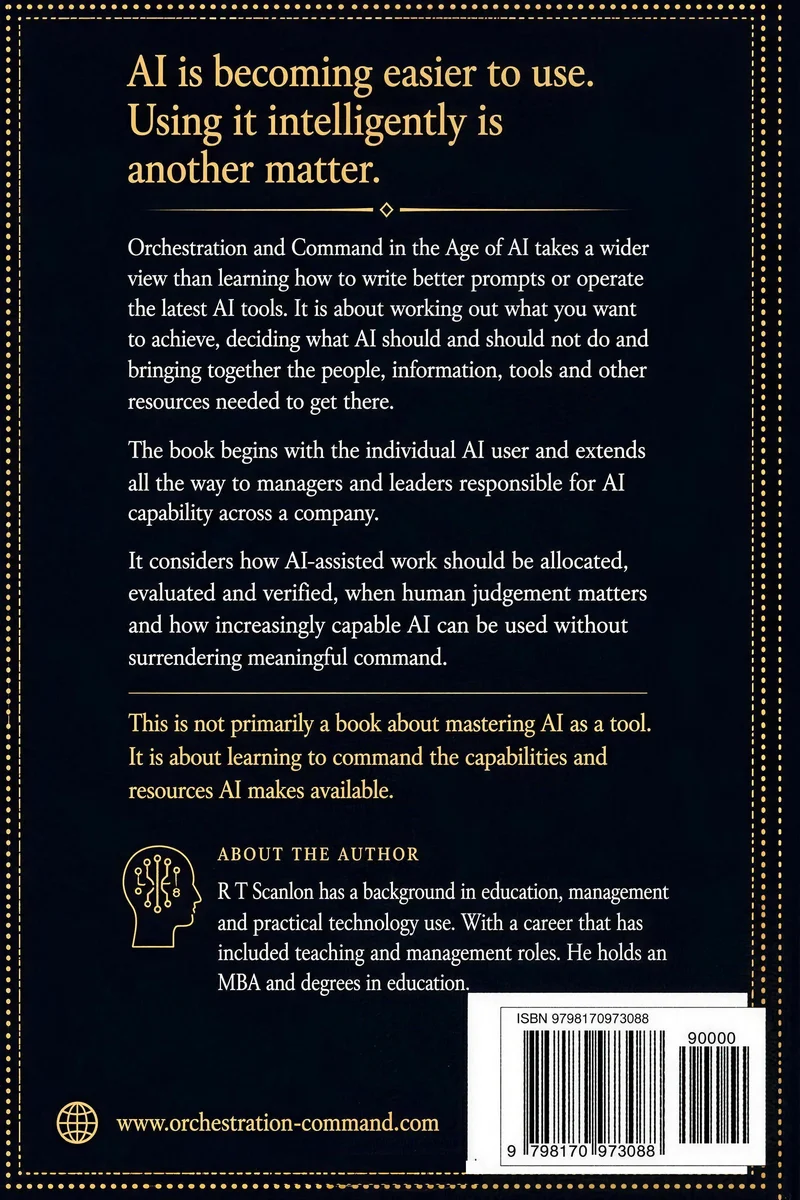
This book takes a wider view than prompt-writing or the latest tools. It starts with what you want to achieve. It helps you decide what AI should and should not do, and how to bring together the people, information, tools and other resources you need to get there.

AI Answer Done Sources 1 2 Confidence Very high Use this answer Copy Ask a follow-up Is this whatwe needed? Where is thisfrom? Too sureof itself Can I explainthis decision? Are you sure?

AI is becoming easier to use. Using it intelligently is another matter.

AI provides capability, but capability is not command.

The central proposition of the book

Orchestration and command

The book's title names two jobs. Switch between them, then point at any part of the diagram to see its role.

Judgement Boundaries Evaluation Oversight Responsibility

Orchestration

Bringing together AI, people, information, tools and other resources, and directing them towards a purpose. Orchestration is the coordinating work that turns capable technology into useful outcomes.

AI is one resource among many.

Command

Retaining judgement, setting boundaries, evaluating what comes back, keeping oversight and holding responsibility. Command is what stops delegation to AI becoming abdication.

AI Commander is a role, not a level of technical AI expertise.

Using AI well, step by step

The book's practical model takes you from purpose to a responsible outcome in ten steps. Each step comes with a question you should be able to answer.

  1. 1 Establish or discover the purpose

    What are we actually trying to achieve? Is that purpose legitimate and acceptable?

  2. 2 Understand the problem

    What do we know, what do we not know and does exploration need to precede definition?

  3. 3 Identify the capabilities required

    What must be done well for the purpose to be achieved?

  4. 4 Choose the resources

    Which combination of AI, people, specialists, software, evidence or direct observation is appropriate?

  5. 5 Allocate the work

    What should AI do, what should people do and what authority should be delegated?

  6. 6 Provide context and interact

    Give the system what it needs to work well, then iterate as understanding develops.

  7. 7 Evaluate

    Is the output or outcome good enough for its purpose?

  8. 8 Verify

    What grounds do we have for believing the important claims or behaviour? How much checking is justified?

  9. 9 Exercise judgement

    What should be accepted, rejected, changed, escalated or acted upon?

  10. 10 Review and learn

    What did the work reveal about the problem, the system and the capabilities that still need to be developed or retained?

Go back a stage when the evidence says so

“It should not be read as a rigid sequence: evaluation, verification or new evidence may require a return to an earlier stage.”

Five principles sit under every step:

  • Human purpose
  • Critical thinking
  • Transparency
  • Privacy and security
  • Fairness

Command wisely. Verify rigorously. Keep learning. Own the outcome.

How much checking does this piece of work need?

Oversight should be proportionate. Low-consequence work you can reverse can stay light. As the stakes, the uncertainty, the authority you hand to AI and the difficulty of putting it right go up, so does the case for stronger checks. Set the sliders for a job you have in mind.

Some
Fairly sure
It drafts, you decide
Fairly easy
Try an example:

“The aim is calibrated reliance: relying on AI neither too much nor too little for the circumstances.”

  1. Light check
  2. Evaluate and verify
  3. Independent check
  4. Specialists and escalation

Evaluate it, then verify what matters

Judge whether the output is good enough for its purpose, then verify the important claims. What grounds do you have for believing them?

Seven mistakes people make when using AI

Chapter 1 names them. Six are in the free sample. The seventh stays sealed until you open the book.

1 of 7

  1. Mistake 1: Thinking intelligent AI use is mainly about good prompts

    “Prompting matters.” … “This is why prompting, despite its importance, is only the beginning.”

    From Chapter 1
  2. Mistake 2: Treating AI as responsible for the outcome

    “Delegating an action does not automatically delegate responsibility for deciding that the action should have been delegated.”

    From Chapter 1
  3. Mistake 3: Seeing AI mainly as a way of getting tasks done

    “Sometimes the user does not yet know exactly what should be done.”

    From Chapter 1
  4. Mistake 4: Accepting a convincing output without judging it

    “A polished output looks finished.” … “The answer may be accurate, sophisticated and useless.”

    From Chapter 1
  5. Mistake 5: Allowing AI to do the thinking the human still needs to do

    “… what capability does the human still need in the new system?”

    From Chapter 1
  6. Mistake 6: Asking AI to solve the first version of the problem

    “There is familiar advice about AI: Define the problem before you start. It is good advice, sometimes.”

    From Chapter 1

Contents

Every chapter, with the page it starts on. Pick one to see where it sits in the book and how many pages it takes.

Read a free sample (opens in a new tab)

The whole book

312 pages

16 chapters, 2 appendices6 figures and 57 tables

  1. The Book in Brief , page 8
  2. Introduction , page 17
  3. Chapter 1 Seven Mistakes People Make When Using AI , page 19
  4. Chapter 2 Define the Problem Before Prompting , page 30
  5. Chapter 3 Orchestration and Command , page 46
  6. Chapter 4 AI Is One Resource Among Many , page 52
  7. Chapter 5 Decide What AI Should Do , page 75
  8. Chapter 6 Direct AI Through Interaction and Iteration , page 88
  9. Chapter 7 Delegating to Agents Without Surrendering Command , page 108
  10. Chapter 8 Commanding AI as an Investigator , page 125
  11. Chapter 9 Evaluate Before Accepting , page 137
  12. Chapter 10 Verification, Triangulation and Attempted Refutation , page 157
  1. Chapter 11 Judgement, Decisions and Responsibility , page 170
  2. Chapter 12 Assisted Performance Is Not Possessed Capability , page 182
  3. Chapter 13 When the Tool Changes, What Should the Human Retain? , page 197
  4. Chapter 14 Learning and Developing Capability with AI , page 224
  5. Chapter 15 Teams, Managers and Companies , page 240
  6. Chapter 16 A Practical Discipline for Retaining Command , page 272
  7. Appendix A , page 292
  8. Appendix B , page 300
  9. Glossary , page 305
  10. Terms and Distinctions Specifically Developed in This Book , page 309
  11. Evidence and Sources , page 311
  12. Book website and supporting resources , page 312

Who the book is for

“You do not need to be a senior manager to exercise command and a senior manager does not need to be the company’s best AI operator.”
From Orchestration and Command in the Age of AI
  1. One person, one task An individual user commanding one AI-assisted task.
  2. Several systems at once An experienced operator combining several AI systems, tools and sources.
  3. A team of people A manager or team leader allocating AI-assisted work among people and deciding how it should be checked.
  4. The whole organisation An organisational leader deciding where AI belongs, what authority it should have, what capability the company needs and how responsibility should be governed.
  • Individual AI users who want to work more intelligently
  • Professionals who must evaluate or remain responsible for AI-assisted work
  • Educators considering learning, assessment and assisted performance
  • Managers and leaders introducing AI into organisations
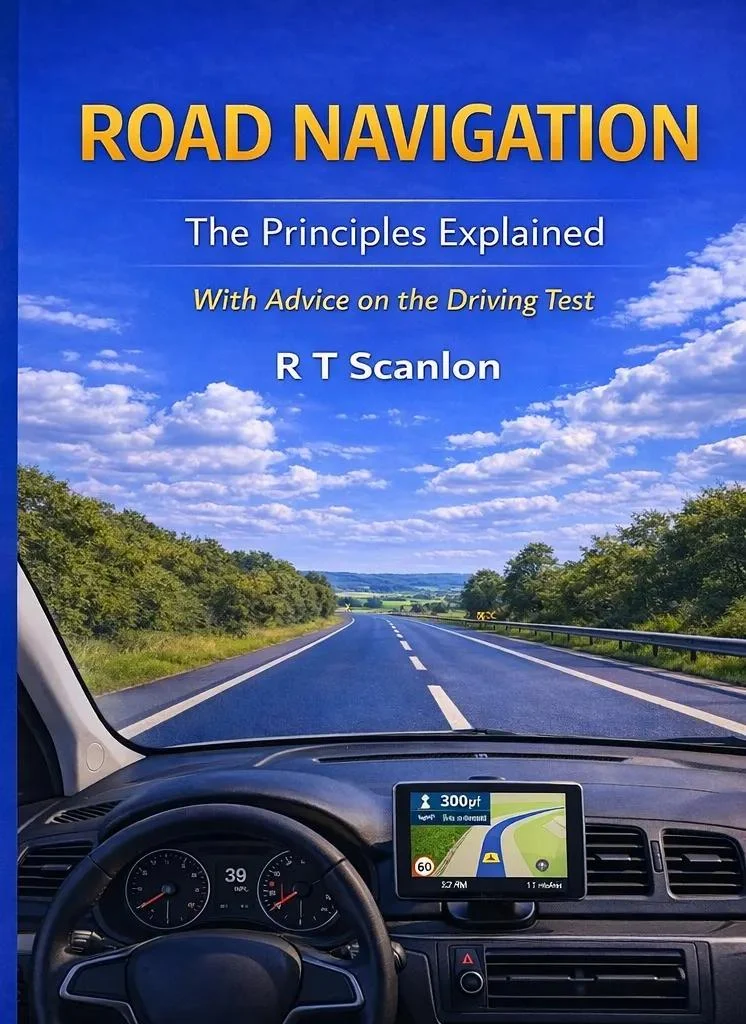
Cover of Road Navigation: The Principles Explained by R T Scanlon, a road seen through a car windscreen with a satnav on the dashboard
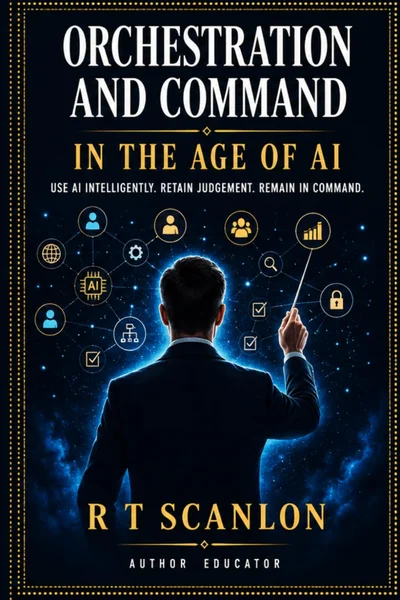
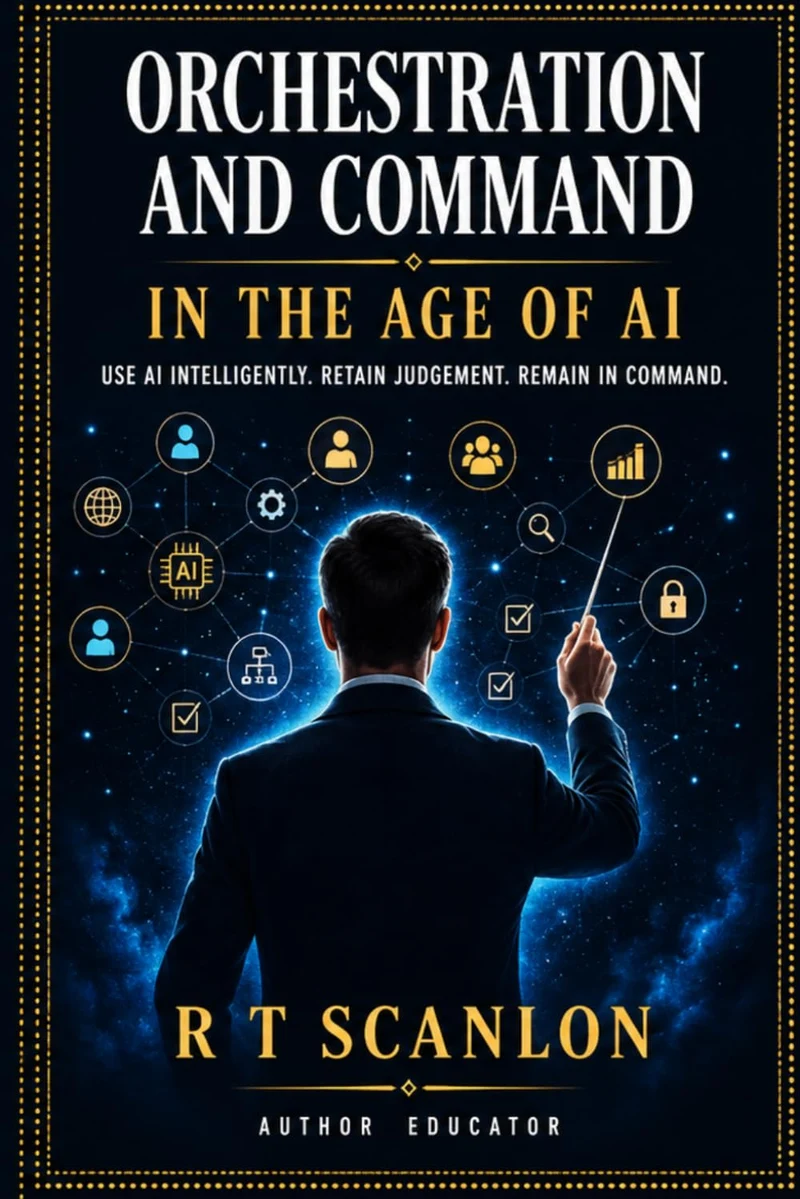
Cover of Orchestration and Command in the Age of AI by R T Scanlon, a conductor raising a baton towards a network of glowing points
2012 How to Get More from Your Satnav
From How to Get More from Your Satnav in 2012, to Road Navigation: The Principles Explained, to Orchestration and Command in the Age of AI in 2026.

R T Scanlon has been writing about using technology intelligently since 2012

His 2012 book, How to Get More from Your Satnav, looked at how drivers can use navigation technology intelligently instead of simply following its instructions. Road Navigation: The Principles Explained took those ideas further. This book asks the same question of AI.

His background is in education, management and the practical use of technology. His career has included teaching and management roles, and he holds an MBA and degrees in education.

R T Scanlon Author and educator

AI may orchestrate the work. Human beings must retain command.

Make full use of increasingly capable AI and keep the judgement, knowledge and responsibility that must stay with you.

Format
Paperback and Kindle
Length
312 pages
Published
23 September 2026
Publisher
Independently published
ISBN-13
979-8170973088

Write to the author

Have a question about the book, or a thought on using AI in your own work? Write to R T Scanlon with this form.