
This way of practising has transformed my own yoga. Now in my mid-sixties, despite arthritis in my lower back, my movement feels fluid and largely pain-free. I also feel I am still progressing rather than simply trying to maintain what I have. Breath, foundation and slower movement have played an important part, while making my practice far more meditative. Students often tell me they feel amazing after class too, which reinforces my sense that this approach can have a powerful effect on how we feel and move.
Breathing is often treated as something that happens alongside yoga. In my teaching, it helps organise the movement.
I use a simple rhythm: Inhale to organise. Exhale. Lift. Lengthen. Move.
It is not the only way to practise. It is the approach I use to connect breath, foundation and movement.
This is the first of three articles exploring the thinking behind the way I teach at Roots Yoga: breath-led movement, learning through slower practice, and the role of interoception and nervous-system regulation.
Why begin with the exhale?
Think about familiar movements: swinging a golf club, throwing a punch, hitting a tennis shot, pushing something heavy. We often breathe out as we move or apply effort.
Research suggests there is a relationship between breathing phase and voluntary action. In a 2020 Nature Communications study, self-initiated movements occurred more often during expiration.
That does not mean every movement should happen on an exhale. For me, it provides an interesting physiological basis for a practical teaching choice: the exhale becomes the cue to move.
The inhale is where we organise
The inhale has a different job. I use it to organise. It gives us a moment to establish the foundation, sense where we are and prepare for the next movement.
The diaphragm contributes to postural control as well as breathing, so respiration and bodily organisation are not completely separate processes. "Inhale to organise" is my teaching application of that broader relationship.
Before moving, we can ask: Where are my feet? Where is my weight? What is supporting the posture? Am I using more effort than I need? Then we move on the exhale.
The foundation comes first
One of the most important principles in my teaching is: the depth of a posture has to be earned by a solid foundation.
I often see students compromise the foundation in order to reach the final shape. A standing leg bends. The spine rounds. The body moves faster or further than the foundation can support. Once that happens, trying to correct the finished position can be difficult.
That is why I do not typically rely on adjusting someone once they have arrived. I prefer to correct the route into the posture. If alignment is lost, I bring the student back to the foundation and we move again. The finished posture is the result of the movement that created it.
Standing T is a good example
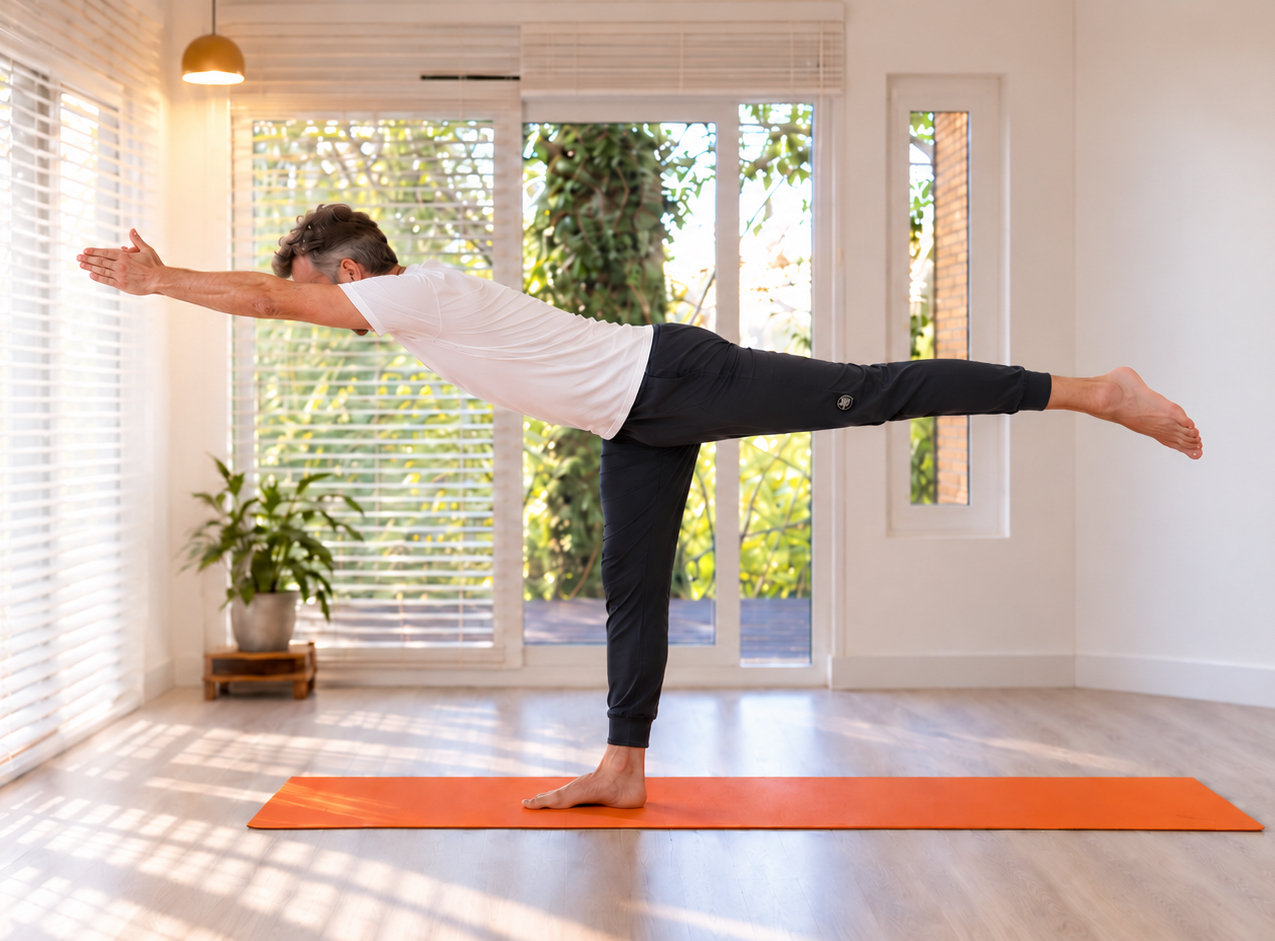
I often see students try to throw themselves straight into the full horizontal posture. As they reach forward, the standing leg bends, the back rounds, and the organised line begins to break down. For me, that is a sign to reduce the range.
Instead of aiming immediately for a full T, on the exhale I might ask the student to move only slightly forward, perhaps to around five past twelve. The standing leg stays straight. The spine stays long. The body moves as one line.
And importantly, that shallower position is not an inferior version of the posture. With the breath it is already the practice of yoga. The transition itself can be a balancing movement requiring strength, control and attention. From there, we can gradually explore more depth while maintaining the foundation.
If the standing leg bends or the back begins to round, I would rather come back up and rebuild than try to correct the posture once it has collapsed. The goal is not simply to get lower. The goal is to move further only while the foundation remains intact.
Exhale. Lift. Lengthen. Move.
Once the foundation is established, the next principle is: create space before you move deeper. On the exhale, I ask whether unnecessary tension can soften. Then we lift, lengthen and move.
I am not claiming that exhaling physically "opens" the spine. The exhale is the cue from which we create length and organise effort. The body still needs muscular support. The aim is to balance effort with ease: enough effort to create stability and movement, enough ease to avoid unnecessary bracing and tension.
The breath helps preserve the posture
The breath gives us a rhythm for moving without losing the foundation. Inhale to organise. Exhale to move. Inhale to re-establish. Exhale to move again.
Rather than rushing towards the final shape, we build the posture progressively. Each inhale gives us another opportunity to organise. Each exhale gives us another opportunity to move while maintaining what we have established.
Using the breath as a monitor
Where it is comfortable, I encourage nasal breathing because the breath gives useful feedback about effort. If the breath becomes strained, that is information: it usually means we have gone further or faster than the foundation can support, and it is time to come back and rebuild.
This is the first of three articles. The next looks at learning through slower practice, and the third at interoception and nervous-system regulation. If you would like to explore this approach in person, book a free 20-minute consultation.