
Book a call

Cathay cadet HR practice: 7 questions free

7 questions60 seconds each7:00 total

Question 1 of 7Paper complete

  1. 1not answered yet
  2. 2not answered yet
  3. 3not answered yet
  4. 4not answered yet
  5. 5not answered yet
  6. 6not answered yet
  7. 7not answered yet

Score 0/7

Paper7:00left

Question1:00left

Clock on standby

Spot the precise best answer

Beat the clock like the ATPL exams. Each question gives you four strong-sounding options and one best answer.

  • 60 sfor each question, on the small dial
  • 7:00for the whole paper, on the big needle
  • A to Dor 1 to 4 picks an answer, Enter checks it
Question 1 opens and the clock starts when you press start.

Read each question, pick your answer, then open the answer to check it.

  1. 1You're asked "Tell me about yourself" in a Cathay cadet interview. What's the best approach?

    1. A concise 1 to 2 minute overview: where you are now, your passion for aviation with examples, and skills and achievements relevant to Cathay.
    2. A 1 to 2 minute professional summary: education, work experience and motivation for aviation, structured around their values.
    3. A detailed 2 to 3 minute story: early influences, all your qualifications, and personal hobbies that link to teamwork.
    4. A brief 1 minute intro: your background, key skills, and enthusiasm for Cathay's Hong Kong hub and cadet programme.
    Show the best answer

    Best answer: A. A is best: lead with where you are now, show your passion for aviation through real examples, and pick out the skills that matter to Cathay. B is over-structured and shows no passion. C is too long and unfocused. D is too brief and generic.

  2. 2When you explain why you want to be a pilot, what should you emphasise?

    1. A lifelong passion, technical aptitude from flight simulators, and dedication to a high-responsibility career in aviation.
    2. Passion for aviation, problem solving under pressure, and fit with the airline's role in connecting the world.
    3. Genuine passion shown through what you have done and experienced, a commitment to safety, and a service mindset towards passengers.
    4. Passion shown through flying hours and hobbies, leadership skills, and long-term progression to command at Cathay.
    Show the best answer

    Best answer: C. C is best: it balances passion with evidence from what you have actually done, safety awareness and a service mindset, which is exactly what Cathay assessors look for. A leans too heavily on simulators. B is vague about service. D jumps to command too early.

  3. 3What are the three key elements of an answer to "Why Cathay Pacific specifically?"

    1. Hong Kong's role as an aviation hub, a modern fleet, and career stability in Cathay's growth plans.
    2. Alignment with their core values (service and safety), a real passion for the Hong Kong and Asia network, and the structured cadet to captain pathway.
    3. A focus on service excellence, global network expansion, and long-term loyalty to one airline.
    4. Company values (safety first), regional leadership, and your personal fit with a multicultural crew.
    Show the best answer

    Best answer: B. B hits the three pillars: values alignment, genuine interest in the region, and a structured career path. A focuses on external factors rather than values. C lacks anything specific to what Cathay offers. D misses the personal connection to Hong Kong and Asia.

  4. 4When you describe a time you faced pressure or a crisis, what's the best technique?

    1. STAR: an overview of the Situation, your Actions under pressure, and the Result with lessons you applied later.
    2. PAR: the Problem you faced, the Actions you took, and the Result achieved, noting the impact on the team.
    3. CAR: the Context or Challenge, the steps of your Action, and the Resolution with a key learning outcome.
    4. STAR: set out the Situation and the Task clearly first, then your own specific Actions, then a Result you can measure.
    Show the best answer

    Best answer: D. D uses full STAR correctly: the Situation and the Task are kept separate, the Actions are your own, and the Result can be measured. A skips the Task. B and C use non-standard frameworks that miss the Task element assessors expect.

  5. 5In an answer about a difficult team situation or conflict, the interviewer wants to see that you:

    1. Analysed the team dynamics, proposed a solution, and showed accountability for your own role.
    2. Found the root cause, started a collaborative resolution, and reflected on your own and the team's growth.
    3. Recognised the conflict early, communicated openly, and reached a positive outcome through compromise.
    4. Stepped in decisively, facilitated a team discussion, and put measures in place so it would not happen again.
    Show the best answer

    Best answer: B. B shows the complete cycle: diagnosis (the root cause), action (a collaborative resolution) and reflection (growth). A focuses on your own accountability without team collaboration. C settles for compromise rather than resolution. D suggests authority rather than facilitation.

  6. 6When you're asked about your biggest failure or mistake, you should focus on:

    1. What went wrong, the changes you made, and evidence that you performed better afterwards.
    2. The details of the mistake, the accountability you accepted, and how you grew professionally from it.
    3. Honest context, the specific actions you took after the failure, and the measurable improvements you have made since.
    4. The circumstances of the failure, the corrective steps you took straight away, and the key lessons that shape your decisions.
    Show the best answer

    Best answer: C. C is strongest: honest context shows vulnerability, specific actions after the failure show ownership, and measurable improvements prove real change. A is close but lacks the honesty and accountability. B is too abstract. D focuses on lessons without proof.

  7. 7For a "quick decision under pressure" question, which structure works best?

    1. STAR: a snapshot of the Situation, the Task made clear, the Action taken, and the Result with reflection.
    2. PARA: the Pressure or Problem, your Assessment, your Response or Action, and the Aftermath or Outcome.
    3. SARA: the Situation, your Analysis, your Response, and the Achievement or Learning.
    4. CARL: the Context, the Action you chose, the Result you delivered, and the Lesson for future situations.
    Show the best answer

    Best answer: D. D is best. CARL (Context, Action, Result, Lesson) is built for quick decision questions: it puts the context first, shows a decisive action, delivers a result and draws out a lesson for next time. STAR works but is slower to set up. PARA and SARA are non-standard frameworks.

How the free paper works

Seven questions from the Cathay cadet HR interview, set like an ATPL exam: four options, one best answer, and a clock that keeps running.

  • 60 s · 7:00

    Timed like the ATPL exams

    Sixty seconds for each question and seven minutes for the paper. The paper clock keeps running while you read each explanation, so keep moving.

  • 7 of 7 explained

    An explanation for every answer

    After each answer you see the best option and why the other three fall short, so you learn what HR is listening for.

  • Confidence

    A Confidence Score at the end

    Your score as a percentage, how many you got right and your time, with a clear next step to close the gaps.
What the seven questions cover

  1. Question 1 Tell me about yourself Your opening answer
  2. Question 2 Why pilot Your motivation
  3. Question 3 Why Cathay The airline itself
  4. Question 4 Pressure A crisis, told well
  5. Question 5 Conflict A difficult team
  6. Question 6 Failure Your biggest mistake
  7. Question 7 Quick decisions A call under pressure
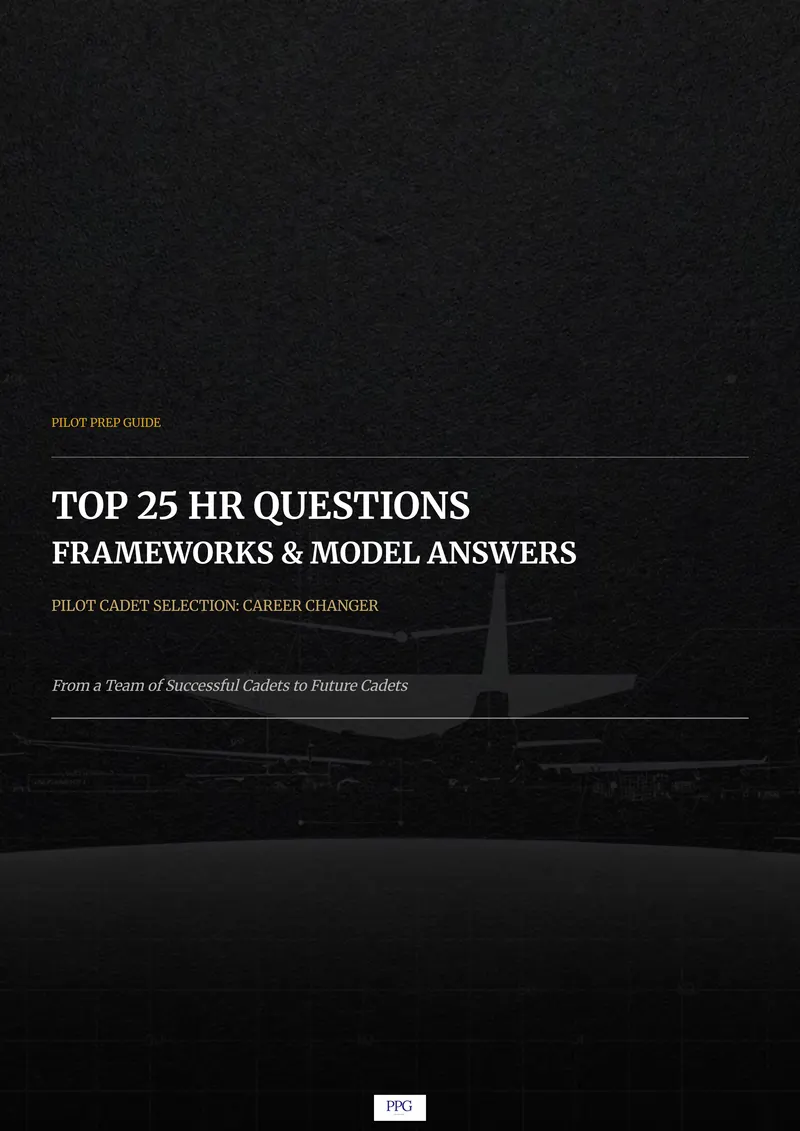
Cover of the Top 25 HR Questions guide, career changer edition
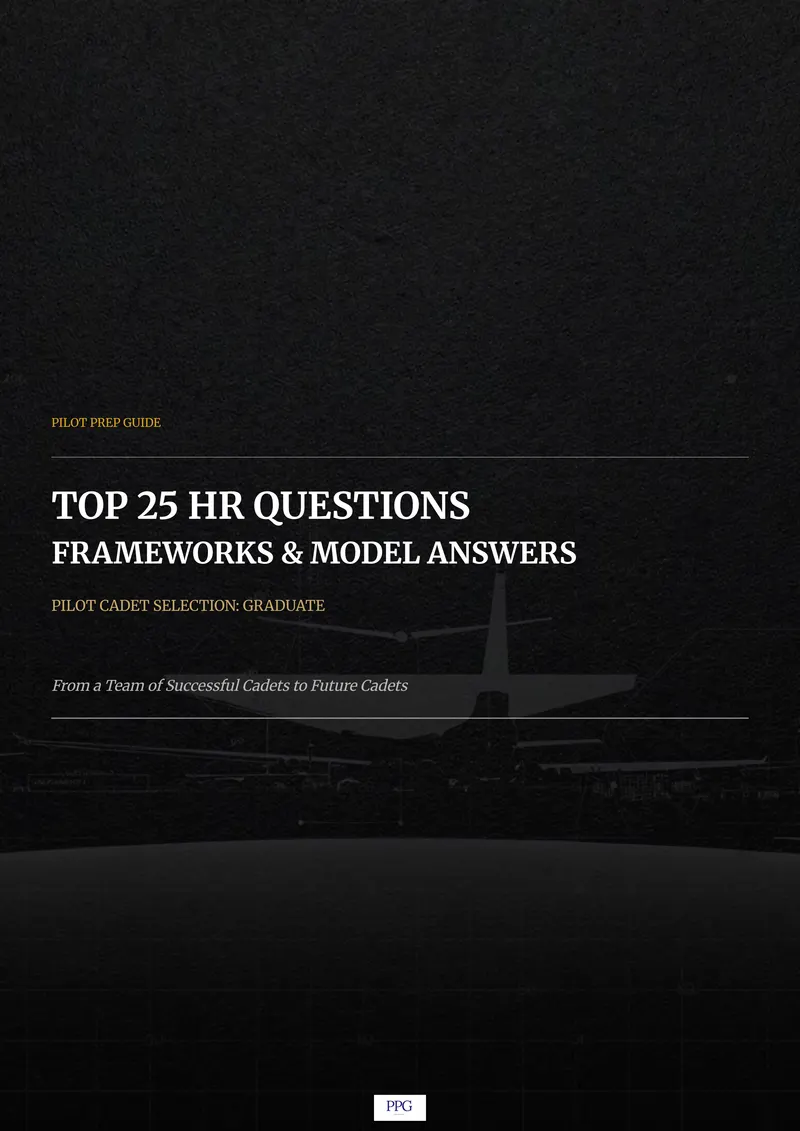
Cover of the Top 25 HR Questions guide, graduate edition
HKD 588

Want all 25?

This paper gives you seven questions. The Top 25 HR Questions guide gives you the twenty-five questions cadet applicants are asked most often, with a model answer for each and the reasons HR asks them.

  • The Top 25The HR questions cadet applicants are asked most often.
  • Proven frameworksSTAR, CARL and Reality/Responsibility, so every answer stays short and clear.
  • Model answersWorked examples that turn your past experience into a strength.
  • Inside the roomWhy HR asks each question, and how to pitch your answer.

Ready to say your answers out loud?

In the paper you pick the best answer. In the interview you have to say it yourself, to a stranger, with the clock running.

30 minutes · HKD 589

Try the HR diagnostic call

A mock interview with immediate feedback, your HR Report Card and a plan for your next steps.

Book a diagnostic call

Launching soon · early access

Join the Self Prep System waitlist

CV templates, aptitude practice, the HR Interview Guide and community events in one place. Join now and we'll send you our HR frameworks and answer structures free.

Reserve your waitlist spot