

Original articles & blog content. Written, illustrated and published, on auto-pilot.
We learn your business, write articles in your voice with their own custom images, and publish them to your WordPress site every week. We set everything up and run it for you, so your blog stays active and Google keeps noticing without you writing a word. Choose how many articles you want each week and leave the rest to us.
Choose how many articles you want
Slide to the number of articles a week, see your price, and order. We study your site, plan the topics your customers search for, then write and publish every article for you.
That is 9 articles a month, about £5.00 each.
Each month your first 10 articles are £5.00 each, the next 10 are £4.25, and so on, so every extra article costs less.
Secure checkout by Stripe
Totally hands free, from setup to publishing
Choose your articles, send us your WordPress login, and we look after everything from there.
What you do
- 1 Choose your articles Pick how many you want each week and see the price as you slide.
- 2 Order securely Pay through Stripe. It is billed monthly, with VAT included.
- 3 Send us your login We email you a link to a short, secure form for your website address and WordPress login.
What we do, every week

Study your business
We read your website and look at the competitors already ranking for what you sell.

Plan your topics
We find the questions your customers type into Google and plan articles that answer them.

Write every article
Original articles in your voice, with proper headings and the search basics done for you.

Make every image
Each article gets its own hero image, in a style we choose to suit your brand.

Publish to your site
Articles go live on your WordPress site on the schedule we agree with you.

Keep it topped up
We keep about two weeks of articles scheduled ahead, so your blog stays active.
6 Reasons You Need Fresh Content, Now More Than Ever!
Google has changed. AI search has changed everything else. A dead blog doesn't just stagnate any more, it actively costs you visibility. Here's why posting regularly on your website is no longer optional!
Google rewards sites that publish
Search engines have always favoured sites that show signs of life. Sites publishing original content monthly consistently out-rank otherwise-identical sites that don't. Stop publishing and you slide down the rankings, even if your old posts were great.
AI search can't quote a blank page
ChatGPT, Perplexity, Google's AI Overviews, all of them cite recent, well-structured articles. Every week without new content is another week you're invisible to the fastest-growing slice of search traffic.
Topical authority compounds
Google trusts sites that consistently cover a niche. Ten posts on related topics over six months outperform ten posts dumped on one Tuesday. Steady, themed publishing is how you build real authority.
Long-tail traffic adds up fast
Every article ranks for keywords you'd never think to target, the specific questions your customers type into Google. One post can pull in dozens of search terms over time, completely free.
A dead blog kills trust instantly
Visitors see "last post: 2022" and assume you're out of business. Up-to-date content signals an active, growing operation. It's a five-second trust check before they even read what you wrote.
Posts are assets, not expenses
Ads stop the second you stop paying. Articles keep earning traffic for years. A consistent weekly rhythm builds a compounding library that pays you back long after the post was published.
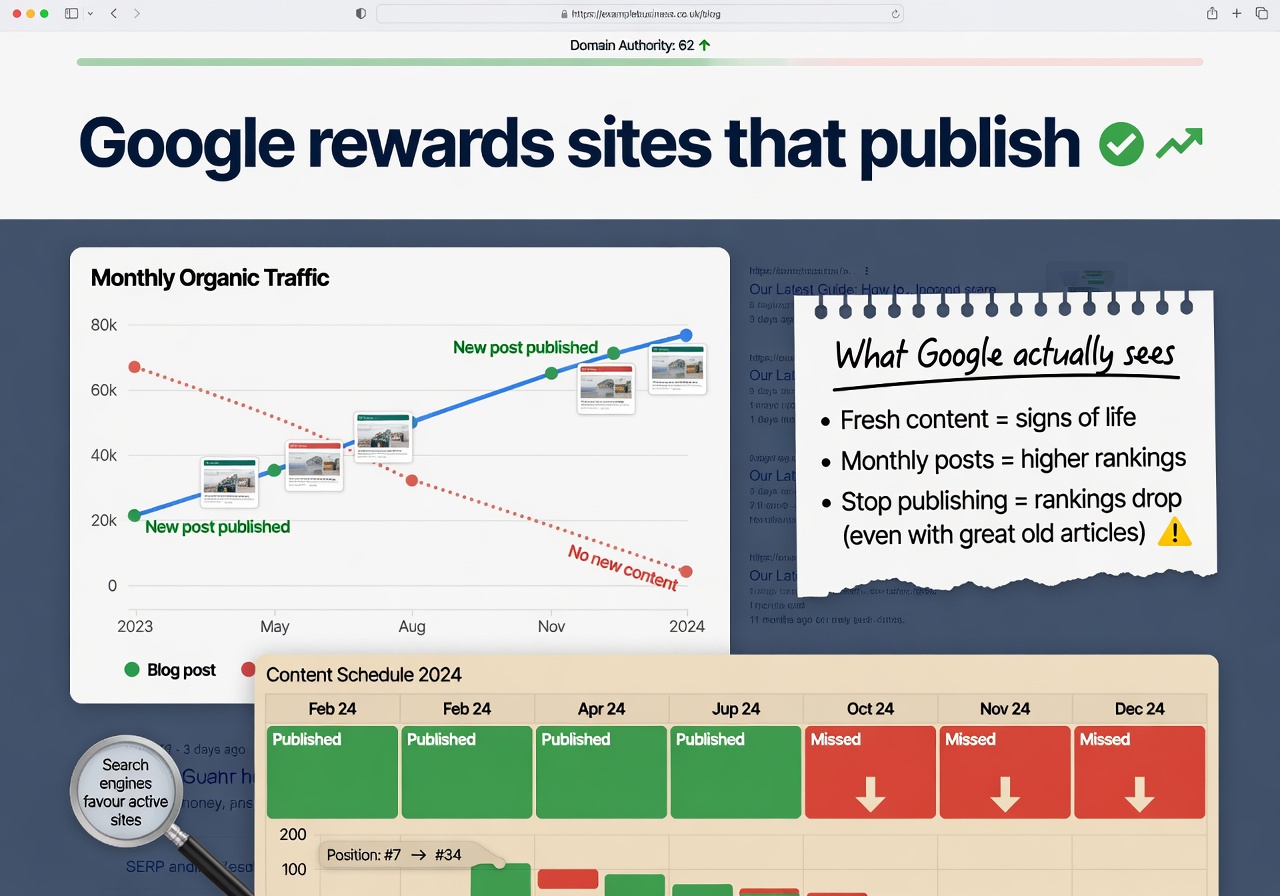
Search engines have always favoured sites that show signs of life. Sites publishing original content monthly consistently out-rank otherwise-identical sites that don't. Stop publishing and you slide down the rankings, even if your old posts were great.

ChatGPT, Perplexity, Google's AI Overviews, all of them cite recent, well-structured articles. Every week without new content is another week you're invisible to the fastest-growing slice of search traffic.
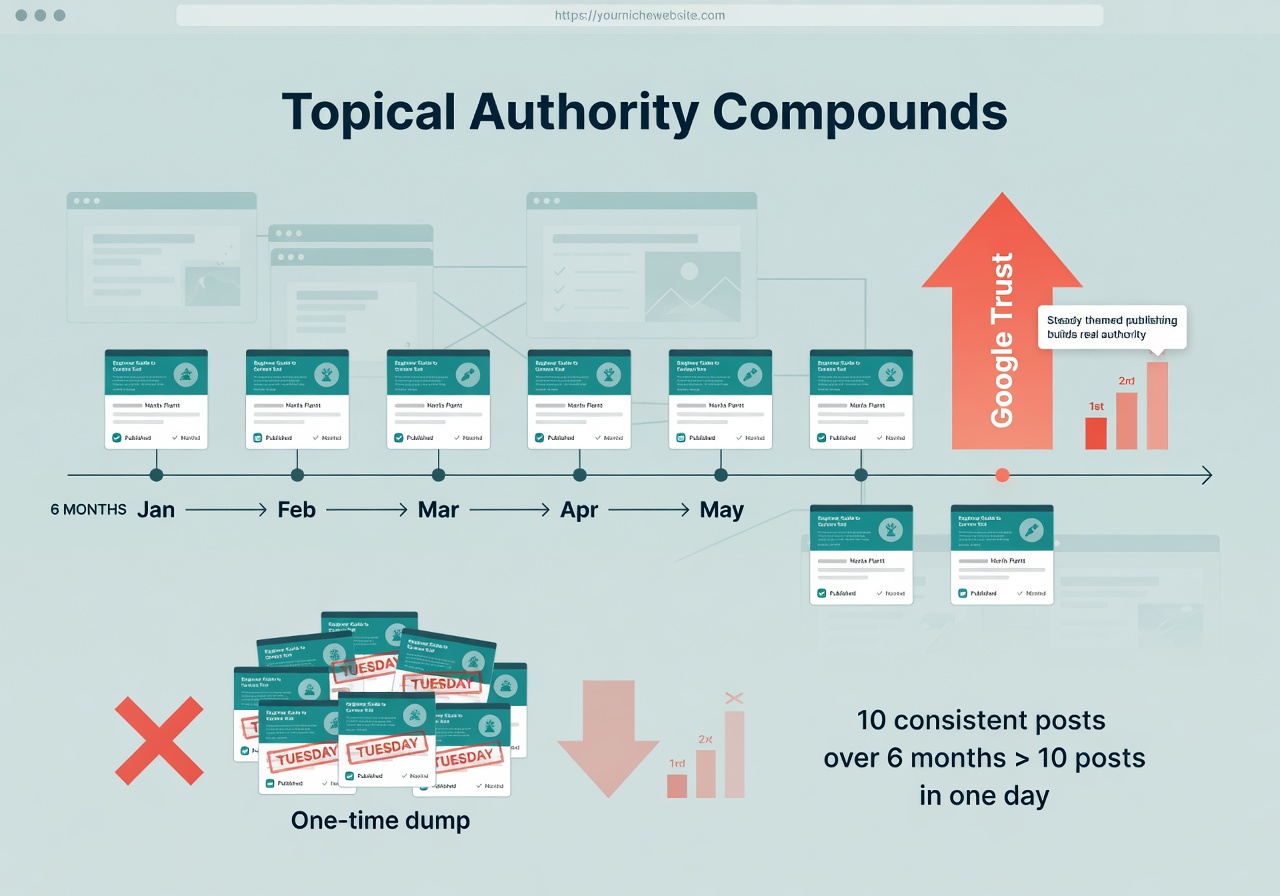
Google trusts sites that consistently cover a niche. Ten posts on related topics over six months outperform ten posts dumped on one Tuesday. Steady, themed publishing is how you build real authority.
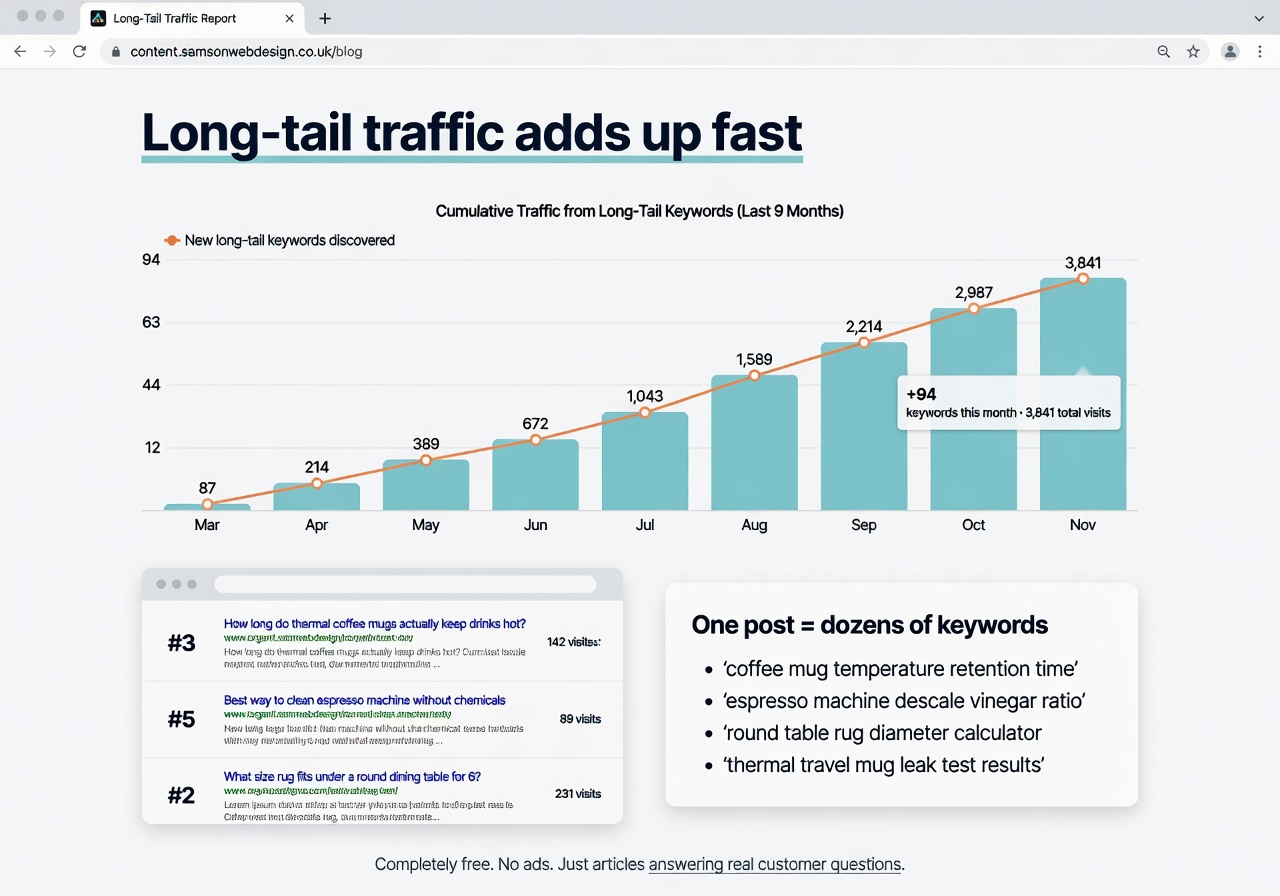
Every article ranks for keywords you'd never think to target, the specific questions your customers type into Google. One post can pull in dozens of search terms over time, completely free.

Visitors see "last post: 2022" and assume you're out of business. Up-to-date content signals an active, growing operation. It's a five-second trust check before they even read what you wrote.

Ads stop the second you stop paying. Articles keep earning traffic for years. A consistent weekly rhythm builds a compounding library that pays you back long after the post was published.
Keep your blog alive without writing a word
Pick how many articles a week you want. We write, illustrate and publish every one, from £25 a month.
Real articles we have written and published
A live sample of articles the Content Engine has written for customer sites. Open any of them and judge the quality for yourself before you order.
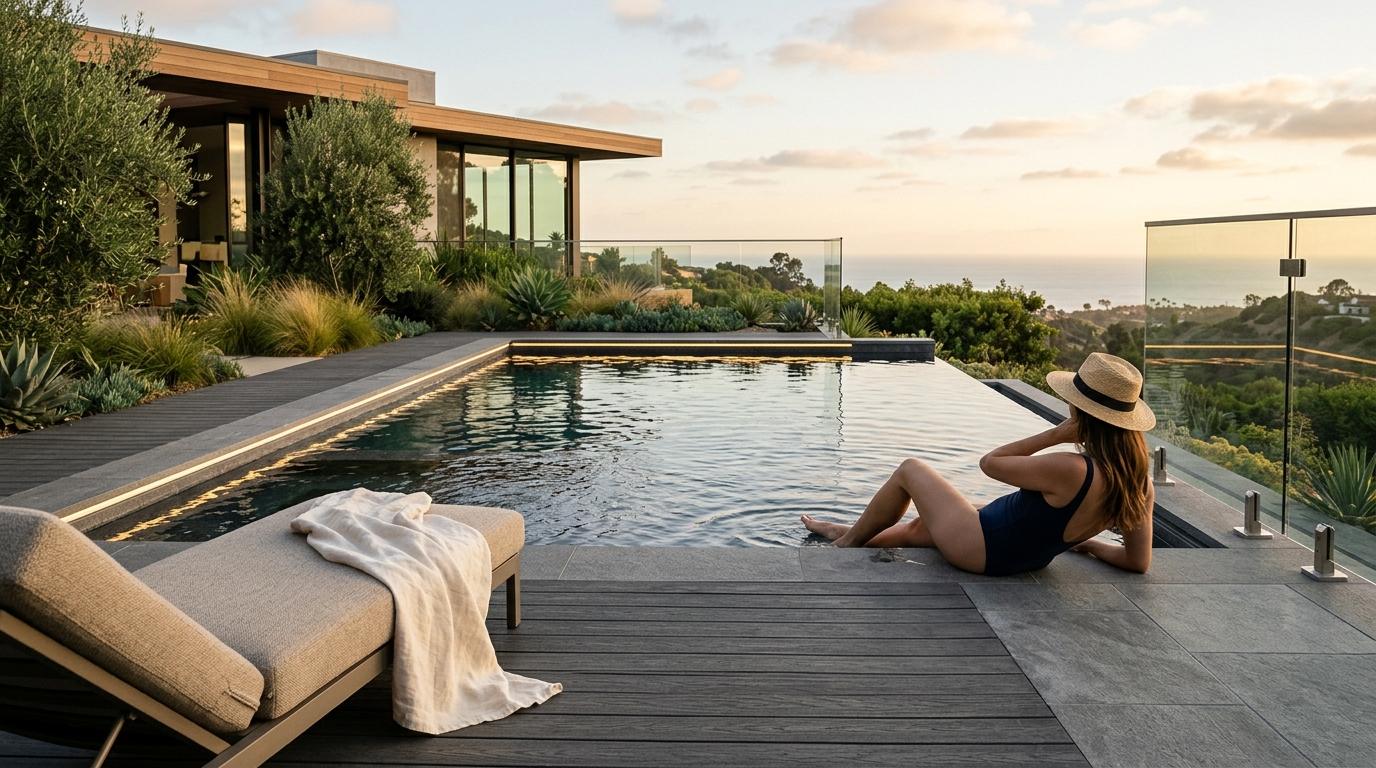
What's Trending in Composite Pool Design: 2025 and Beyond
The conversation around swimming pool ownership has changed significantly over the last few years. Buyers are no longer simply asking for a rectangular hole in the garden filled with water. They are arriving at the design stage with clear ideas about aesthetics, technology, and sustainability, and they expect the finished result to reflect all three. If you are planning a new pool or upgrading an existing one, here is where premium composite design is heading.
Architectural Shapes Are Taking Over
The freeform pool had its moment, and now the pendulum has swung firmly toward clean geometry. Straight edges, sharp corners, and precise rectangular or L-shaped layouts are the shapes homeowners are consistently asking for right now. These designs photograph beautifully, integrate naturally with contemporary landscaping, and give outdoor spaces a coherent, intentional feel rather than something that looks dropped into the garden by accident.
For composite pools specifically, this plays to one of the material's genuine strengths. Unlike concrete, which requires extensive on-site forming and finishing to achieve truly crisp lines, a high-quality composite shell is manufactured to precise tolerances and arrives ready to install. The result is a consistently sharp aesthetic without the post-construction variables that can soften a concrete pool's geometry over time.
Interior Colours and Finishes Are Getting Bolder
White and pale blue interiors still sell, but there is a growing appetite for something more considered. Deep charcoal and graphite interiors create that mirror-like reflection effect that looks exceptional on a bright day. Soft grey tones sit well against natural stone copings and timber decking. Some homeowners are even choosing contrasting tile borders or feature walls to add visual depth to an otherwise minimal shell.
The composite manufacturing process supports this well. Manufacturers like Leisure Pools offer a range of interior finishes built directly into the shell material, which means the colour is structural rather than painted on. That matters for longevity, particularly in the UK climate where freeze-thaw cycles can be harder on applied surface coatings than most people expect.
Smart Technology Is Now a Standard Expectation
Automation has moved from a premium add-on to a near-universal expectation among buyers investing seriously in a pool. Homeowners want to control water temperature, lighting, filtration schedules, and covers from a phone. The ability to warm the pool before you get home, or check the chemical balance remotely, is not a gimmick. It is a genuine quality-of-life improvement that also helps protect a significant financial investment.
The current generation of pool control systems, from brands like Hayward and Pentair, can integrate with home automation platforms and provide real-time alerts if something goes wrong. For UK homeowners who may only use their pool intensively for five or six months a year, being able to manage the off-season maintenance remotely is particularly valuable.
Energy Efficiency Is Driving Equipment Choices
Running costs matter more than they used to, and the rise in UK energy prices over recent years has made buyers much more attentive to efficiency ratings. Variable-speed pumps are now the obvious choice over single-speed models, offering energy savings of up to 80 percent in typical use. Heat pump technology has also improved considerably, with modern units achieving COPs (coefficients of performance) well above 5, meaning they generate more than five units of heat for every unit of electricity consumed.
Paired with a quality pool cover, a well-specified heat pump can extend the usable season in the UK well into autumn without punishing running costs. For homeowners investing in a composite pool with a longer design life, specifying efficient equipment from the outset is the sensible approach. The payback period on a variable-speed pump versus a standard pump is typically under two years.
Built-In Features That Expand How You Use the Pool
A pool that serves one purpose is increasingly hard to justify at the premium end of the market. Buyers want features that make the space work harder across different moods and seasons. Some of the features coming up most frequently in design conversations right now include:
- Tanning ledges (also called baja shelves or sun shelves), which sit just below the waterline and allow lounging in shallow water without getting fully submerged
- Integrated spa bays or hydrotherapy zones, either within the main shell or as an adjacent attached spa
- In-floor cleaning systems that remove the visual clutter of traditional surface skimmers
- LED lighting rigs with colour-changing capability, which transform the pool into a focal point after dark
- Swim jets and resistance systems for fitness-focused use in smaller pools
Composite shells lend themselves well to many of these features because the design can be engineered at the manufacturing stage rather than retrofitted on-site. A tanning ledge, for example, is a structural element of the shell rather than something added afterwards.
Sustainability Is Becoming a Design Criterion
Eco-conscious choices are increasingly part of the brief for premium pool buyers. This shows up in equipment selection, as discussed above, but also in material choices for surrounding areas, water management systems, and even the choice of pool shell itself. Composite construction is inherently lower-impact than concrete over its lifetime. There is no need for acid washing, resurfacing every decade, or the significant water loss associated with replastering. A quality composite shell with a lifetime structural warranty simply does not require the ongoing resource expenditure that concrete pools do.
Saltwater chlorination continues to grow in popularity as a gentler, lower-chemical alternative to traditional dosing. Robotic cleaners with energy-efficient motors reduce the load on circulation pumps. And rainwater harvesting systems are beginning to appear in more ambitious garden designs, though these remain a niche choice for now.
What This Means for Your Pool Project
The consistent thread across all of these trends is intentionality. Homeowners are putting more thought into pool ownership than previous generations did, and they are asking better questions before they commit. They want a pool that fits the architecture of the house, works within a realistic running cost, and delivers a genuine return in daily use rather than sitting underused for eight months of the year.
Composite pools are well positioned to meet this moment. The combination of design precision, material durability, lower long-term maintenance, and compatibility with modern equipment makes them the logical choice for a UK homeowner thinking seriously about where their money goes. If you are starting that conversation, the design decisions you make now will shape how much value you get from the investment for the next thirty years.
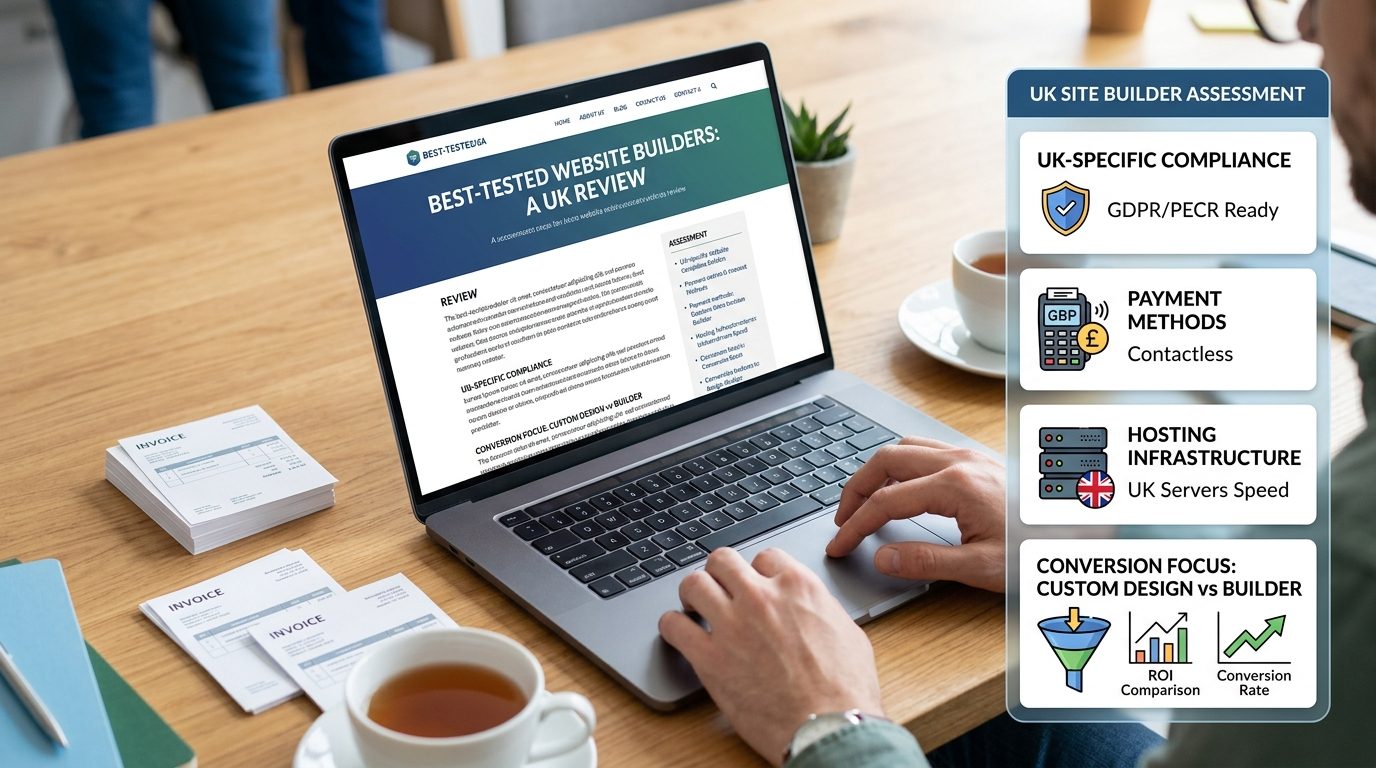
Tested Website Builders for Small UK Businesses: Our Honest Assessment
Every week, someone asks us whether they should just build their own website on Wix or Squarespace instead of commissioning a professional design. It is a fair question. These platforms have come a long way, and for some businesses they genuinely do the job. But "some businesses" is doing a lot of work in that sentence, and the devil is very much in the detail.
Here is our honest, no-fluff breakdown of the main builders available to UK small businesses right now, what they are good at, where they fall short, and how they stack up against a properly built custom site.
Wix: The All-Rounder Most People Start With
Wix is the obvious starting point for most small business owners. The drag-and-drop editor is genuinely easy to use, there are hundreds of templates, and the pricing starts from around £9 a month for a basic plan. For a local trades business, a freelancer, or a startup that needs a credible online presence quickly, Wix can absolutely work.
On the UK-specific side, Wix supports PayPal and Stripe out of the box, which covers most payment needs. It hosts on servers with European data centres, which helps with GDPR compliance, though you will still need to configure cookie consent and privacy policies yourself. The built-in SEO tools are decent for beginners, but they have limits once you start chasing competitive local search terms.
The main frustration we see with Wix sites is that they can become difficult to customise once a business grows. The editor gives the impression of flexibility, but you are always working within its constraints. Switching templates later is also more painful than it sounds.
Shopify: Strong for E-Commerce, Weaker for Everything Else
If you are selling physical products online, Shopify is hard to argue against. It handles inventory, shipping integrations, and checkout flows better than any other builder at this price point. It supports UK payment methods including Stripe, PayPal, and Klarna, and it meets PCI DSS compliance requirements for card processing without you needing to think about it.
Shopify's hosting infrastructure is robust and fast, which matters for conversion rates. Studies consistently show that a one-second delay in page load time reduces conversions, and Shopify's CDN handles that well globally, including for UK visitors.
Where Shopify struggles is outside pure e-commerce. If you want a content-heavy site, a services business, or anything beyond a shop, the experience feels shoehorned. The blog functionality is limited, and the template ecosystem, while large, skews heavily toward retail aesthetics. Transaction fees also apply on most plans unless you use Shopify Payments, which catches some business owners off guard.
Squarespace: Good-Looking but Conversion-Light
Squarespace consistently produces the best-looking sites of any builder. If your business lives or dies on visual presentation, such as photography, interiors, fashion, or creative services, Squarespace templates are genuinely impressive.
The trade-off is that Squarespace prioritises aesthetics over conversion optimisation. You have less control over page structure, calls to action, and the finer points of user journey than you would with a custom build. For businesses where generating enquiries or leads is the primary goal, this matters more than it might seem.
UK payment support is solid, with Stripe and PayPal covered, and GDPR cookie controls are available. Pricing runs from around £11 a month, stepping up quickly once you add e-commerce features.
Webflow: Powerful, But Not for the Faint-Hearted
Webflow occupies an interesting middle ground. It gives you far more design and structural control than Wix or Squarespace, and the output can be genuinely impressive in terms of performance and flexibility. It is the builder we would point a technically confident business owner toward if they wanted to self-manage something more sophisticated.
That said, Webflow has a steep learning curve. It is built around web design concepts like box models and interactions that most non-designers find confusing. If you need to make quick changes under pressure, Webflow can become a liability rather than an asset. The pricing also climbs quickly for e-commerce functionality.
What the Builders All Have in Common
Whatever platform you choose, there are limitations that apply across the board:
- You are renting space on someone else's infrastructure, not owning it. If the platform changes its pricing, terms, or features, your site is affected.
- Template designs are shared across thousands of businesses. Standing out takes extra effort.
- SEO performance tends to plateau. These platforms generate code that works, but rarely as cleanly or efficiently as a properly coded custom site.
- Conversion rate optimisation is limited. You cannot always place elements where you want them, test layouts freely, or integrate with every third-party tool.
When a Custom Website Makes More Sense
For a business that is just getting started and needs a basic presence, a website builder is a perfectly reasonable way to get online affordably. We would never pretend otherwise.
But there are clear situations where a custom-built site pays for itself:
- Your business model depends on enquiries or leads rather than passive browsing.
- You operate in a competitive local market where ranking on Google for the right terms is critical.
- You need integrations with booking systems, CRMs, or industry-specific tools.
- Your brand needs to convey quality, trust, or expertise at first glance.
- You have outgrown a builder and are fighting its constraints every time you try to grow.
A well-built custom site typically outperforms a builder template on conversion rate because it is designed around how your specific customers think and what makes them act. That is not a vague claim. It comes from designing sites with clear calls to action, fast load times, and user journeys built around actual business goals rather than generic template layouts.
Our Honest Take
Wix is the best all-round builder for most UK small businesses starting out. Shopify wins on e-commerce. Squarespace is the right pick if visual presentation is your priority. Webflow suits those who want more control and are prepared to invest time in learning it.
But if your website is a key part of how your business earns money, the question worth asking is not which builder is best. It is whether a builder is the right tool at all. For businesses in competitive markets, that distinction tends to show up pretty quickly in your enquiry rate.
If you are unsure which direction makes sense for your situation, we are always happy to have a straight conversation about it. No pressure, no jargon, just practical advice based on what your business actually needs.
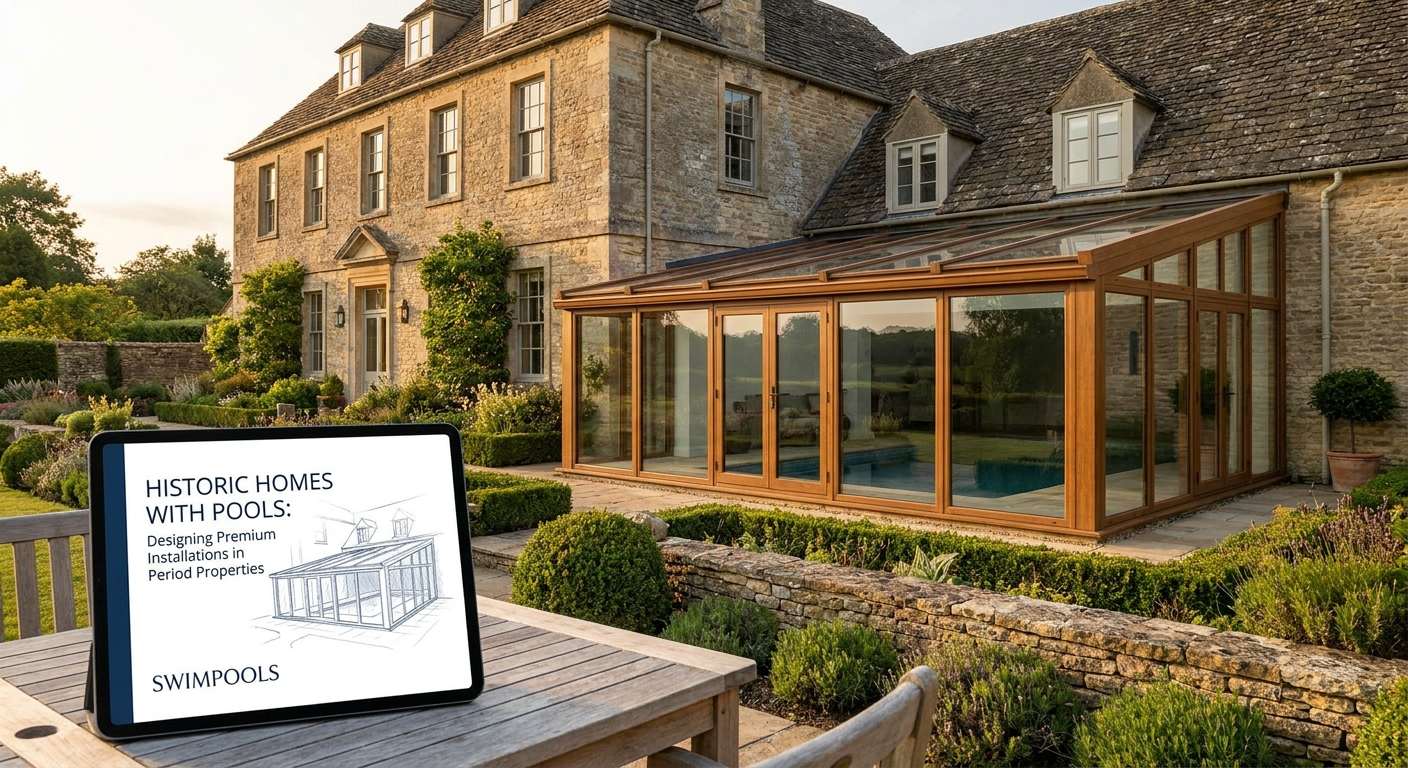
Historic Homes with Pools: Designing Premium Installations in Period Properties
A Grade II listed country house in North Yorkshire recently came to market at £1.5 million, with the pool explicitly listed as a headline feature alongside its Mouseman joinery and original stone detailing. That pairing of heritage craft and modern water leisure is not unusual in premium property circles. What is unusual is getting the pool installed in the first place, because a period property with a pool is genuinely difficult to deliver well, and the number of contractors equipped to do it properly is very small.
The gap between a pool that enhances a listed property and one that damages it permanently is mostly a matter of preparation. Get the planning approach wrong, choose the wrong materials, or position the pool without reading the site properly, and you will spend months undoing the damage with your conservation officer. Get it right, and you have one of the most distinctive and valuable residential assets in the country.
Why Period Properties Are the Most Rewarding Pool Projects
Premium period homes with thoughtfully installed pools command asking prices that reflect the rarity of the combination. Heritage homes at the higher end of the market, where pools feature as genuine design statements rather than afterthoughts, regularly appear with asking prices well above £1.5 million, and agents consistently report that the pool is cited in buyer interest. The pool is not incidental at this level. It is part of the reason a buyer pays the premium.
The challenge is not simply one of aesthetics, though that is real enough. It is simultaneously legal, structural, and contextual. A listed building presents constraints that a modern detached house simply does not. You are working within planning law that covers the entire curtilage of the property, within a structural environment that may include ancient retaining walls and century-old drainage, and within a visual context where every material choice is subject to scrutiny by people whose job is to protect the historic character of the site. Most standard pool installers encounter this combination and walk away. The bespoke work required, from heritage impact assessments to custom shell sizing that respects garden proportions, falls entirely outside their standard offer.
This is precisely why Swimpools treats these projects as its most satisfying commissions. The combination of composite pool technology from Leisure Pools and genuinely bespoke enclosure design means there is a credible technical answer to almost every constraint a period property presents. Where an off-the-shelf fibreglass shell in a standard size would look wrong in a walled kitchen garden, a composite shell can be sized and finished to respect the geometry of the space. Where a standard aluminium-framed enclosure would be refused consent outright, a bespoke timber-framed structure in reclaimed oak can be designed to read as a garden building rather than a pool cover.
This article covers the full journey from that initial site context to long-term stewardship. We start with planning law, which is non-negotiable and sets the parameters for everything else. Then we work through how to read the site before any design begins, the material palettes that earn conservation officer approval, why composite construction outperforms alternatives in heritage settings, how bespoke enclosures can genuinely disappear into a period garden, how to conceal plant rooms without touching historic fabric, and finally what maintaining a heritage pool well actually looks like over the decades.
Permitted Development Does Not Apply: Planning Consent for Listed Pool Projects
The single most important thing to understand before you commission any design work on a pool at a listed property is this: permitted development rights do not apply. On a modern house, a pool dug in the garden with no associated structure above ground level might require no planning permission at all. On a listed property, the same pool, dug to the same depth, in a position with no sightlines from the principal elevation, still requires both full planning permission and Listed Building Consent. There are no shortcuts here, and proceeding without consent can result in enforcement action requiring you to reinstate the land entirely at your own cost.
A Grade II listing covers the curtilage of the property, not just the building itself. This means the garden, any outbuildings, boundary walls, and the ground beneath them all fall within the scope of the listing. Any external structure, including a pool shell, pool enclosure, or the plant room serving either of them, is subject to control. This catches many homeowners off guard, particularly those who have experience of permitted development at previous modern properties.
Historic England guidance on works to listed buildings states clearly that work on or in connection with a listed building must not unacceptably alter the character or appearance of the building. The phrase "in connection with" is the operative one. A pool dug entirely below ground level, with no coping, no enclosure, and no visible plant equipment, still alters the setting of the building. Consent is still required, and it will still be assessed against the question of whether the character and appearance of the listed asset are preserved.
The Role of the Conservation Officer
Conservation officers at local planning authorities hold significant discretionary power in how they interpret and apply this guidance. Two conservation officers in two neighbouring authorities may take meaningfully different positions on what constitutes an acceptable pool installation in a walled garden. This is not a flaw in the system. It reflects the genuine variety of listed buildings and their settings. What it means in practice is that engaging your conservation officer before submitting any formal application is not a courtesy call. It is a strategic necessity that can reshape your entire design brief.
A pre-application meeting with the conservation officer gives you the opportunity to understand their specific concerns before money is spent on detailed design. Common concerns include:
- Visibility of the pool from the principal elevation or from a public right of way near the property
- The character of any proposed enclosure and whether it reads as a new structure within the historic garden
- The materials proposed for coping, surround, and any above-ground elements
- The location and visual impact of any plant room or equipment housing
- The treatment of excavated spoil and whether its disposal affects the archaeology of the site
Going into that meeting with outline proposals rather than finalised drawings means you can incorporate the officer's feedback into the design, rather than defending a scheme that has already cost you tens of thousands in design fees. Installers who skip this stage and proceed directly to a formal application almost always face either refusal or a request for significant revisions that push the project back by months.
Heritage Impact Assessments
Applications for Listed Building Consent are substantially stronger when accompanied by a heritage impact assessment prepared by a qualified historic environment consultant. This is a formal document that identifies the significance of the listed asset, describes the proposed works in detail, assesses the impact of those works on the significance of the asset, and argues that the installation preserves or enhances that significance rather than diluting it. It is not a document you prepare yourself, and it is not a generic template. A credible heritage impact assessment is site-specific and author-specific, and conservation officers can tell immediately when one has been written by someone unfamiliar with the property or its designation.
Commissioning this document early, before your pool design is finalised, gives you the opportunity to adjust the design in response to the assessment's findings. A heritage consultant who identifies that a particular part of the garden has high archaeological sensitivity, for example, can steer the pool to a different position before any planning documents are submitted.
The Realistic Timeline
Budget for time as carefully as you budget for cost. From the initial pre-application conservation officer meeting to receiving Listed Building Consent typically takes between six and twelve months, depending on the complexity of the proposal, the responsiveness of the authority, and whether any revisions are requested during the statutory consultation period. Planning permission and Listed Building Consent are separate processes that run in parallel but can have different determination timescales. Factor this into your project programme from the outset. A pool that you want to be swimming in by the summer of one year may need its consent applications submitted in the autumn of the previous year, with pre-application engagement beginning before that.
Reading the Property Before Drawing a Single Line
Every decision about pool position, depth, enclosure design, and plant room location flows from a detailed site survey carried out before any design work begins. This is not a topographic survey alone. It needs to map drainage patterns across the entire garden, identify the root protection zones of any mature trees subject to Tree Preservation Orders, locate all underground services including drainage runs, electricity cables, and water supply pipes, and assess the load-bearing capacity of any existing terracing, ha-ha walls, or raised garden structures. Installing a pool adjacent to an eighteenth-century brick retaining wall without understanding its foundations is a structural risk that no amount of good design can retrospectively resolve.
The orientation of the main facade is a controlling factor that the conservation officer will raise if you do not address it first. The almost universal expectation in heritage pool projects is that the pool should be subordinate to and invisible from the principal elevation. In practical terms, this means the rear garden or a screened side garden is almost always the right location. A pool visible from the front of a Grade II listed manor house, however carefully detailed, will face an extremely difficult planning argument. Starting with the rear of the property removes that argument before it begins.
Working With Topography
Natural topography can work significantly in your favour, particularly on country house sites where the garden has level changes as part of its historic design. A sloped rear garden at a Georgian property, for example, can allow the pool to sit at a lower level than the ground floor terrace, making it invisible from the principal reception rooms and from any elevated public viewpoint beyond the boundary. This is a meaningful planning advantage, because it removes the need for any screening structure above the pool, which would itself require consent and introduce a new element into the historic garden.
When topography allows the pool to read as a lower garden feature rather than a prominent installation on the main lawn, conservation officers are frequently more receptive to the proposal as a whole. The pool becomes, in visual terms, no more intrusive than an ornamental pond at a lower terrace level, which is a precedent with a long history in formal English garden design.
Existing Garden Structures as Assets
Existing garden walls, substantial yew hedges, walled kitchen gardens, and historic orchard enclosures are assets rather than obstacles at the site survey stage. Conservation officers actively welcome proposals that use existing historic fabric as the primary screening device for a pool, because it means the proposal introduces no new structure into the garden's character. A pool set within a walled kitchen garden that has been in continuous use since the eighteenth century sits within a precedent of enclosed garden use that is relatively straightforward to argue in heritage terms. A pool requiring a new freestanding brick screen wall on an open lawn does not.
Note which of these existing structures already have consent or are part of the listed curtilage in their own right. A walled kitchen garden that forms a scheduled part of the listed asset will itself require careful treatment during any construction phase, which has implications for access routes, machinery movement, and the protection of historic masonry during excavation.
Planning the Plant Room Early
The position of the pool plant room is consistently overlooked at the site survey stage, and it creates significant problems later. Plant rooms require access for maintenance, ventilation, and in some configurations drainage routes for backwash. Retrofitting a plant room location into a design that was drawn up without considering it often means introducing a new structure, or compromising an existing one, that could have been avoided entirely with earlier planning.
The composite pool technology used in Leisure Pools' range is built with compact, integrated plant room configurations in mind. This matters specifically in heritage settings because it means the mechanical equipment can be housed in an existing outbuilding such as a stable block, cart lodge, or disused dairy, rather than requiring any new-build footprint. Using an existing structure for the plant room is consistently viewed more favourably by conservation officers than constructing a new one, and it often sidesteps a separate consent requirement entirely. Identify the candidate outbuildings at the survey stage, confirm their structural suitability, and factor the distance from the outbuilding to the proposed pool position into the design from the start.
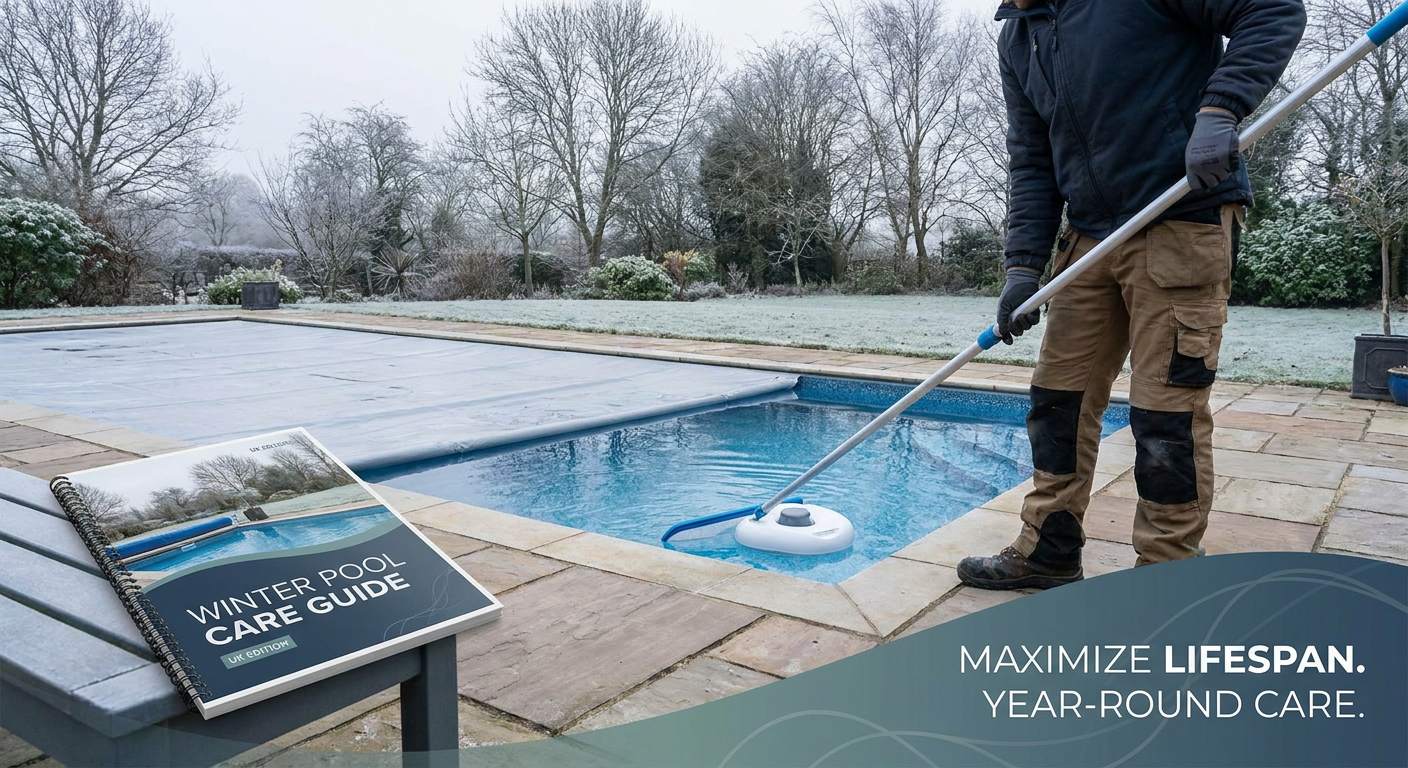
Winter Pool Care Essentials: Keep Your Investment Protected Through the Cold Months
For many pool owners, winter feels like a pause button. The cover goes on, the heating drops, and the pool quietly disappears from the weekly routine. But leaving a pool truly unattended through the colder months is one of the most common and costly mistakes a homeowner can make. Composite pools are built to last, but they still need consistent attention year-round to perform at their best and honour that lifetime warranty.
Here's what active winter pool management actually looks like for UK homeowners, and why it pays to stay on top of it even when you're not swimming.
Why Winter Maintenance Matters More Than You Think
The UK doesn't get the extreme freezing temperatures that make some North American pools genuinely dangerous to leave full of water, but our winters bring their own challenges. Persistent rain, falling leaves, algae growth in cold damp conditions, and fluctuating temperatures all put pressure on pool chemistry and equipment.
Neglect during winter typically shows up as expensive problems in spring: green water, scaling on surfaces, corroded pump components, or cracked fittings. Catching issues early, or preventing them entirely, is always cheaper than repairing them. This is especially true for composite pools, where protecting the surface and structural integrity is a long-term investment rather than a short-term fix.
Water Chemistry Doesn't Take a Holiday
One of the biggest misconceptions about winter pool care is that chemistry stops mattering when the water is cold. It doesn't. Imbalanced water is actually more damaging in winter because problems sit unnoticed for weeks rather than days.
At a minimum, test your water chemistry every two to four weeks throughout winter. The key parameters to keep in check are:
- pH: keep it between 7.2 and 7.6
- Total alkalinity: aim for 80 to 120 ppm
- Free chlorine: maintain at least 1 to 3 ppm even in winter
- Calcium hardness: target 200 to 400 ppm to protect composite surfaces from scale or etching
Cold water holds chlorine longer, so you won't need to dose as frequently as in summer. But the target levels don't change. A good digital test kit or a strip-based tester will give you reliable readings throughout the season.
Keep the Circulation Running
It might be tempting to switch the pump off entirely through winter to save on electricity. Resist that urge. Stagnant water allows algae and bacteria to take hold far more quickly, and can cause chemical stratification where the water at the bottom has a completely different balance to the water at the surface.
Running your circulation system for four to six hours a day through winter is usually sufficient to keep the water moving and the filtration effective. If temperatures drop close to zero, running the pump overnight helps prevent water in the pipework from freezing. Some pool owners use a frost protection timer for exactly this purpose, and it's a small operational cost compared to the price of burst pipework.
Cleaning and Debris Management
Autumn leaves are the obvious culprit, but winter brings its own debris challenges. Wind, rain, and bare-branched trees mean organic material can find its way into the pool regularly. Decomposing leaves release tannins that stain pool surfaces and deplete sanitiser faster.
A well-fitted pool cover is your first line of defence. Solid safety covers and thermal covers both keep debris out and retain some heat, reducing the load on your heating system if you run one over winter. Check the cover regularly and clear pooling water or debris from the top before it finds a way in around the edges.
Even with a cover in place, a quick vacuum and brush of the pool walls every couple of weeks is worthwhile. Algae can cling to composite surfaces in cold weather just as it does in summer, and a quick brush stops it from establishing a foothold before your next chemical dose takes effect.
Equipment Checks: Don't Wait Until Spring
Winter is an ideal time to inspect and service your pool's mechanical components, precisely because the pool isn't in heavy use. A few things worth checking through the colder months:
- Pump and filter: listen for unusual noise, check for leaks around fittings, and backwash or clean the filter as needed
- Heater: if you're running a heat pump or gas heater, have it serviced before the coldest months arrive rather than after
- Lighting and automation systems: check for moisture ingress and ensure waterproof seals are intact
- Skimmer baskets and drain covers: clear any blockages and inspect for cracks caused by temperature changes
Catching a small seal failure or a hairline crack in a skimmer in January is a very different proposition from discovering it when you're trying to open the pool for guests in May.
Pool Enclosures and Winter Swimming
Not every UK pool owner shuts up shop for winter. If you've invested in a pool enclosure, you may well be swimming year-round, and that's one of the strongest arguments for the investment. An enclosure retains heat, keeps debris out entirely, and extends your effective swimming season by several months on either side of summer.
For those who do swim through winter, maintenance demands actually become simpler in some respects. You're testing and adjusting chemistry regularly, the circulation is running at full capacity, and you'll spot equipment issues quickly. The same good habits that keep a summer pool healthy apply, just with slightly lower chemical consumption due to the cold.
Planning Ahead for Spring Opening
The real reward for consistent winter maintenance is a pool that opens cleanly and quickly in spring. Owners who maintain chemistry and circulation throughout winter typically need only a day or two to get their pool swim-ready in March or April. Those who leave it entirely dormant often face a week or more of chemical correction, surface cleaning, and equipment troubleshooting before the water is safe and inviting.
Before you close out the winter season, it's worth scheduling a professional water test and service visit for early spring. A pool technician can check equipment more thoroughly than a visual inspection allows, balance the water precisely ahead of heavy summer use, and flag anything that needs attention before it becomes a problem mid-season.
Consistent care through winter isn't a burden. It's the straightforward difference between a pool that's ready when you are, and one that costs you time and money before you've even had a swim.
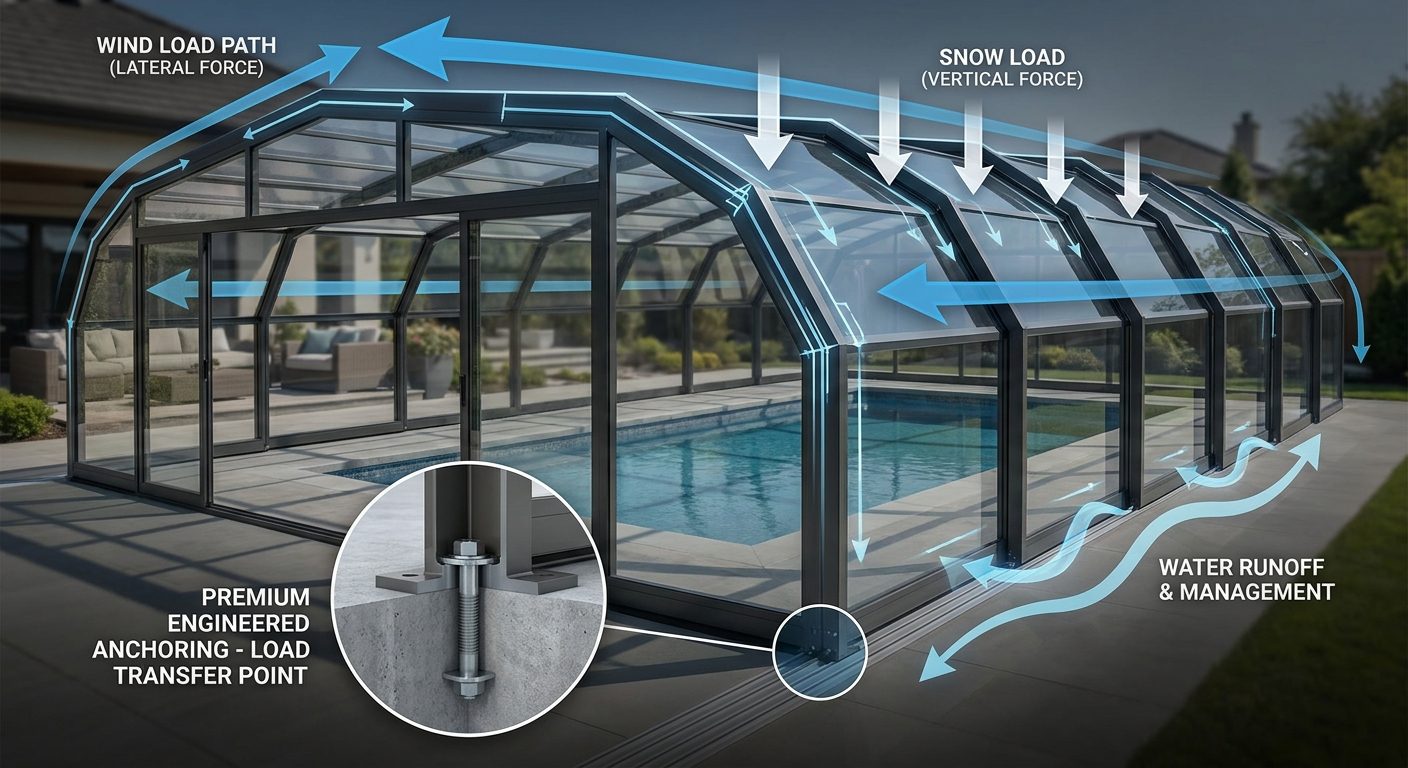
Structural Mounting and Load Management in Pool Enclosure Design
A pool enclosure that has never been tested by a serious storm is an untested structure. In exposed coastal and upland locations across the UK, wind speeds regularly exceed 90 km/h, and in exceptional events the Met Office records gusts above 140 km/h. An enclosure sitting directly over a pool full of water is not something you want to discover is under-engineered at that moment.
The conversation most buyers have with suppliers focuses on aesthetics, footprint, and price. Load management almost never comes up at the point of sale. That omission has consequences that stretch years into the ownership experience, from cracked panels and buckled bars to voided insurance claims after storm damage.
Why Load Management Makes or Breaks a Pool Enclosure
Pool enclosures occupy an engineering category that demands more than typical garden structures. A pergola or gazebo that shifts in a storm is an annoyance. A pool enclosure that fails under load can shatter polycarbonate panels, buckle glazing bars, and deposit shards of material directly into the water below. The hazard zone is a swimming pool, not a lawn.
Wind speeds in the UK vary considerably by location, but exposed sites on the south-west coast, northern uplands, and highland Scotland regularly see sustained winds exceeding 90 km/h. These are not rare events. They occur every winter, often multiple times, and any structure installed outdoors must be designed with this as an expected operating condition rather than a worst-case exception.
What separates a budget enclosure from a premium, patented system is almost entirely explained by how each handles the interaction between dynamic and static loads. A budget frame is typically designed to just meet the minimum numbers for each load category in isolation. A premium engineered frame accounts for the combined loading scenario: the roof already carrying snow when a wind gust hits, or standing water adding mass to joints already stressed by thermal movement.
Domestic buyers rarely know to ask about load ratings, combined load factors, or the specific standards a structure has been tested to. Yet these figures determine three things that matter enormously over a ten or twenty year ownership period:
- The structure's usable lifespan before fatigue cracking or joint failure begins
- Whether a home insurance policy will pay out after structural damage, since policies typically require structures to meet applicable building standards
- Whether the enclosure is actually usable on the worst days of the year, which is precisely when its value is highest
This article unpacks the four main load categories every enclosure frame must resist: wind, snow, water accumulation, and self-weight. It then explains the specific engineering choices that address each one, so you can ask the right questions before committing to a purchase.
The Four Load Categories Every Enclosure Frame Must Resist
Structural engineers classify loads acting on a building into distinct categories because each behaves differently and must be combined in specific ways. Pool enclosures, despite being smaller than most buildings, are subject to the same physics and the same regulatory framework under Building Regulations Approved Document A and the overarching load combination methodology set out in BS EN 1990.
Dead Load (Permanent Self-Weight)
Dead load is the permanent, unchanging weight of the structure itself. For a pool enclosure, this means the aluminium frame, all fixed glazing or polycarbonate panels, any guttering, and the hardware connecting them. For typical aluminium and polycarbonate combinations, this sits in the range of 8 to 15 kg per square metre depending on panel thickness and profile dimensions.
This load is constant and predictable, which makes it the easiest to design for. The danger is that cost-cutting on profile weight reduces material cross-section, which also reduces resistance to every other load type. A frame that is light because it is slender is not a benefit. It is a compromise that will show itself under live and dynamic loading.
Imposed Live Load (Snow)
Snow is classified as an imposed live load because it varies with time and location. In the UK, BS EN 1991-1-3 defines characteristic ground snow loads ranging from approximately 0.15 kN/m2 in southern England to 0.6 kN/m2 in the Scottish highlands. These figures translate to roughly 15 kg and 60 kg per square metre respectively, and they represent the design value that a roof must carry without permanent deformation.
The Scottish figure is four times the southern England figure. An enclosure designed only for the south-east market and then installed in Perthshire or the Pennines is being used outside its design envelope. This is not a theoretical concern. Snow load failures in lightweight structures occur in the UK every few winters, particularly in March when wet, heavy snow can accumulate faster than ambient temperatures can clear it.
Wind Load (Dynamic Pressure and Suction)
Wind loading is more complex than snow because it acts in multiple directions simultaneously and alternates rapidly in gusting conditions. On the windward face of an enclosure, wind creates positive pressure pushing inward. On the leeward face and across the roof, it creates negative pressure pulling outward, a suction effect that is often more destructive than direct impact pressure.
Glazing bar connections and panel retention systems must resist both forces. A panel retained adequately against inward push can still be lifted out by suction if the fixing system has not been designed for negative pressure. This is a specific failure mode that budget systems commonly exhibit and that properly engineered enclosures address through profiled retention channels with mechanical locks, rather than simple compression fit or adhesive.
Hydraulic Load (Standing Water)
Rainwater pooling on a low-pitch roof section is the most overlooked load category in residential pool enclosure design. A 10-millimetre depth of standing water across a 20 square metre roof section weighs 200 kg. If drainage is inadequate or partially blocked, that water accumulates progressively during a sustained rainfall event, adding a variable and growing load to joints and profiles that were sized only for their static and snow design values.
The particular danger of hydraulic load is that it accelerates joint fatigue. The load is not constant. It builds as rain falls, partially drains, builds again, and fluctuates with wind-driven surges. Repeated load cycles of this type initiate micro-cracking at fixing points faster than a single large static load would.
Why Combined Loads Are the Real Test
These four categories do not take turns. A heavy snowfall in February does not wait for wind to stop before arriving. A snow-loaded roof simultaneously experiences wind suction on its upper face, compression from the snow mass, and the dead load of the frame itself. BS EN 1990 and Approved Document A set out specific partial load factors for combining these inputs, and a competent enclosure design must demonstrate adequate performance under the governing combined scenario, not simply under each load in isolation. Any supplier unable to provide combined load calculations for the specific site conditions should be asked to explain why not.
How Aluminium Profiles Are Engineered to Channel Force Safely
The choice of aluminium as the structural material for premium pool enclosures is not primarily aesthetic. It reflects specific mechanical properties that match the demands of long-span, load-bearing outdoor structures, and the way those properties can be shaped through extrusion into geometries that would be uneconomic or impossible in other materials.
Hollow Extruded Sections and Second Moment of Area
Extruded aluminium profiles are formed by pushing heated aluminium alloy through a shaped die, which means the cross-section of every metre of the profile is identical and precisely controlled. Crucially, that cross-section can include internal voids, webs, and ribs that distribute material away from the neutral axis of the section. Moving material away from the centre of a beam dramatically increases its second moment of area, which is the geometric property that determines bending resistance.
A hollow box section with internal ribs can have a second moment of area three to five times greater than a solid rectangular section of the same mass. This is a performance advantage that steel cannot replicate at equivalent weight, because the minimum practical wall thickness for welded steel sections is considerably greater than for extruded aluminium. The result is a pool enclosure frame that is genuinely light without being structurally compromised.
Alloy Specification: 6063-T6 and 6082-T6
Not all aluminium is structurally equivalent. The two alloy grades used as industry standards for structural pool enclosure profiles are 6063-T6 and 6082-T6. The 6063-T6 grade offers a yield strength of approximately 170 MPa and is commonly used for lighter architectural profiles where formability and surface finish are priorities. The 6082-T6 grade offers a yield strength of approximately 255 MPa and is the appropriate choice for primary structural members carrying significant combined loads.
The T6 suffix refers to the temper: solution heat-treated and then artificially aged to maximise strength. A profile sold without alloy and temper certification should be treated with caution, because the same profile geometry in a lower-grade or incorrectly tempered alloy will fail at a fraction of the load.
Why Arch Geometry Outperforms Flat Roofs Under Load
The moment of inertia of a profile determines bending resistance, and doubling the depth of a beam increases its bending resistance by a factor of eight. This is why taller arch profiles perform so much better than shallow flat-roofed alternatives when snow loads are applied. The arch geometry delivers a further structural benefit beyond section depth.
A curved roof converts what would be bending moments in a flat beam into axial compression along the profile. Aluminium resists axial compression far more efficiently than it resists bending, because the entire cross-section is engaged rather than just the extreme fibres. The arch is not simply an aesthetic choice. It is the load path that suits the material most closely, which is why award-winning pool enclosures consistently favour arch configurations over flat alternatives.
Thermal Expansion and Slip Joints
Aluminium expands and contracts at approximately 23 micrometres per metre per degree Celsius. For a 10-metre enclosure experiencing a 20-degree Celsius temperature swing between a cold winter morning and a warm summer afternoon, that translates to approximately 4.6 mm of dimensional change. Across a full seasonal range of perhaps 40 degrees, the movement reaches nearly 10 mm.
If that movement cannot occur freely, it becomes a force applied to the joints and glazing channels. The result is progressive loosening of fixings, cracking of sealed interfaces, and eventually failure of the glazing itself. Correctly designed enclosures incorporate slip joints at specific intervals that allow thermal movement to occur without transmitting force to adjacent components. The joints are engineered clearances, not oversights.
Integrated Extrusion Profiles and the Problem They Solve
The weakest points in any structural assembly are the interfaces between components that were designed separately and then bolted together. A glazing bar that has a separate drainage channel clipped onto it, with a separate fixing bracket bolted through both, has three interfaces where load transfer is imperfect, where corrosion can begin, and where fatigue cracking initiates under repeated loading cycles.
Patented extrusion profiles from manufacturers like Arch Enclosures address this directly by integrating glazing channels, drainage routes, and structural fixing points into a single extruded section. The drainage channel is not an addition. It is part of the profile geometry. The glazing retention groove is machined into the same aluminium that carries the structural load. This eliminates the interface problem entirely. The load path from panel to profile to fixing to foundation is continuous, with no bolt holes, no dissimilar material joints, and no separate components working loose over time. It is the single most important manufacturing difference between a commodity enclosure and an engineered one.

Do You Need an SEO Consultant? What UK Small Businesses Should Know Before Hiring
A plasterer in Bognor Regis once paid £600 a month for six months to an SEO agency he found through a cold email. At the end of that period, his Google rankings had barely shifted, and the agency's reporting showed him something called "domain authority improvement" that meant nothing to his enquiry rate. He had spent £3,600 and had nothing to show a bank manager, let alone a new customer. This kind of story is not unusual. It plays out across the UK every week, and the reason it keeps happening is structural, not accidental.
Why So Many UK Small Businesses Get Burned by SEO Promises
The SEO industry has no formal regulation in the UK. There is no licensing body, no required qualification, and no minimum standard. Somebody who read a few blog posts over the weekend can register a limited company on Monday morning and start cold-calling local businesses as an SEO consultant by Tuesday. That is not an exaggeration. It is how a meaningful proportion of the people in this industry entered it.
The appeal of ranking well on Google is completely understandable. Google processes roughly 8.5 billion searches a day. A local roofing company sitting at the top of those results for searches like "roofer in Worthing" or "flat roof repair Brighton" would generate genuine, qualified leads at a fraction of the cost of paid advertising. That same scale, though, makes the space enormously attractive to poor operators. Where there is demand and confusion, there are people willing to sell vague promises at a high price.
The specific damage for UK small businesses tends to come from generic packages that were never designed with a local business in mind. A bulk link-building package, for example, might involve getting your website mentioned on fifty low-quality directory sites based in the United States. For a national retailer with a large domain and an established content strategy, that might be one small tactic in a much larger programme. For a local plumber in Worthing or a trades business in Brighton, it does almost nothing for local rankings and carries a real risk of a Google penalty if the links come from sites that violate Google's guidelines. The money is gone, the rankings do not move, and the consultant has a contract that makes it very hard to leave.

The purpose of this article is not to put you off getting SEO help. For most small businesses with a local market, good SEO work done consistently over time is one of the highest-return investments available. The purpose is to give you the specific questions, benchmarks, and warning signs that separate genuine experts from people who are good at selling. What follows covers what "AI SEO" claims actually mean, the red flags to watch for before you sign anything, realistic costs and timelines, how local SEO differs from general SEO, and a framework for deciding what level of help your business actually needs right now.
What 'AI SEO' Actually Means and Why the Label Should Make You Cautious
Spend ten minutes looking at SEO consultants online at the moment and you will notice a pattern. Almost everyone has added "AI" somewhere to their service description. "AI-powered SEO", "AI-driven content strategy", "next-generation AI optimisation". The label sounds impressive and modern, and it is almost entirely meaningless without further explanation. The term covers several genuinely different things, and only some of them are worth paying for.
Where AI genuinely helps in SEO work
There are legitimate uses of machine learning and AI tooling in SEO, and a good consultant will be using them. Tools like Semrush's AI writing assistant, Surfer SEO, and Ahrefs use machine learning to do things that used to take hours of manual work: surfacing keyword gaps in your content compared to competitors, analysing the structure and depth of the pages currently ranking for a given query, and flagging technical issues across a site faster than any human audit. These tools are genuinely useful. They make competent SEO practitioners faster and more thorough.
Generative Engine Optimisation, often abbreviated to GEO, is a real and emerging discipline worth understanding. It focuses on making your content citable and quotable by tools like ChatGPT, Google Gemini, and Anthropic's Claude. As more users ask AI assistants questions rather than running traditional searches, the way content needs to be structured is shifting. GEO favours clear, direct, natural-language answers to specific questions rather than keyword-dense paragraphs written to satisfy an older version of Google's algorithm. If a consultant mentions GEO and can explain it in plain terms, that is a reasonable sign they are keeping up with real developments in the field.
What AI cannot do, regardless of what anyone tells you
AI cannot guarantee rankings. No tool, however sophisticated, can override Google's algorithm or predict exactly how it will respond to a set of changes on your site. The algorithm is updated thousands of times a year, and even Google's own engineers do not fully know how every signal interacts. Any consultant claiming their AI system "guarantees" or "secures" specific positions is either misrepresenting the technology or does not understand it.
AI also cannot replace the judgment calls that make SEO work for a specific local business. Knowing which three keywords matter most for a drainage contractor in Sussex, understanding the seasonal patterns in how their customers search, recognising that a competitor is ranking on a technicality that will not last, deciding whether a piece of content should answer a question directly or guide the reader to a consultation enquiry form, these are decisions that require human understanding of a specific business in a specific market. A machine learning tool can surface options. It cannot choose.
The specific risk for small businesses is a practice that has become common since generative AI tools became widely available. Some consultants use tools like ChatGPT to produce large volumes of content quickly, publishing dozens of pages a month that are technically readable but thin, repetitive, and offer nothing a reader could not find on any of the other hundred sites doing the same thing. This is sometimes sold as an advantage, "we can publish more content than the competition", but bulk low-quality content is precisely what Google's helpful content updates have been targeting since 2022. It can actively suppress a site's rankings rather than improve them.
A practical test you can apply before signing anything: ask any consultant claiming AI expertise to explain which specific tools they use, what information those tools need from your business to produce useful outputs, and how a human reviews and edits the outputs before anything goes live on your site. A competent practitioner will answer this in detail without hesitation. common hiring mistakes often trace back to accepting vague answers to exactly these questions. If the response is vague, or if the consultant seems annoyed that you asked, that tells you what you need to know.
Red Flags That Should Stop You Signing Any Contract
Most SEO contracts are signed after one sales call and a PDF proposal. The pressure to act quickly, combined with the complexity of the subject, means business owners often commit to spending thousands of pounds without asking the questions that would immediately reveal whether the consultant is any good. Here are the specific warning signs worth checking before you put your name to anything.
Guaranteed number-one rankings
Google has stated publicly and explicitly that no one can guarantee a number-one position in its organic search results. The algorithm is too complex, too frequently updated, and too dependent on competitor behaviour for any outcome to be guaranteed. A consultant who promises a top ranking is either misinformed about how search engines work, which is a serious problem in a person you are paying to manage your search presence, or they know the claim is false and are making it anyway to close the sale. Neither version is acceptable. A reputable consultant will talk in terms of realistic improvement ranges and traffic growth over time, not guaranteed positions.
Vague deliverables
A legitimate proposal is specific. It names actual activities with actual quantities. Something like "four optimised blog posts per month targeting the keywords X, Y, and Z, plus a monthly technical audit and one outreach-based backlink from a relevant UK industry publication" is a deliverable. "Content marketing and link-building support" is a description of a general category of activity that could mean almost anything, including very little. If you cannot hold the consultant accountable to a specific output at the end of each month, the contract is protecting them, not you.
Refusal to share a sample report
Ask any prospective consultant to show you an anonymised monthly report from a current client. Most good consultants will do this without much hesitation because they are proud of what they show clients. If they refuse, that is worth noting. If they do share a report and it shows only impressions, clicks, and domain authority scores rather than leads generated, enquiries received, or revenue influenced, the metrics have been chosen to look impressive rather than to reflect business outcomes. An impression is not a customer. A report that cannot connect SEO activity to actual enquiries is not measuring the thing that matters to you.
Long lock-in contracts with no review clause
SEO does take time, and a consultant asking for a minimum initial commitment of three to six months is reasonable. A consultant asking for a twelve-month or longer lock-in with no performance review clause is a different matter. Good practitioners are confident enough in their work to include a 90-day review point with the option to exit if agreed targets have not been met. If a consultant is unwilling to include any kind of performance milestone or exit right, ask yourself why they need that protection.
Secretive link-building
Backlinks remain one of Google's most significant ranking signals, and acquiring them is a legitimate part of SEO work. A consultant should be able to show you exactly which sites they intend to build links from and why those sites are relevant and trustworthy. Any consultant who refuses to disclose their link sources, citing "proprietary methods" or "our network", is very likely using private blog networks or link farms. These are sets of websites that exist purely to pass links to paying clients, in direct violation of Google's guidelines. A site that has received a manual penalty for unnatural links can take months to recover, and some never fully do. The short-term cost of switching consultants is far lower than the long-term cost of a penalty.
Promises of results within weeks
Organic SEO for a new or under-optimised site typically takes three to six months to show measurable movement in rankings and traffic. Anyone promising visible results within a few weeks is either talking about something other than sustainable organic SEO, perhaps paid ads dressed up as SEO, or they are telling you what you want to hear. There are occasional exceptions: a well-established site with strong existing authority that has a specific technical problem fixed can recover rankings quickly. But for the typical small business starting or restarting an SEO programme, three to six months is the honest minimum.
No questions about your actual business
This one is perhaps the most telling and the most commonly overlooked. If a consultant sends you a proposal without first asking about your customers, your geographic target area, your current website traffic, your main competitors, your average order or job value, and what you have already tried, they do not have a strategy for your business. They have a template they send to everyone. Good SEO for a sole-trader electrician in Shoreham is a completely different programme from good SEO for a multi-location estate agent in West Sussex. A consultant who cannot articulate that difference, because they never asked the questions needed to understand it, will not produce results that reflect your specific situation.
Realistic Costs and Timelines for UK Small Business SEO
One of the first questions a business owner asks is: what should this actually cost? The honest answer is that pricing in the SEO industry is all over the place, which makes it genuinely hard to know whether you are getting value or being taken for a ride. Having some ballpark figures in your head before any sales call gives you a much stronger starting position.
A freelance SEO consultant working with a UK small business on a local campaign will typically charge between £300 and £800 per month. Where you land in that range depends mostly on how competitive your niche is. A sole trader offering garden clearance in a market town is a very different proposition from a solicitor competing across a large city.
Small agency retainers for a bespoke, ongoing service sit between £500 and £1,500 per month for most UK small businesses. If you see a package under £300 per month, it is almost certainly a templated service where your campaign gets the same treatment as hundreds of other clients. Automated reports get sent, a few directory submissions happen in the background, and nobody is actually thinking about your specific business or market.
The £99 per month SEO package that arrives in your inbox is the clearest example of the false economy to avoid. That price point cannot cover meaningful work in any of the five core activities that actually move the needle:
- Keyword research relevant to your specific services and location
- On-page optimisation of title tags, headings, meta descriptions, and page structure
- Technical fixes for crawl errors, site speed, and Core Web Vitals
- Content creation that earns search visibility over time
- Link acquisition from relevant, trustworthy UK sources
Ask any consultant you are considering how their monthly fee is split across those five areas. A vague answer or a heavy weighting toward reporting rather than doing is a useful signal.
If you want a standalone health check before committing to anything ongoing, a thorough one-off technical audit for a small business site should cost between £250 and £800. That should cover Core Web Vitals, crawl errors, on-page structure, and a review of your existing backlink profile. Anything cheaper is probably a tool export with a logo on the front.
On timelines, be prepared to hear things you do not want to hear. For a local service business targeting Worthing, Sussex, or a single UK town, realistic expectations look like this: three to six months to see ranking improvements for your target terms, and six to twelve months before you have consistent lead flow coming in from organic search. Anyone promising faster results without a credible explanation of why your situation is different is either guessing or misleading you.

Why Local SEO Is a Different Game and Matters More for Most UK SMEs
National rankings are a trophy most small businesses neither need nor can realistically win. A heating engineer in Worthing does not need to outrank every other heating engineer in the country. They need to appear when someone three streets away types "boiler repair Worthing" into Google. That is a fundamentally different objective, and it requires a different approach to achieve it.
The single most impactful free tool available to any local UK business is Google Business Profile. A fully optimised profile, with accurate categories, a complete services list, recent photos, and regular posts, consistently outperforms businesses that are spending money on broad SEO while neglecting it. If yours is incomplete, fixing it this week will do more for your local visibility than most paid activities you could start today.
Citations and the NAP consistency rule
Local citations are listings of your business name, address, and phone number across directories and data aggregators. Google uses consistency across these listings as a trust signal to confirm you are genuinely based where you claim. The main directories worth prioritising for a UK small business include:
- Yell
- Checkatrade (particularly strong for trades)
- Thomson Local
- Bing Places
- Apple Maps
Even a minor inconsistency, such as "Street" in one place and "St" in another, can dilute the trust signal. An audit of your existing citations is usually one of the first things a competent local SEO consultant will run.
How Google's local pack actually works
The map results that appear at the top of a local search, the three-pack, are driven by three signals: proximity of the searcher to your business, relevance of your business category to what they searched for, and prominence built from reviews, links, and citation volume. A good local SEO consultant should be able to explain clearly how they plan to influence all three, not just the one that is easiest to work on.
Reviews deserve particular attention. hiring SEO consultants who ignore reviews are ignoring one of the most powerful ranking levers in local search. Businesses with 50 or more Google reviews and a consistent average above 4.2 stars appear significantly more often in local pack results than competitors with thinner or older review profiles. A review generation strategy, meaning a repeatable process for asking satisfied customers to leave a review, is not an optional extra. It is core to local SEO performance.
The mismatch to actively avoid is hiring a consultant whose background is national e-commerce SEO to run a local trades campaign. The skills overlap, but the priorities are entirely different. Someone optimised to selling sofas to the whole of England thinks in terms of domain authority, content at scale, and technical architecture. Someone who knows local SEO thinks about your Google Business Profile, your review velocity, your citation footprint, and hyperlocal content. Make sure you are hiring the right type of expertise for the work you actually need done.
How to Decide What Level of SEO Help Your Business Actually Needs
Before you speak to a single consultant or request a single proposal, it helps to know where you actually stand. Three questions will tell you most of what you need to know:
- Is your site currently getting any organic traffic at all? (Check Google Search Console, which is free.)
- Are you appearing in Google Maps results when you search for your main service plus your town?
- Are competitors outranking you for searches you know your customers use?
If the answer to all three is no, do not sign a monthly retainer yet. Start with a one-off technical audit and Google Business Profile optimisation. A broken or poorly structured site will not benefit meaningfully from ongoing SEO spend. You would be pouring money into activity built on an unstable foundation.
If you have some traffic but it is not converting into enquiries or sales, the problem may not be SEO at all. It may be the website itself. Page speed, unclear calls to action, confusing navigation, or a design that does not inspire trust can all kill conversions even when rankings are decent. A web design review should come before more SEO investment in that scenario. More traffic to a site that does not convert is not progress.
Before any conversation with a consultant, define what success looks like in specific terms. A goal like "I want to generate 10 new enquiries per month from organic search within six months" gives both sides a clear success measure. It prevents the vague deliverable creep that leaves business owners three months in wondering what they have actually paid for. realistic SEO cost ranges make more sense once you have a defined outcome to benchmark against. Consultants who push back on specific goals or who respond with metrics like "impressions" and "visibility" rather than leads are worth questioning.
On the in-house versus outsourced question: a business owner who can genuinely commit four to six hours a week has a real shot at making meaningful progress using Google Search Console, Google's own SEO Starter Guide, and tools like Google Analytics. But most small business owners running a team, managing customers, and handling the day-to-day are not realistically going to find that time consistently. In that case, outsourcing and spending those hours on the work only you can do in your business is almost always the better use of your time and money.
The right consultant or agency will ask more questions in your first conversation than they answer. They will want to understand your customers, your location, your competitors, and what has already been tried. They will set honest expectations about what is achievable in your timeframe and budget, and they will treat your money with the same care they would give their own. That combination is not rare, but it does require you to look past the polished sales decks and ask the straightforward questions that reveal whether there is real expertise behind the pitch.
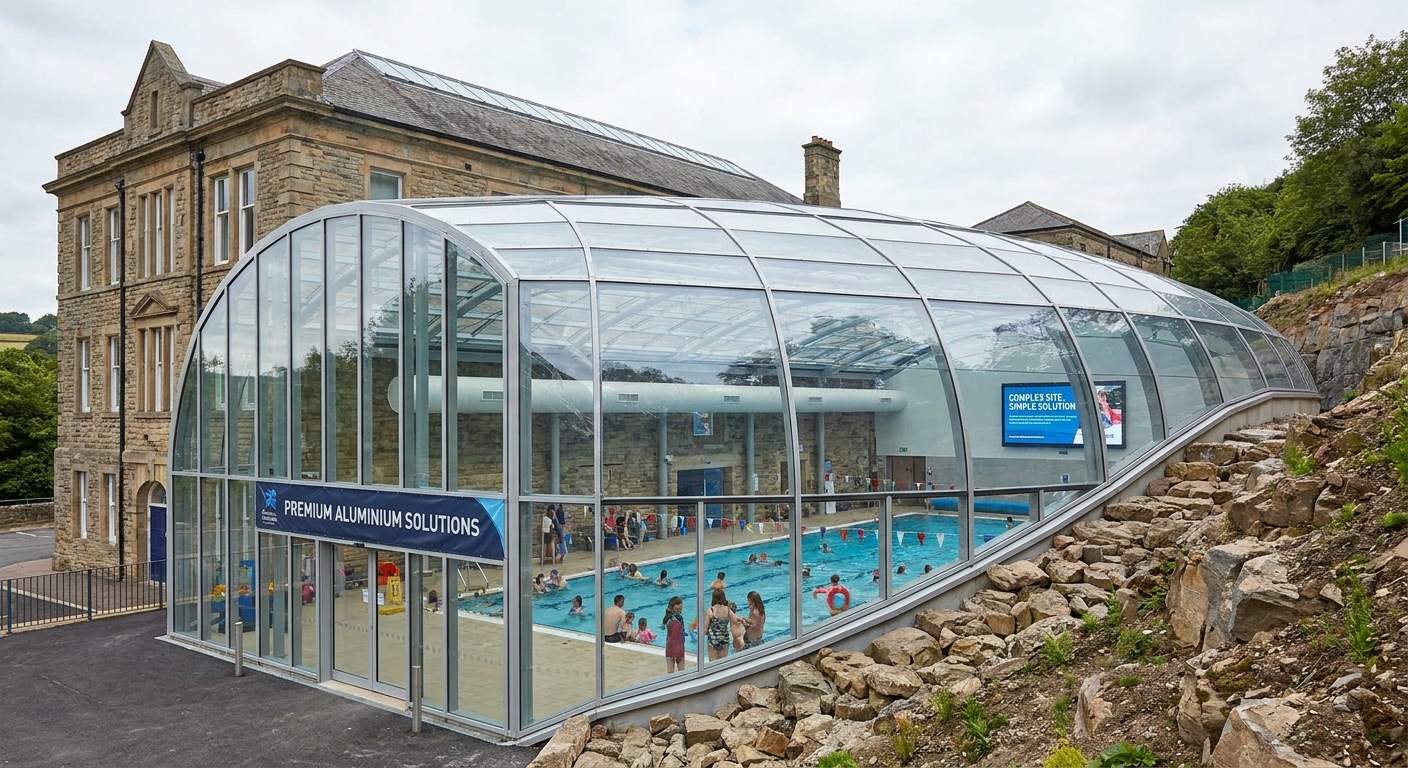
Challenging Projects Made Simple: How Premium Aluminium Pool Enclosures Conquer Complex Site Conditions
A leisure centre in the north of England recently needed a full pool enclosure retrofit while the facility remained open to the public. The access route to the pool deck ran through a fire door corridor 950 mm wide, the roof above already carried a mechanical plant load, and the planning officer had specified a ridge height no greater than 4.2 metres to protect the neighbour's outlook. None of those constraints cancelled the project. All three were resolved through the choice of structural system.
That kind of situation is not unusual. It is, in fact, close to the norm. Understanding why, and what the aluminium-based solutions actually involve in practice, is the subject of this article.
Why Pool Sites Are Almost Never Straightforward
Most UK pool redevelopment projects carry at least one of four site constraints before a single drawing has been produced. Restricted access for plant and machinery, proximity to listed or neighbouring structures, irregular ground plans, or extreme local wind and snow loading requirements: any one of these would complicate a build. On real projects, they tend to arrive together.
Commercial aquatic centres add another layer of difficulty because they rarely sit as standalone buildings. They occupy leisure campus masterplans assembled over decades, which means the enclosure must integrate with existing rooflines, match cladding palettes specified years ago, and respect planning conditions that were written long before the pool enclosure was ever considered. The planning officer is not being obstructive when they flag a condition like that. They are enforcing an agreement the local authority made with the community when the original development was approved.
Domestic pool owners face a parallel but distinct set of pressures. Rear garden dimensions rarely align with standard module widths, which is not the fault of any particular system but simply reflects the enormous variety of UK residential plot shapes. Permitted development rights impose precise height limits that vary by local authority and can differ even between neighbouring streets in the same postcode. A structure that qualifies for permitted development on one side of a road may require a full planning application on the other.
The instinct to treat any of these constraints as a reason to pause or walk away from the project is understandable, but it is the wrong starting point. Each constraint is, in practical terms, a design brief. The height limit tells you the maximum ridge profile your system must achieve. The narrow access corridor tells you the maximum component dimension your profiles must stay within. The neighbouring listed building tells you the finish palette and glazing reflectivity your planning application needs to address. Treated as instructions rather than obstacles, the constraints make the specification tighter and the final result better.
This article traces how premium aluminium systems resolve four categories of real-world complexity, using the decisions made on actual redevelopment projects as evidence. The aim is not to suggest that every project is simple. It is to show that complexity, handled through the right structural approach, produces results that would have been unachievable with heavier or less adaptable materials.
What Makes Aluminium the Structural Material of Choice for Awkward Builds
The case for aluminium on difficult pool sites starts with a straightforward structural fact. Aluminium alloy profiles used in high-specification enclosures achieve a strength-to-weight ratio roughly three times better than steel per unit of cross-section. That matters most when the span is long, because it means longer unsupported runs without intermediate columns that would obstruct sightlines or break up the pool deck. On a 20-metre span, removing two internal columns is not a cosmetic upgrade. It changes how the space works for swimmers, coaches, and maintenance staff.
Corrosion resistance is the second structural argument, and in a pool environment it is not a minor technical footnote. Marine-grade 6063-T5 alloy, finished with an anodised or powder-coated surface, resists chlorine off-gassing and the humid air that pools generate constantly. Steel fixings in the same environment typically show visible rust within 18 months. That is not an estimate based on worst-case conditions. It reflects what maintenance teams at commercial leisure facilities observe routinely. Specifying aluminium throughout, including fixings and brackets, removes that maintenance cycle entirely.
Thermal expansion is a detail that separates well-engineered systems from cheaper alternatives. Aluminium expands at approximately 23 micrometres per metre per degree Celsius. Across a 15-metre enclosure span, a 30-degree seasonal temperature swing produces around 10 mm of total movement. A system designed without expansion joints built into the profile connections will transfer that stress directly into the glazing seals, which fail progressively and expensively. Systems where the expansion joint is integral to the profile geometry absorb the movement without loading the glass at all. It is a detail you cannot see when the structure is finished, but you notice its absence within two or three seasons.
The manufacturing process itself creates flexibility that other materials cannot match at equivalent cost. Aluminium extrusion allows bespoke profile geometries to be produced in relatively small batch runs. If a planning condition requires a curved roof form, or an architect specifies a pitched profile that matches an existing leisure centre roofline, that geometry can be engineered into the extrusion without the kind of tooling investment that makes bespoke steel fabrication prohibitively expensive for all but the largest projects. Curved and pitched forms are standard project types rather than exceptional commissions.
End-of-life recyclability is worth noting as a practical procurement point, not just a sustainability aspiration. BREEAM assessments for commercial leisure facilities now explicitly consider recyclability of structural materials. Domestic clients pursuing planning consent for sustainable garden structures are increasingly presenting recyclability credentials as part of their application. Aluminium is fully recyclable without loss of material properties, and that characteristic is documented and verifiable, which matters when a planning submission or a BREEAM report needs supporting evidence.
For heritage settings specifically, where the visual weight and finish of an enclosure must defer to the existing architecture, the ability to specify precise RAL colours and low-sheen anodised finishes through the extrusion process means the structure can be made to recede visually. That is a design tool as much as a material property, and it opens up heritage property retrofits that heavier or more visually dominant materials would rule out from the start.
Confined Access and Tight Footprints: The Logistics Problem Solved on Site
One of the most consistent practical difficulties in aquatic centre redevelopments is that the pool is already there and is still in use. The enclosure must be assembled around live infrastructure, which means no full-site crane swing, no temporary closure of pool lanes to stage materials, and no option to break through the building envelope at a convenient point without triggering a full building regulation inspection sequence.
Premium aluminium systems address this directly through how they are manufactured and shipped. Profiles arrive pre-cut and labelled to the project schedule, sized so that two or three operatives can carry them by hand. That eliminates the heavy-lift equipment requirement at the point where it creates the most disruption. A telehandler that cannot physically reach a rear-of-site pool deck because the access route passes through an indoor corridor is not a problem you solve with a bigger machine. You solve it by not needing the machine at all.
The practical numbers on a representative commercial project illustrate the difference. An enclosure spanning 25 metres by 14 metres, covering an existing outdoor teaching pool at a leisure facility, was erected in under three weeks using a team of four installers. The team worked from lightweight mobile towers rather than scaffolding, because the profile connections use mechanical fixing rather than site welding. No hot works permits were required. No exclusion zones around welding equipment disrupted the adjacent car park or main building entrance. The programme ran to schedule because none of the delays that affect steel fabrication and concrete programmes were present.
Modular bay construction provides a specific logistical advantage that becomes important when access to one area of the site is blocked temporarily. Because each bay is a structurally complete unit before the next is started, installers can move to an adjacent bay if plant, deliveries, or pool operations create a temporary obstruction. A poured concrete or structural steelwork programme demands continuity. The sequence cannot be reordered once started without affecting structural integrity. Aluminium modular systems allow the installation sequence to be adapted day by day without compromising the engineering.
For domestic builds, the access constraint that matters most is the side passage. A standard Victorian terrace side return is typically between 800 mm and 950 mm wide, and for many rear garden pool projects it is the only route to the installation area. Profiles for domestic enclosure systems are sized with this in mind. Standard lengths fit through a 900 mm gap, and no individual component exceeds the weight limit for a two-person manual carry under current manual handling regulations. That last point matters not just for compliance but for the practical reality that most domestic installations do not carry a large site workforce. Two operatives working efficiently through a side passage is a solved problem, not a reason to exclude aluminium from the specification.
The combination of light weight, pre-cut delivery, and mechanical fixing also reduces the margin for on-site error. When every component is labelled to position and the connection is a bolt rather than a weld bead, the skill requirement shifts from specialist trades to trained installers following a documented sequence. For clients concerned about programme certainty, that consistency is one of the most reassuring aspects of premium enclosure systems, particularly where the project timeline is tied to a school term, a seasonal opening date, or a commercial launch deadline.
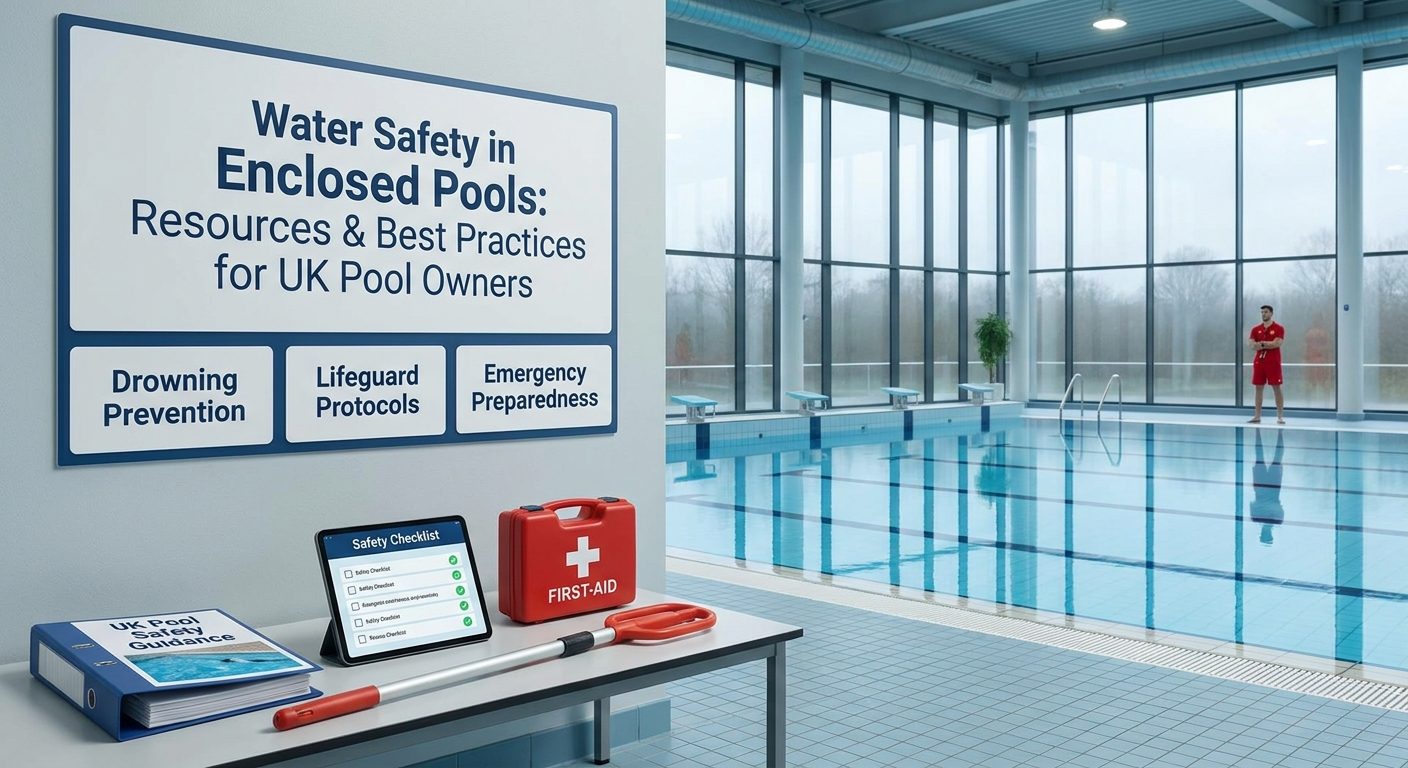
Water Safety in Enclosed Pools: Resources and Best Practices for UK Pool Owners
Most domestic pool owners think about safety in terms of what they can see: a child near the water's edge, a slippery tile, an unsecured gate. What they often miss is the environment itself. An enclosed pool changes the conditions around the water in ways that quietly increase risk even as they appear to make swimming safer and more comfortable.
Getting this right starts with understanding what makes an enclosed pool different, not just from an engineering standpoint, but from a human physiology and emergency response standpoint too.
Why Enclosed Pools Create a Unique Safety Environment
An aluminium pool enclosure reduces wind, raises ambient humidity, and cuts UV exposure dramatically compared to an open-air pool. These changes feel pleasant, but they have a direct effect on how swimmers and the people watching them perceive fatigue and risk. Reduced wind means sweat evaporates more slowly, which dulls the natural sensation of overheating. Humidity levels inside a well-sealed enclosure can sit above 70 percent for much of the day, compounding this effect.
Acoustic conditions inside an enclosure are also fundamentally different. Sound reflects off aluminium and polycarbonate glazing rather than dispersing into open air. The result is a wash of reverberant noise that makes it genuinely harder to locate the source of a shout or a splash. In an open-air pool, a cry for help carries a clear direction. Inside an enclosure, that same sound can seem to come from everywhere and nowhere at once.

The absence of strong daylight variation is another underappreciated factor. Outdoors, the shift from bright afternoon sun to cooler late-afternoon light acts as a natural cue to get out of the water. Inside an enclosure, light levels stay relatively stable throughout the day, especially under overcast UK skies. Swimmers, particularly children, lose their instinctive sense of how long they have been in the water. Even in a heated pool set to a comfortable 28 degrees Celsius, prolonged immersion steadily draws heat from the body. Cold exhaustion in a warm pool is a real phenomenon.
The WHO recreational water guidelines are explicit that physical environment factors including enclosure type, bather load, and supervision ratios must be assessed together rather than independently. A pool that is safe for two supervised adults is not automatically safe for a group of children at a birthday party, even if nothing structural has changed.
Domestic enclosed pools present a particular challenge: they are statistically unsupervised for the vast majority of the day. No family with a private pool employs a lifeguard during every session. This means passive safety layers, including poolside alarms, automatic pool covers, and secure access control, are not optional extras to add if budget allows. They are the primary line of defence. Understanding that baseline is where every enclosed pool safety plan has to start.
The Drowning Risk Data Every Pool Owner Should Know
Drowning is the third leading cause of unintentional injury death worldwide. The World Health Organization records roughly 320,000 drowning deaths per year globally, a figure that almost certainly undercounts the true total because many incidents in lower-income countries go unregistered. In the UK, the Royal Life Saving Society reports that on average more than 400 people drown annually, and while coastal and inland open water account for the largest share, private swimming pools and garden water features contribute a meaningful proportion of non-coastal incidents.
The age profile of risk at residential pools is stark. Children aged one to four face the highest relative drowning risk in private pool settings. The critical window between the last time a child is seen and the moment they are found in water is typically under three minutes. That is not a margin that allows for a distracted search of the house. It is barely enough time to reach the pool from an adjacent room.
For enclosed domestic pools, warmer water temperatures make this demographic risk worse in a specific way. A comfortably heated pool encourages longer, more relaxed swim sessions. Parents who might supervise closely for the first twenty minutes tend to relax their attention as a session extends into an hour. The pool enclosure itself, by making swimming feel so pleasant and normalised, can actually reduce the vigilance that an outdoor pool in colder weather tends to prompt automatically.
The US National Water Safety Action Plan identifies five core layers of protection that every pool owner should understand:
- Water competency, meaning swimmers have the skills to stay safe if something goes wrong
- Physical barriers and alarms that prevent unintended access
- Close supervision with a designated, undistracted watcher
- Life jackets and poolside rescue equipment
- Emergency action readiness including CPR training and a practiced response plan
The Action Plan is explicit that no single layer is sufficient on its own. A child who can swim confidently can still drown. Barriers can be left open. Supervisors get distracted. Emergency readiness matters most when every other layer has failed, which is precisely when you need it most.
One risk that domestic pool owners consistently underestimate is secondary drowning, also called dry drowning or post-immersion syndrome. When a swimmer inhales even a small amount of water, it can trigger pulmonary oedema, a swelling of the lung tissue, in the hours after they leave the pool. The swimmer walks away apparently fine and then deteriorates over the following six to twenty-four hours. Symptoms include persistent coughing, unusual fatigue, chest tightness, and irritability in children. Guidance on recognising these signs should be printed and displayed poolside, not buried in a welcome pack.
Barrier Design and Access Control Inside an Enclosure
The aluminium structure of a pool enclosure forms an effective outer shell, but it does not replace the secondary physical barrier that UK Building Regulations and the Health and Safety Executive both recommend between living areas and the water. The enclosure keeps weather out. A pool fence keeps unsupervised people, particularly children, away from the water's edge. These are two different safety functions and both are necessary.
A compliant pool fence specification is not complicated, but the details matter in practice:
- Minimum height of 1.1 metres, measured from the ground on the pool side
- Vertical bar spacing no greater than 100mm, preventing a small child's head from passing through
- No horizontal rails on the pool-facing side that could function as a climbing aid
Fences that meet the height requirement but include a decorative horizontal rail halfway up are a common installation error. A four-year-old can use a 500mm horizontal bar as a foothold and be over a 1.1 metre fence in seconds. The design of the fence matters as much as its dimensions.
Gate specification is where many installations fall short. The standard for a compliant pool gate requires it to be self-closing from any open position and self-latching with the latch mechanism on the pool side at a height above 1.5 metres. A gate that requires two simultaneous actions to open, for example lifting a lever while pressing a button, adds a critical extra second of delay. That second matters with a determined toddler. A gate with a latch a child can reach and operate with one hand does not meet the practical intent of the guidance, regardless of its height.
Inside an aluminium enclosure, the door seals and locking mechanisms deserve their own maintenance schedule. Aluminium is highly corrosion resistant, but the gaskets, hinges, and latch mechanisms of enclosure doors are subject to humidity, pool chemical vapour, and physical use throughout the year. A door that closes and latches correctly in installation can, after two seasons of heavy use, develop enough misalignment that a child applying their body weight can push it open. Enclosure door mechanisms should be inspected every six months, with any play in hinges or resistance in latches addressed immediately.
Retractable pool covers serve a dual function that makes them one of the most cost-effective safety investments for an enclosed pool. A commercial-grade retractable cover rated to support 100 kilograms per square metre provides thermal retention when the pool is not in use and acts as a physical barrier that prevents an unsupervised person from entering the water. The thermal benefit alone typically reduces heating costs by 30 to 50 percent, which makes the safety benefit effectively free. When specifying a cover, the load rating matters: decorative or lightweight solar covers do not perform this safety function.
Pool alarms compliant with ASTM F2208 standard detect sub-surface movement and trigger an audible alert within 30 seconds of water displacement. They are a genuine backup layer, particularly for detecting an entry into the pool that occurs when visual supervision has lapsed. They are not, however, a replacement for physical barriers. An alarm that sounds after a child has entered the water is useful only if someone can respond immediately and competently. The combination of a compliant fence, a self-latching gate, a rated pool cover, and an ASTM-compliant alarm addresses risk in depth rather than relying on any one mechanism.
For domestic enclosed pools without a dedicated lifeguard, visible poolside signage is both a legal best practice and a practical tool. Signage should state pool rules clearly, specify maximum bather loads, and show the exact location of rescue equipment including a reaching pole, a throw line, and a first aid kit. Emergency responders arriving at an unfamiliar property in the dark or under stress need to find equipment without a guided tour. Signage that assumes everyone already knows where things are kept is signage that will fail at the worst possible moment. The water safety culture you build around your pool depends as much on these physical and visible cues as it does on any single piece of equipment.
Lifeguard Protocols Adapted for Enclosed Pool Settings
Staffing ratios matter enormously before anyone enters the water. The Royal Life Saving Society UK and the Institute of Swimming recommend a maximum supervision ratio of 1 lifeguard to 25 swimmers for general recreational sessions, dropping to 1 lifeguard to 10 swimmers when children under eight are in the water. These figures are not guidelines to aim for in quiet periods, they are the ceiling, and any session that exceeds them is operating outside accepted safe practice.
The physical environment inside an aluminium enclosure introduces a hazard that open-air or traditional indoor pools do not present in the same way. Reflections off polycarbonate or glass panels can produce glare blind spots that cut across a lifeguard's sightlines at certain times of day. The practical fix is straightforward: repositioning the lifeguard chair at a 45-degree angle to the main light source, typically the largest glazed roof section, significantly reduces the glare effect and restores clean sightlines across the full pool surface.

The 10/20 rule sets the functional test for any pool supervision setup. A lifeguard must be able to scan the entire pool within 10 seconds and physically reach any swimmer in distress within 20 seconds. Enclosed pools with irregular panel shadows, roof struts, or unusual pool geometries can create areas where this standard is harder to meet. Every commercial operator should walk through a formal 10/20 assessment before the first public session, checking that no shadow zone or structural obstruction creates a dead time beyond those thresholds.
Fatigue is a compounding risk that the enclosed environment makes worse. Elevated humidity and temperature inside a pool enclosure accelerate the physical and cognitive drain on a working lifeguard far faster than conditions in a conventional outdoor setting. Lifeguards in enclosed pools should rotate off active poolside duty after no more than 45 minutes and must have a genuine break, not a reassignment to pool-deck cleaning or equipment checks, before returning to scanning duties.
For any commercial enclosed pool, a written Pool Operating Procedure document is not optional. Under the Health and Safety at Work Act 1974, operators are required to document normal operating procedures, emergency action plans, and a first-aid provision log in a single, accessible record. It must be reviewed at least annually and updated whenever the pool layout, staffing structure, or emergency equipment changes.
Domestic enclosed pools operate without professional lifeguards, which makes the discipline of a buddy system and a designated water watcher even more important. One adult who stays dry and watches only, no phone, no book, no conversation, is the functional equivalent of a supervision protocol for a private pool. That role should rotate between adults in the group at fixed intervals, ideally every 15 to 20 minutes, so attentiveness stays sharp. The water safety culture around a domestic pool is built from habits like this, not just equipment.
Building an Emergency Action Plan That Actually Works
An Emergency Action Plan written for a conventional outdoor pool does not transfer cleanly to an enclosed setting. The structure changes the geometry of an incident: exit points are specific and may be locked, access for emergency vehicles is different, and responders arriving for the first time may not immediately understand how to get inside. A plan built around those realities is the only kind worth having.
Every EAP for an enclosed pool must contain six defined elements. It is worth being explicit about what they are:
- A clear chain of command that names who takes control when something goes wrong
- A communication system specifying how staff alert each other and emergency services, radio, fixed phone, or mobile, and what happens if the primary system fails
- Evacuation routes that account specifically for the enclosure's exit points, including which doors open from inside without a key
- First-aid equipment locations marked on a physical floor plan that every staff member has seen in person
- A named assigned caller to emergency services, so that multiple people do not all assume someone else has made the call
- A post-incident reporting process that specifies who completes which forms and within what timeframe
One detail that catches commercial operators off guard: emergency services responding to a pool incident need to know an enclosure is present before they arrive. If panels are locked or responders are unfamiliar with the entry mechanism, access can be delayed by a minute or more at exactly the worst time. The postcode, any gate codes, and a brief note on how to open the enclosure should be pre-registered with the local ambulance service. Many services maintain a Special Patient Notes or premises hazard register that accepts this kind of information proactively.
AED placement is a specific decision inside an enclosure, not a generic one. Humidity inside a fully enclosed pool space can regularly exceed 85 percent relative humidity, particularly in winter when the heating load is high. Sustained exposure at that level degrades AED electrode pads over time, reducing the reliability of the device at the moment it is needed most. The correct placement is wall-mounted at the poolside exit door, outside the humid enclosure interior, where pads remain stable and the unit is still reachable in seconds from the waterside.
Rescue equipment must meet minimum specifications and must be reachable in under five seconds from any poolside position, not locked in a cupboard, not resting behind a folded sun lounger. The standard kit for an enclosed pool includes:
- A reaching pole of at least 3.7 metres
- A throwing rope of at least 7.5 metres, stored in a bag or on a reel that deploys cleanly
- A rigid rescue tube for in-water support
All three items should be mounted visibly at poolside, checked weekly for physical condition, and replaced immediately if damaged.
An EAP that has never been rehearsed is essentially a document. RLSS UK's Pool Emergency Procedures guidance requires commercial pools to run live drills at least twice per year, with results recorded in a pool safety log. A drill should simulate a realistic scenario, an unresponsive swimmer at the far end of the pool, for example, and should stress-test the communication chain as well as the physical response. Drill records matter: they are evidence of due diligence if an incident ever leads to an investigation.
After any serious incident, the work does not stop when the pool reopens. Critical incident stress debriefing for all staff present is recommended within 72 hours, both as a duty of care and as a practical measure to maintain team cohesion and performance. Separately, the Health and Safety Executive requires that all near-miss and injury incidents at commercial pools be recorded under RIDDOR reporting requirements. Failing to report is itself a compliance failure, even if the incident itself was handled correctly.
Practical Resources and Next Steps for Enclosed Pool Owners
The most useful resources for enclosed pool owners in the UK are free, specific, and already published. The Royal Life Saving Society UK publishes the Pool Safety Operations Manual as a free download from its website. It covers everything from supervision ratios to emergency equipment checklists, and it is written to be usable by both commercial operators and domestic pool owners. If you have not read it, that is the single most practical hour you can spend on pool safety before doing anything else.
Commercial operators who want independent verification of their safety management should look at Swim England's PoolSafe scheme. It is an independent audit of how a pool is managed, and completing it results in a quality mark that carries real weight with insurers and local authorities. Underwriters increasingly ask for evidence of formal safety management when pricing commercial pool cover, and PoolSafe documentation is one of the clearest ways to provide it.
The National Water Safety Forum, a UK coalition that includes the RLSS, the RNLI, and Sport England, maintains the Water Incident Database (WAID). Pool operators can use it to benchmark their incident rates against national averages, which is a genuinely useful reality check. An operator who has recorded zero incidents across two years might conclude their safety culture is excellent, or they might be under-recording. WAID data provides context that internal records alone cannot.
For domestic owners, the most cost-effective safety investment is a basic first aid course that covers CPR and drowning response. St John Ambulance runs half-day courses for around £60 per person. A household with a pool should treat that expenditure the same way it treats buying a smoke alarm, it is not optional, and the cost is trivial against the risk it addresses. An RLSS Water Safety Award covers similar ground and is a good option for families who want a recognised qualification rather than a one-day refresher.
Finally, if you are specifying or upgrading an aluminium pool enclosure, use the procurement process as an opportunity to embed safety into the structure itself. Ask your manufacturer for documentation on emergency egress points, door load ratings under external force, and recommended maintenance schedules for locking mechanisms and panels. These questions turn safety from a box ticked at handover into a feature of the building. An enclosure designed with clear emergency access and well-maintained exits is one that emergency services can reach quickly, that occupants can exit without confusion, and that holds its safety standard year after year rather than just on installation day.

The True ROI of a Premium Swimming Pool: Resale Value, Lifestyle, and Long-Term Economics
Ask a UK homeowner whether a swimming pool adds value to their property and you will get a mixed response. Ask one who has lived with a premium composite pool for five years and the answer almost always shifts. The question is not simply whether a pool adds kerb appeal. It is whether the total investment, purchase price, running costs, maintenance, and eventual resale value, stacks up over time.
The short answer is: it depends entirely on what you buy and how it is built. A budget fibreglass shell or an ageing liner pool can drain money quietly for years. A properly specified composite pool from a manufacturer with a lifetime structural warranty is a different calculation altogether.
What UK Buyers Actually Pay and What They Get Back
Premium residential pools in the UK typically start around £30,000 for a straightforward installation and can reach well above £80,000 once you factor in enclosures, heating, automation, and landscaping. That sounds steep until you consider that a conservatory or a substantial kitchen renovation routinely costs a similar amount with a far shorter usable season.
In terms of resale uplift, the picture is nuanced. Research from Savills and various estate agents consistently suggests that a well-maintained, attractively presented pool can add between 5% and 15% to a property's sale price in the right market. On a £600,000 home, that is a potential uplift of £30,000 to £90,000. Location matters enormously here. In areas where affluent buyers expect outdoor entertaining space, a pool is a positive differentiator. In smaller suburban plots where outdoor space is limited, the equation is tighter.
The caveat is always condition. A pool that looks dated or carries obvious maintenance issues can actively deter buyers. This is where the choice of construction technology becomes a long-term financial decision, not just a lifestyle one.
The Maintenance Cost Problem (and How to Avoid It)
Traditional concrete pools, while durable, are porous. They require regular acid washing, resurfacing every 10 to 15 years, and ongoing remediation of cracks caused by ground movement. A full concrete pool refurbishment in the UK can cost anywhere from £8,000 to £25,000 depending on size and condition. Over a 25-year ownership period, those costs compound significantly.
Composite pools built on advanced fibreglass and resin technology sidestep most of these problems. The shell is non-porous, which means algae finds far less purchase and chemical consumption drops. The structure flexes slightly with ground movement rather than cracking. There are no internal surfaces to resurface. The ongoing cost profile is genuinely lower, and that matters when you are calculating true lifetime cost of ownership.
Leisure Pools, one of the world's largest composite pool manufacturers, backs their shells with a lifetime structural warranty. That is not a marketing phrase. It transfers the financial risk of structural failure from the homeowner to the manufacturer for the life of the pool. When you are making an investment of this scale, that guarantee is a meaningful part of the value proposition.
Lifestyle Value: The Return That Does Not Show on a Spreadsheet
Financial ROI is only half the story. The lifestyle return on a premium pool is substantial and largely invisible in any conventional cost analysis.
Consider the alternative spend. A UK family taking a week-long overseas holiday to access pool facilities might spend £4,000 to £8,000 per trip. Over ten years that is £40,000 to £80,000. A private pool at home replaces much of that spend while adding daily usability, fitness benefits, and a social anchor for family life that a holiday simply cannot replicate.
There is also the health dimension. Regular swimming is one of the most effective low-impact exercises available. Access to a private pool removes the friction of public leisure centres, timetable constraints, and travel. For families with children, early regular swimming builds confidence and water safety. For adults managing joint pain or recovering from injury, pool access has clear therapeutic value.
Why Build Quality Is the Central Variable
The home leisure sector broadly has seen strong demand since the early 2020s as UK homeowners invested heavily in outdoor living space. That demand has attracted a wide range of suppliers at different quality tiers. Not all pools are built equally, and the price difference between a budget option and a premium composite pool reflects genuine differences in longevity, performance, and long-term cost.
When evaluating any pool investment, the questions worth asking are:
- What is the structural warranty, and who backs it?
- What is the surface technology and how often will it need maintenance?
- How is the shell manufactured and what does it flex with ground movement?
- What is the expected chemical consumption compared with concrete alternatives?
- What enclosure and heating options are available to extend the usable season in the UK climate?
A pool that answers those questions well is one that protects its value across decades. A pool that cannot answer them clearly is a liability dressed as an asset.
Making the Numbers Work in the UK Context
The UK climate is an obvious objection to pool ownership. However, a composite pool paired with a good enclosure and an efficient heat pump extends the swimming season from the typical six summer weeks to something closer to nine or ten months. A solar-assisted heating system can reduce running costs further. The combination makes the lifestyle case much stronger and the cost-per-use figure more reasonable.
For a homeowner planning to stay in a property for ten years or more, the financial case for a premium pool is genuinely sound when you account for the full picture. Capital value uplift, avoided holiday costs, reduced ongoing maintenance versus cheaper alternatives, and the transferable lifetime structural warranty all contribute to a return profile that stands up to scrutiny.
The analogy with any major home investment holds here. A well-specified kitchen from a quality manufacturer retains its value better than a cheap flat-pack fit-out. A premium composite pool from a manufacturer with a lifetime warranty retains its value better than a budget liner or a porous concrete shell. The upfront cost is higher. The long-term economics are better. That is the real calculation worth making.

Why Citations Now Matter More Than Backlinks for Your Business Visibility Online
For years, getting other websites to link back to yours was the main way to climb Google's rankings. More backlinks from credible sites meant more authority, more visibility, more customers. Simple enough.
That logic still holds some water for traditional search. But something significant is shifting. AI-powered search tools like Google's AI Overviews, ChatGPT, and Perplexity are increasingly deciding what information people see before they ever scroll to a list of blue links. And the signal those tools rely on is not the backlink. It is the citation.
What is a citation, exactly?
In SEO terms, a citation is any place on the web where your business is mentioned, usually with your name, address, and phone number (often called NAP data). Think Google Business Profile, Yell, Checkatrade, Thomson Local, Yelp UK, Facebook business pages, and trade-specific directories.
A citation does not need to include a clickable link to count. Just being mentioned consistently and accurately across trusted sources tells search engines and AI tools that your business is real, established, and relevant to a specific location or industry.
How AI search changes the game
When someone asks Google's AI Overview or ChatGPT a question like "best plumber in Worthing" or "affordable web design for small businesses in Sussex", the AI is not crawling the web in real time looking for pages with the most backlinks. It is drawing on its training data and live index to identify sources it already trusts.
According to research cited by xseek.io, 58% of online searches now trigger an AI-generated answer. Separate analysis found that strong AI citation presence can boost a brand's visibility in those generative answers by around 40%. If your business is not mentioned in the places these AI systems consider credible, you may simply not appear in those answers at all, regardless of how many backlinks you have built up over the years.
Backlinks and citations are effectively solving two different problems. Backlinks still help your pages rank in the traditional "ten blue links" part of Google. Citations help determine whether AI tools mention you by name when someone is looking for exactly what you offer.
What this means for a small UK business
If you run a local or regional business, whether you are a tradesperson, a solicitor, a beauty salon, or a startup offering a service, this shift is actually good news. Building citations is far more accessible than chasing backlinks from high-authority publishers. You do not need a PR agency or a content team. You need consistency and the right listings.
Here is where to focus your effort:
- Google Business Profile: This is non-negotiable. Keep your name, address, phone number, website, opening hours, and categories accurate and up to date. Respond to reviews. Add photos regularly. Google's AI draws heavily on this data when surfacing local businesses.
- Core UK directories: Make sure your details are consistent on Yell, Bing Places, Apple Maps, and the Thomson Local directory. Inconsistencies between listings (a slightly different address format, an old phone number) actively undermine your credibility with AI systems.
- Industry-specific directories: A builder should be on Checkatrade and Rated People. A solicitor should appear on the Law Society's Find a Solicitor tool. A restaurant belongs on TripAdvisor and OpenTable. Niche directories carry real weight because they signal relevance, not just existence.
- Local press and community sites: A mention in your local newspaper online, a charity sponsorship listed on a community website, or a feature in a local business roundup all count as citations. These also have the bonus of reinforcing your local relevance.
- Social profiles: Facebook Business, LinkedIn company page, and even Instagram can function as citation sources. Keep your NAP data consistent here too.
The consistency rule matters more than you think
One of the most common mistakes small businesses make is having slightly different versions of their details scattered across the web. The business name might be "Samson Web Design" in one place and "Samson Web Design Ltd" in another. The phone number might be missing an area code somewhere. The address might use "Road" in one listing and "Rd" in another.
To a human this looks like a trivial variation. To an AI system deciding whether to trust a source, inconsistency is a red flag. Audit your existing listings using a free tool like BrightLocal or Whitespark, and clean up anything that does not match your primary details exactly.
Do backlinks still matter at all?
Yes. Do not abandon link-building entirely if it is working for you. Backlinks remain important for ranking in traditional Google search results, particularly for competitive keywords. If you are trying to rank a service page for "web design Worthing" or "boiler repair Brighton", quality backlinks from local business associations, suppliers, and industry bodies still help.
The smarter approach is to treat citations and backlinks as complementary. Citations build the foundation of trust that AI tools need to recognise and recommend your business. Backlinks help push your pages up the traditional rankings. Together, they cover both the old and new versions of how search visibility actually works.
A practical starting point
If you are not sure where to begin, start with a simple audit. Search your business name on Google and note every listing that appears. Check whether the details match. Then work through this short list:
- Claim and fully complete your Google Business Profile if you have not already.
- Check your Bing Places listing (many businesses forget this one).
- Search your business on Yell and update or claim it.
- Pick two or three industry-specific directories that are relevant to your sector and make sure you are listed.
- Set a reminder to review your listings every six months.
None of this requires a big budget or technical expertise. It requires attention to detail and a bit of time. Given that more than half of all searches now produce an AI-generated answer, getting your citations right is one of the most practical things you can do to stay visible in the months and years ahead.
If you want help auditing your current online presence or getting your listings in order, the team at Samson Web Design is happy to take a look. It is the kind of groundwork that makes everything else you do online work harder for you.
What goes into every article
Research, writing, images, search basics and publishing. We handle every part of it for you.
Real research behind every article
We look at the sites already ranking for your keywords and the news in your industry, so each article answers what people search for right now.
Original, in your voice
We write every article from scratch in a voice that matches your brand. We learn that voice once, when we set you up.
A custom image for every article
Each article gets its own hero image, in a style we choose to suit your brand, so your blog stops looking like everyone else's stock photos.
Search basics done for you
Meta titles and descriptions, proper headings, links to your other pages and the keywords your customers use.
Published to your site
Articles go live on your WordPress site on the schedule we agree, sent straight to it. No copying and pasting, no plugin to install.
We set it all up
Send us your WordPress login and we connect your site, free. If you have no blog page yet, we build one for you.
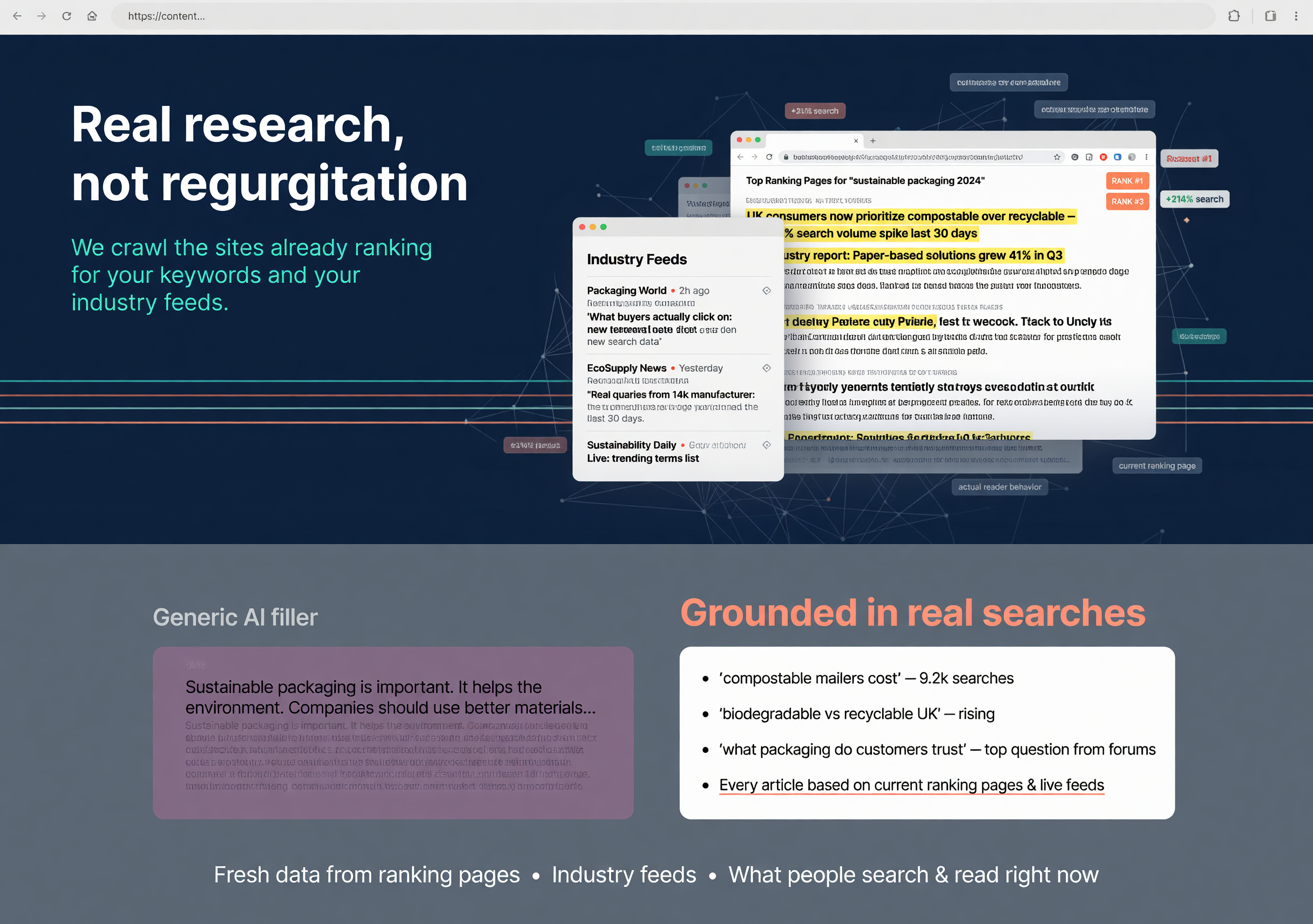
We look at the sites already ranking for your keywords and the news in your industry, so each article answers what people search for right now.

We write every article from scratch in a voice that matches your brand. We learn that voice once, when we set you up.

Each article gets its own hero image, in a style we choose to suit your brand, so your blog stops looking like everyone else's stock photos.
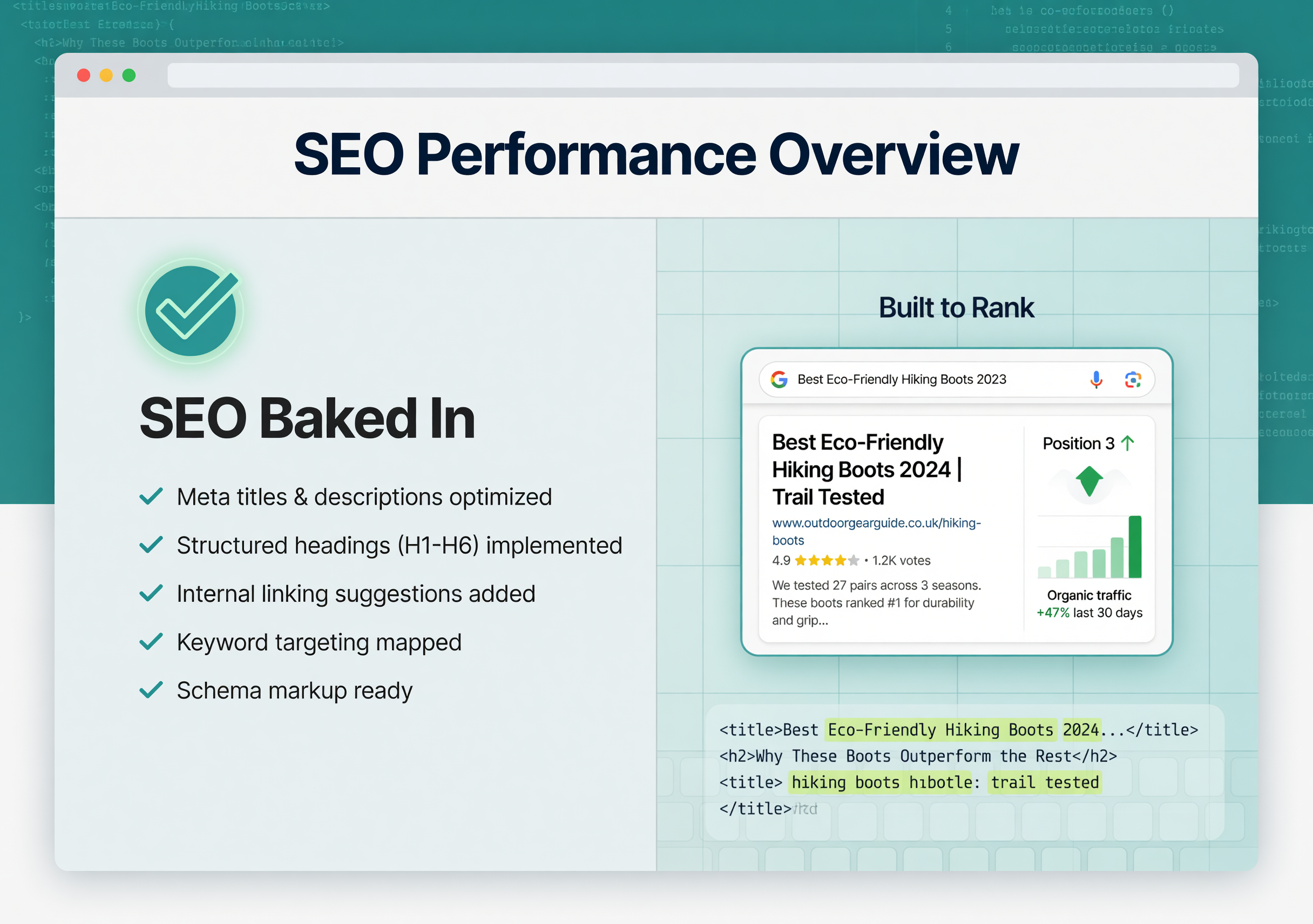
Meta titles and descriptions, proper headings, links to your other pages and the keywords your customers use.

Articles go live on your WordPress site on the schedule we agree, sent straight to it. No copying and pasting, no plugin to install.
Send us your WordPress login and we connect your site, free. If you have no blog page yet, we build one for you.
All of that, done for you every week
Research, writing, custom images and publishing, on the schedule we agree with you. No setup fee and no minimum term.
Pay per article, and the more you have, the less each one costs
All prices include VAT. Each month your first 10 articles are £5.00 each, the next 10 are £4.25 each, and so on down to £1.75 for every article over 50. You pay monthly, with no setup fee.
No setup fee
We connect your website and build a blog page if you need one, at no extra charge.
Cancel any time
There is no minimum term. Tell us and we stop your subscription. Articles already published stay on your site.
Rewrites on us
Not happy with an article or its image? Tell us and we redo it, at no extra cost.
Ready? Choose your articles and see your monthly price as you slide.
Questions people ask before ordering
Get your blog working for you
Fresh articles in your voice, with their own images, published every week. No setup fee, no minimum term, cancel any time.
That is 9 articles a month, about £5.00 each.
Each month your first 10 articles are £5.00 each, the next 10 are £4.25, and so on, so every extra article costs less.
Secure checkout by Stripe