If you’ve been hearing the phrase “answer engine optimisation” and quietly wondering what on earth it means, you’re not alone. Search has shifted considerably in the past couple of years, and keeping up with the jargon can feel like a full-time job when you’re already running a business. This guide cuts through the noise and explains what actually matters for your website.
First, a Quick Recap of Traditional SEO
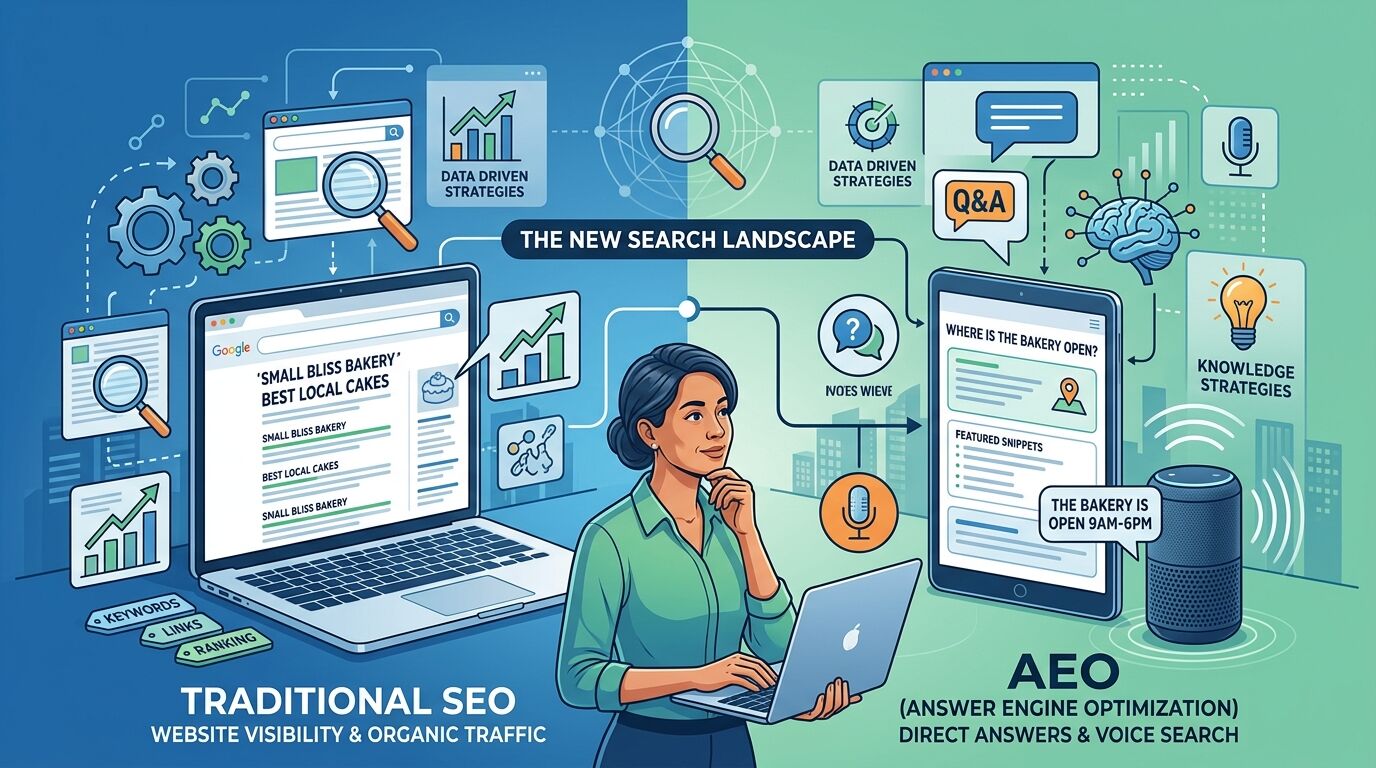
Traditional SEO (search engine optimisation) is the work that helps your website appear in Google’s search results. It covers things like choosing the right keywords, earning links from other websites, writing useful content, and making sure your site loads quickly and works on mobile.
The goal has always been to rank on page one for searches your customers are making. A plumber in Worthing wants to show up when someone types “emergency plumber Worthing” into Google. That’s classic SEO, and it still works.
Traditional SEO is built around the idea that users click a link, visit your website, and hopefully get in touch. The whole system depends on that click happening.
So What Is AEO?
Answer engine optimisation (AEO) is about getting your content quoted or summarised by AI-powered tools rather than just ranked in a list of links. Think of Google’s AI Overviews (those summaries that appear at the top of search results), voice assistants like Siri or Alexa, and tools like ChatGPT or Google’s Gemini.
When someone asks a voice assistant “what’s the best way to clean a blocked drain” or queries an AI chatbot about a local service, those systems pull from content across the web and generate a direct answer. They don’t show ten blue links. They just answer. AEO is the practice of making sure your business is the one being quoted.
The key difference is this: traditional SEO earns you a ranking, while AEO earns you a mention inside someone else’s answer.
Why Does This Matter for Small Businesses?
More people are getting answers without ever clicking a link. Google’s own AI Overviews now appear on a huge proportion of searches, particularly for question-based queries. Voice search has grown steadily, especially for local and on-the-go lookups. And a growing number of people are asking ChatGPT or similar tools for recommendations instead of searching Google at all.
If your business only exists as a ranked page but never appears in an AI-generated answer, you risk becoming invisible to a portion of your audience. That portion is growing. For small businesses competing locally, this is worth paying attention to now rather than scrambling to catch up later.
The good news is that AEO and traditional SEO are not opposites. They share a lot of common ground.
What AEO Actually Looks Like in Practice
You don’t need a completely separate strategy for AEO. What you do need is content that answers questions clearly and directly. AI systems favour content that is:
- Written in plain language, without excessive jargon
- Structured so that questions and answers are easy to identify (FAQ sections work well here)
- Backed by verifiable, accurate information rather than vague claims
- Consistent with information elsewhere on the web, such as your Google Business Profile
Schema markup (a type of code added to your website) also plays a role. It helps search engines and AI tools understand exactly what your content is about, whether that’s your opening hours, your services, or a specific question you’ve answered. A good web developer can add this without you needing to touch any code yourself.
Traditional SEO Still Matters, A Lot
Don’t let the buzz around AEO convince you to abandon the fundamentals. Google still processes billions of searches every day, and the majority of those still produce a list of ranked pages. High rankings still drive clicks and calls for local businesses.
Technical SEO (site speed, mobile-friendliness, security), keyword-targeted content, and a healthy backlink profile all remain essential. If your website has weak foundations, AEO improvements will have limited impact anyway, because AI systems tend to favour content from websites that are already well-regarded.
Think of traditional SEO as building the house, and AEO as making sure the right rooms are signposted clearly for visitors who arrive via a different door.
Where Should You Actually Focus?
For most small business owners, the answer is to do both, but in the right order. Here’s a practical way to think about it:
- Get the foundations right first. If your website is slow, hard to navigate, or missing basic SEO, fix that before anything else. No strategy works on a broken site.
- Build genuinely useful content. Answer the questions your customers actually ask. A solicitor in Brighton might write a clear FAQ about conveyancing fees. A landscaper might explain when to plant certain shrubs. This content serves both traditional SEO and AEO.
- Structure your content clearly. Use headings, short paragraphs, and FAQ sections so that both humans and AI can scan it easily.
- Keep your business information consistent. Your name, address, phone number, and opening hours should match across your website, Google Business Profile, and any directories you’re listed on. AI systems cross-reference this information.
- Ask your web team about schema markup. It’s one of the more technical AEO improvements, but it makes a real difference to how AI tools understand your pages.
The Bigger Picture
Search is not going to snap back to what it was five years ago. AI-generated answers are part of how people find information now, and that’s only going to increase. Businesses that adapt their content to serve both traditional search engines and AI tools will be in a stronger position than those who don’t.
The reassuring part is that the core principle has not changed: create content that is genuinely useful, accurate, and easy to understand. That has always been good SEO. It also happens to be exactly what AI answer engines are looking for.
If you’re unsure where your website currently stands on either front, a simple SEO audit is a good starting point. We work with small businesses across Sussex and the wider UK to make sure their websites are built for visibility, whether that’s on a Google results page or inside an AI-generated answer. Get in touch and we’ll take a look.