If your Google Analytics has looked a little quieter lately, you are not imagining it. AI search tools like ChatGPT, Perplexity, and Google’s AI Overviews are answering more questions directly, without sending users to a website at all. For a small business owner watching their visitor numbers, that can feel alarming.
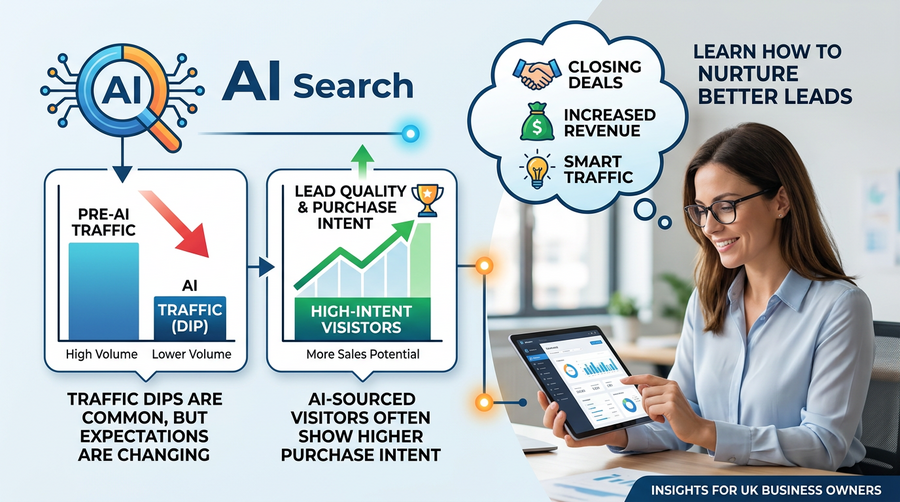
But here is the thing worth knowing: the people who do click through from an AI response are often far more serious about buying than the casual browsers who used to stumble across your site via a generic keyword search. Traffic may be down. Quality is up. And that matters more than most business owners realise.
What AI Search Actually Does to the Buying Journey
Traditional search sent millions of people to websites at every stage of thinking about a purchase. Someone wondering vaguely “what is web design” would land on your page, read a bit, then leave. AI search compresses that early research phase. The tool gives them the basic answer straight away.
What it cannot easily replicate is the specific, trust-building content that helps someone decide which business to actually hire or buy from. By the time a person clicks through to your site from an AI response, they have already done a lot of their thinking. They are not browsing. They are evaluating.
HubSpot’s State of AEO 2026 report found AI search was the number one predictor of purchase intent for software buyers, which is a significant signal. A separate 2026 study by Eight Oh Two Marketing, which surveyed 500 active AI users, found that consumers are now using AI as their first stop in the search journey, reshaping how they find information and make buying decisions. The implication for businesses is straightforward: fewer tyre-kickers, more genuine prospects.
Why Lower Traffic Is Not a Crisis
It helps to reframe the numbers. If your site used to get 1,000 visitors a month and 10 of them made an enquiry, that is a 1% conversion rate. If AI search cuts your traffic to 600 but 12 of those make an enquiry, your conversion rate is now 2%. You have more leads from fewer visits. That is a better business outcome, even if the dashboard looks less impressive.
Google’s AI Overviews now reach two billion monthly users, and AI Mode has rolled out across more than 200 countries. The shift is not a blip. It is the new normal for how people research purchases online. Businesses that adapt to it will do better than those who spend their energy worrying about raw traffic volume.
What These Visitors Expect When They Arrive
This is where many small business websites fall short. AI-referred visitors have already had a surface-level question answered. They arrive expecting depth, credibility, and specificity. A thin landing page with a few bullet points and a contact form will not cut it.
Think about what someone needs to see to feel confident enough to call you or fill in a form. That usually means:
- Clear evidence of experience, including specific projects, named clients, or case studies
- Honest pricing information, or at least a guide to how you charge
- Detailed service pages that answer likely follow-up questions
- Reviews and testimonials that are recent and specific, not generic five-star ratings
- A straightforward way to get in touch, without unnecessary friction
Visitors clicking through from AI responses expect to find substantial, authoritative content rather than basic pages. If your site still looks like a digital brochure from 2015, that is worth fixing now.
How to Make Yourself More Visible in AI Results
Appearing in AI-generated answers is not entirely different from traditional SEO, but the emphasis has shifted. AI tools tend to pull from sources that are seen as clear, trustworthy, and genuinely useful. Thin content optimised purely for keyword stuffing will not perform well.
A few practical things that help:
- Write content that directly answers specific questions your customers actually ask
- Use plain language and clear structure, with proper headings and logical flow
- Build your authority through consistent publishing, whether that is a blog, guides, or FAQs
- Make sure your business details are consistent across your website, Google Business Profile, and any directories
- Earn mentions and links from other credible local or industry sources
The goal is to be the kind of source an AI would confidently cite when someone asks a question in your area of expertise. That starts with having genuinely useful content on your site.
Nurturing the Leads Once They Arrive
Because AI-referred visitors are further along in their thinking, they may not need as much persuasion. But they do need reassurance. Your job is to confirm that their initial impression of you (whatever the AI suggested) is accurate and that you are the right choice for their specific situation.
A clear, fast-loading contact page helps. So does a phone number displayed prominently, not buried in the footer. If you run a service business, a short paragraph explaining exactly what happens after someone gets in touch can remove hesitation. People want to know the next step before they commit to taking it.
If you have a mailing list or a free download, this audience is exactly the kind of prospect worth capturing for a longer nurture sequence. They already know who you are. A well-timed follow-up email with useful information can be the difference between a browsed website and a paying client.
The Bigger Picture for UK Small Businesses
McKinsey’s 2025 global survey found that 79% of organisations now use generative AI, up from just 33% in 2023. AI is not arriving. It is already reshaping how your potential customers research and buy. The businesses that treat this as a problem to resist will be left behind. The ones that see it as a shift in customer behaviour worth understanding will be better placed to grow.
You do not need to overhaul everything at once. Start with your most important service pages. Make sure they are detailed, clear, and written for someone who is genuinely close to making a decision. Then look at how easy it is for that person to take the next step when they land on your site.
Less traffic but better leads is actually a good deal. You just need a website that is ready to handle them.