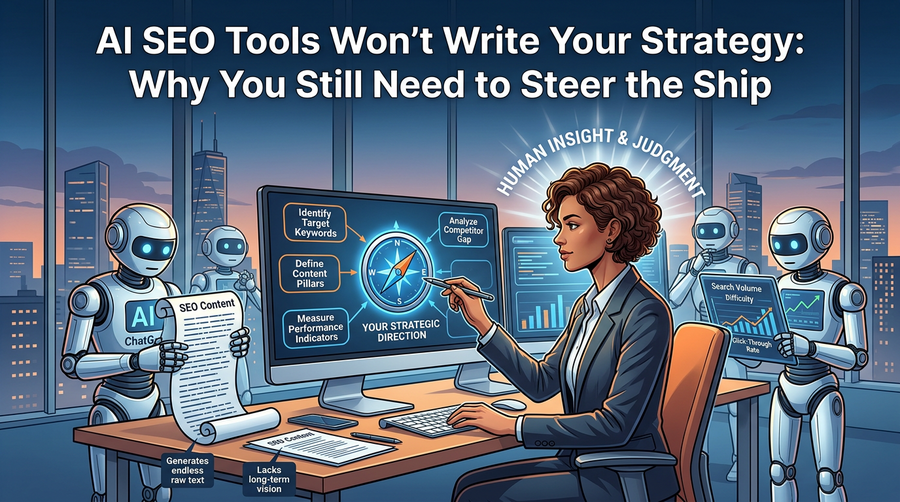
There’s a tempting idea doing the rounds right now: just point an AI tool at your website, let it do its thing, and watch the traffic roll in. If only it were that simple. The reality, as Google’s own engineers have been quietly pointing out, is that AI tools still need very specific instructions to do anything useful for your search rankings.
For small business owners already juggling a hundred things at once, this matters. Misunderstanding what AI can and can’t do with SEO can cost you time, money, and positions on Google that are genuinely hard to claw back.
What ‘Vibe Coding’ Actually Means
‘Vibe coding’ is a phrase that’s been floating around tech circles recently. It describes the practice of giving an AI tool a loose, conversational prompt and trusting it to produce something usable, without writing precise instructions or reviewing the output carefully. Think of it as the digital equivalent of telling a builder to ‘just make it look nice’ and then being surprised when the kitchen ends up pink.
Google’s John Mueller and Martin Splitt have both experimented with this approach when building things with AI assistance. Their conclusion? The tools are genuinely useful, but they do not automatically think about SEO. You have to tell them to. Explicitly, specifically, and repeatedly.
What AI Tools Actually Do Well
To be fair, AI tools have genuinely useful applications in the SEO world. They can save hours on repetitive tasks that used to eat up a freelancer’s entire afternoon. Some solid examples include:
- Drafting meta descriptions for large numbers of pages in one go
- Generating first drafts of blog posts around a keyword you specify
- Suggesting related keywords you might not have thought of
- Formatting structured data markup when given the right inputs
- Checking content for readability and flagging overly complex sentences
These are real time-savers, and if you’re not using them at all, you’re probably working harder than you need to. But notice something about that list: every single task on it requires a human to provide the direction first. The AI doesn’t decide which keywords matter for your business. You do.
The Strategy Gap AI Cannot Fill
Here’s where a lot of small business owners come unstuck. They use an AI tool to generate content or tweak their site, and the output looks polished and professional. But polished and professional is not the same as strategically sound.
SEO strategy involves decisions that require genuine knowledge of your business, your customers, and your market. Which search terms are your potential customers actually using? Are those terms competitive enough that you’d be wasting effort chasing them, or niche enough that you could realistically rank within six months? What does your local competition look like in Worthing or Brighton compared to national players? An AI tool has no idea, unless you tell it, and even then it cannot verify whether the information is current or accurate.
Google’s algorithm doesn’t just look at individual pages in isolation. It looks at your whole site’s authority, your backlink profile, how long people spend on your pages, and dozens of other signals that take time and deliberate effort to improve. No AI tool generates backlinks for you, builds relationships with local directories, or spots that your contact page is mysteriously not being indexed.
The Real Risk of Handing Over the Wheel
When small business owners treat AI as a fully autonomous SEO manager, a few predictable problems tend to crop up:
- Keyword stuffing by accident. AI tools sometimes repeat target phrases more than is natural, especially if you give them a keyword and ask them to write around it without guidance on density.
- Generic content that ranks for nothing. Without specific direction, AI tends toward the broad and the obvious, which means your content competes with thousands of nearly identical pages.
- Technical issues that get ignored. AI content tools don’t audit your site speed, flag broken links, or notice that your images are missing alt text. Those problems quietly drag your rankings down.
- Wrong audience targeting. A tool doesn’t know whether your customers are mostly local homeowners or national procurement managers. It will write for whoever you tell it to, but you have to know that yourself first.
How to Use AI as a Useful Assistant, Not a Replacement
The right way to think about AI in your SEO workflow is as a capable assistant who needs clear briefs. A good assistant speeds up execution. They don’t set the agenda.
Before you ask any AI tool to help with SEO, make sure you have answers to these questions yourself:
- Which three to five pages on your site are most important for generating leads or sales?
- What are the specific search terms your ideal customer would type into Google?
- What makes your business genuinely different from competitors in your area?
- What action do you want visitors to take when they land on each page?
Once you can answer those clearly, you can give an AI tool the kind of specific prompt that actually produces useful output. ‘Write a 400-word service page for a Worthing-based plumber targeting emergency boiler repairs, aimed at homeowners aged 35 to 60, with a call to action to phone us’ will get you something far more usable than ‘write a plumber page’.
Strategy Is Still a Human Job
None of this means you should avoid AI tools. Used well, they are a genuine productivity boost for small business owners who can’t afford a full marketing team. But they work best when a real person, whether that’s you or an agency you trust, has already done the thinking.
If you’re not sure where your SEO strategy stands right now, that’s often the best place to start. A proper audit of your current rankings, your site’s technical health, and your competitors’ visibility will tell you far more than any AI-generated content ever could. From there, you can use tools intelligently, with a clear destination in mind, rather than just vibing and hoping for the best.