If you have been following tech news lately, you might have seen headlines suggesting AI is about to replace web designers entirely. It is an understandable worry, especially if you are a small business owner trying to decide whether to invest in professional web design or just let a chatbot do it for you. The short answer? AI is a useful tool, not a replacement for the thinking that makes a website genuinely effective.
What AI Can Actually Do in Web Design
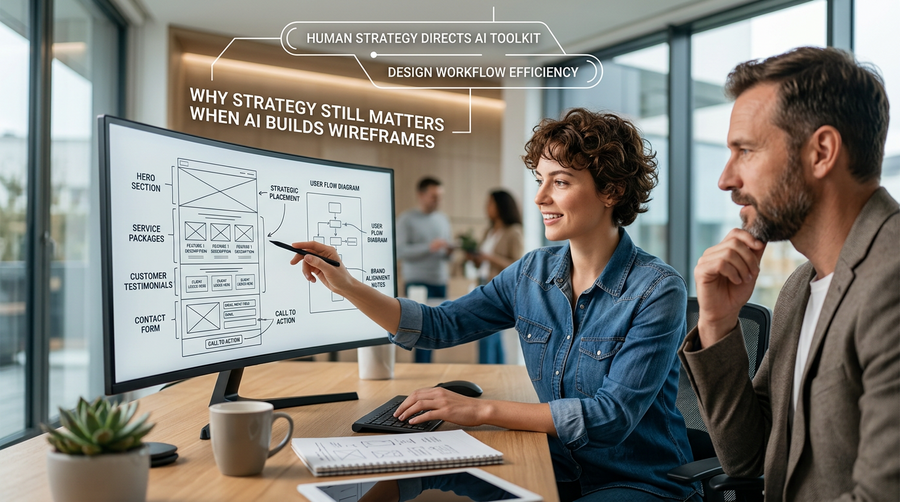
Modern AI tools are genuinely impressive. Platforms like Figma’s AI features, Uizard, and Framer can generate layout suggestions, colour palettes, and basic wireframes based on a text prompt. Feed one of these tools a sentence like “homepage for a local plumber in Worthing” and it will spit out something that looks reasonable within seconds.
That speed is not nothing. It saves time on early drafts and helps designers explore ideas more quickly. But generating a wireframe is a bit like generating a building floor plan without knowing how many people will use the building, what they will do inside it, or whether the client wants a shop, a surgery, or a storage unit.
The Part AI Cannot Do: Understanding Your Business
A website is not just a collection of pages. It is a tool designed to do a specific job, usually to convert visitors into enquiries, bookings, or sales. Doing that job well requires answers to questions that no AI can pull out of thin air.
- Who are your ideal customers, and what do they actually want when they land on your site?
- What makes your business different from the three competitors who show up alongside you in Google results?
- What action do you most want a visitor to take, and where in their journey are they likely to take it?
- Are there trust barriers specific to your industry that the design needs to address?
These are not technical questions. They are strategic ones. Getting them right is what separates a website that sits there looking pretty from one that actually brings in work.
Strategy Is Where the Real Value Lives
Think about what goes into a well-built website for a small business. Yes, there is the visual design. But before a single pixel is placed, an experienced designer is thinking about site structure, user journeys, calls to action, page load speed, mobile behaviour, and how the whole thing will perform in search results. None of that comes from a prompt.
A good web designer working with a local tradesperson, say a bathroom fitter in West Sussex, knows that most visitors will arrive via mobile after a quick Google search. They know that person is probably comparing three or four businesses and will decide in under thirty seconds whether to stay or leave. The design needs to answer their questions fast, build trust quickly, and make it ridiculously easy to get in touch. An AI tool has no idea about any of that context unless a human feeds it in.
AI as a Useful Assistant, Not the Decision Maker
The most accurate way to think about AI in web design right now is as a capable but junior assistant. It can draft things, suggest options, and speed up repetitive tasks. But it needs directing. Someone still has to define the brief, evaluate the output, spot what is wrong, and make the calls that affect whether the site performs well or not.
Professional designers are already using AI tools to work more efficiently. That is a good thing. It means more time can go into the strategic thinking, the conversations with clients, and the refinement that actually moves the needle. The role has shifted, but it has not disappeared. If anything, the thinking that humans bring to the table has become more important, not less.
What Happens When You Skip the Strategy
There is no shortage of businesses that have tried to cut corners with website builders and template tools, which are essentially a less sophisticated version of what AI now offers. The results are predictable. Sites that look fine but rank poorly. Pages that confuse visitors rather than guiding them. Homepages that talk about the business instead of talking to the customer.
A website built without strategic input tends to reflect what the business owner thinks is important rather than what a potential customer needs to see. Those two things are rarely the same, and the gap between them is exactly where leads get lost.
What You Should Actually Be Asking
Instead of worrying about whether AI will replace your web designer, it is worth asking better questions before your next website project.
- Does the person or agency designing my site understand my customers, not just my industry?
- Are they thinking about what happens after launch, including SEO, ongoing updates, and performance?
- Can they explain why they are making the design choices they are making?
- Are they treating the website as a business tool or just as something that needs to look good in a portfolio?
If you are getting clear, confident answers to those questions, you are talking to someone who brings genuine value. AI tools in the background of their workflow are a bonus, not a threat.
The Bottom Line for Small Business Owners
AI is changing how web designers work, but it is not changing what a good website needs to do for your business. You still need someone who understands your goals, your customers, and the competitive landscape you are operating in. Someone who can make strategic decisions, not just generate outputs.
The smartest thing AI has done for small business owners is make it clearer than ever that the real value in web design was never about pushing pixels around. It was always about the thinking behind those decisions. And that, for now, is still very much a human job.
If you want a website that works as hard as you do, get in touch with the team at Samson Web Design. We have been helping small businesses across West Sussex and beyond get results online since 2006.