A tradesperson in Worthing spends £400 a month on Google Ads, gets clicks, and wonders why the phone isn't ringing. The landing page they're sending traffic to is the homepage, which loads slowly on mobile, mentions their services in general terms, and has no clear call to action. The ad spend is burning, but the rest of the setup hasn't kept pace. This is one of the most common and most avoidable situations in small business digital marketing, and it almost always comes down to the same root cause: channels running in isolation.
Why Running Channels in Silos Is Quietly Costing You Money
A silo, in this context, is when each marketing channel has its own budget, its own person managing it, and no shared goal tying it to the others. The result is that channels end up competing rather than complementing each other. Your SEO agency is chasing different keywords from the ones your PPC campaign is bidding on. Your social media posts point to a different part of the website from your email campaigns. Nothing is pulling in the same direction.
The tradesperson example above is a textbook silo problem. The Google Ad is doing its job: it puts the business on page one for a relevant search. But the landing page, which should be the continuation of that ad's promise, hasn't been optimised for those keywords. The visitor arrives, doesn't immediately see what they came for, and leaves within seconds. The click cost is lost. Multiply that across hundreds of clicks a month and you have a serious leak.
To put real numbers on it: if the average cost-per-click for a local trades search term is £2.50 and your landing page bounce rate is 70%, you are paying for roughly 280 wasted clicks out of every 400. At £2.50 each, that is £700 a month in lost spend before a single enquiry is generated. Fix the landing page and drop the bounce rate to 40%, which is achievable with the right page structure, and you recover roughly £300 in effective value from the same £400 budget without changing the ad itself.
Research published by MDPI on SME digital marketing finds that scarce resources are amplified as a problem when channels are not coordinated. Small businesses already have less budget and fewer people than larger competitors. When the budget that does exist is split across disconnected efforts, every pound works less hard than it should. Coordination is not just a nice-to-have: it is how businesses with limited resources close the gap on better-funded rivals.
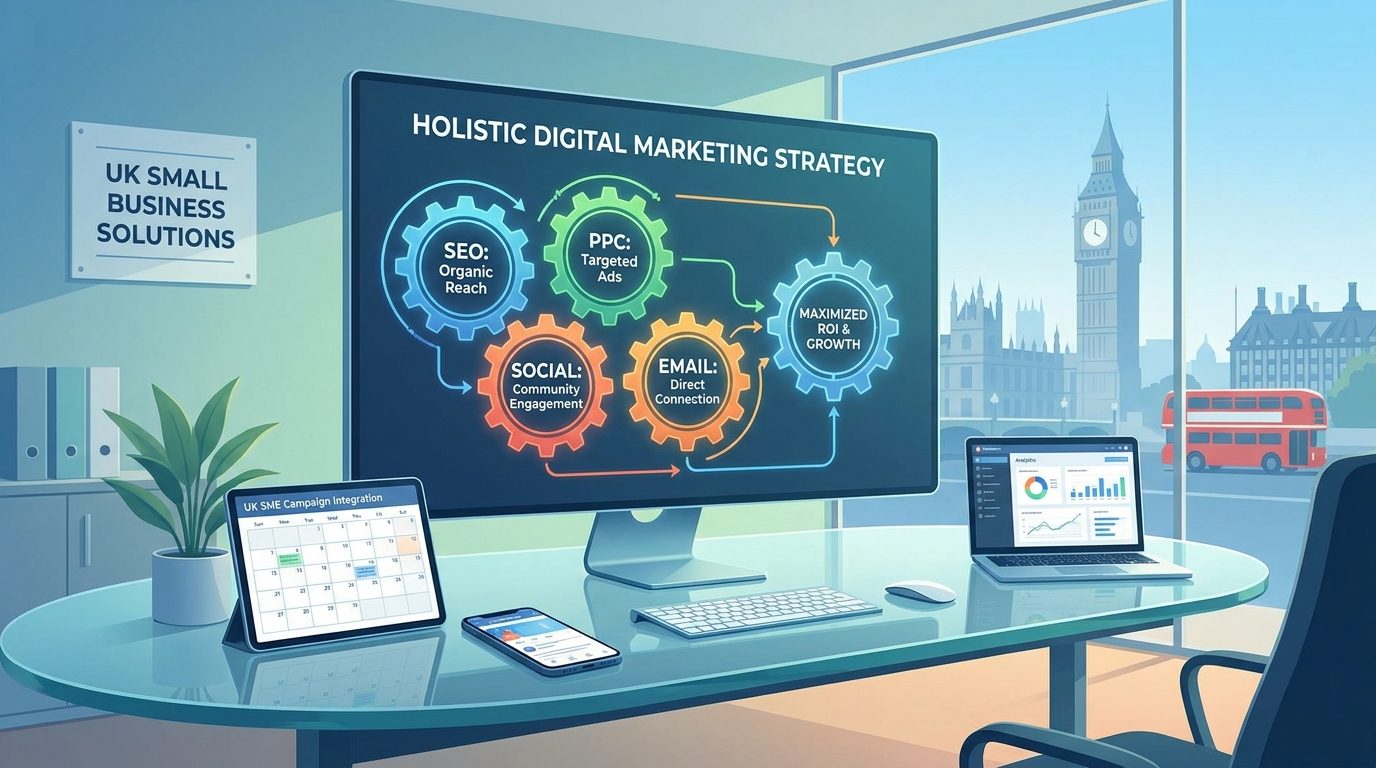
The integrated model treats SEO, PPC, social media, and email as interconnected gears rather than separate engines. Data from one channel informs decisions in another. The keywords your PPC campaign proves convert well become the focus of your next SEO push. The email subject line that gets a 40% open rate becomes your next ad headline. Everything talks to everything else.
Most UK small businesses start with a single channel because it feels manageable. One thing to learn, one invoice to pay, one metric to watch. That instinct is understandable. But what this article will show, step by step, is that adding channels in a joined-up way actually simplifies decisions rather than complicating them, because each new channel starts to answer questions the first one couldn't.
What Each Channel Does Best (and Cannot Do Alone)
Understanding what each channel is genuinely good at, and where it runs out of road, is the foundation of any integrated strategy. Most of the confusion about digital marketing comes from expecting a channel to do something it was never designed to do.
SEO: the long game
SEO builds compounding organic visibility, but it does so slowly. A realistic timeline for a new or under-optimised website to reach page one for competitive local terms is three to six months, sometimes longer. That makes it a long-term asset rather than a quick fix. The upside is that once rankings are established, the traffic they generate doesn't stop the moment you stop paying, which is a meaningfully different dynamic from every other channel on this list.
What SEO cannot do is generate traffic on day one. It also cannot tell you in advance, with any certainty, which specific keywords will actually lead to enquiries rather than just visits. You can make educated guesses using tools like Google Search Console or Ahrefs, but proving that a keyword converts requires real traffic data. A term like 'boiler installation Worthing' might attract 200 visits a month and produce no enquiries, while 'emergency boiler repair Worthing' attracts 40 visits and produces 12 calls. Volume is not the same as value, and SEO alone cannot distinguish the two without a conversion tracking layer underneath it.
PPC: the proof engine
Google Ads provides immediate page-one presence for exact search terms, often within hours of a campaign going live. That speed makes it ideal for testing whether a keyword actually converts before you commit SEO budget and effort to building content around it. If you run a PPC campaign for 'emergency boiler repair Worthing' and it produces enquiries at a sensible cost, that's a signal worth taking seriously when planning your organic content strategy.
The critical weakness of PPC is that it stops the moment the budget stops. There is no residual value. The day you pause the campaign, the traffic disappears. It is also increasingly expensive in competitive service sectors, where cost-per-click for local trades keywords can run to several pounds per click. In some markets, such as emergency locksmiths or personal injury solicitors, clicks can exceed £15 to £20 each. At that price, even a modest bounce rate becomes a significant financial event.
Social media: familiarity over time
Platforms like Facebook, Instagram, and LinkedIn are not primarily conversion channels for most small service businesses. Their real strength is building brand familiarity and trust signals over time. Someone who has seen your content a dozen times before they need your service is far more likely to choose you over a business they've never encountered. That's valuable, but it's a different kind of value from a search click.
The limitation is that organic social reach is throttled by platform algorithms, particularly on Facebook, where organic reach for business pages has declined sharply over the past decade. You can work around this with paid social, but that adds budget. And even with paid social, direct conversion rates tend to be lower than search intent channels, because the person seeing your ad wasn't necessarily looking for what you offer at that moment.
Email: the highest ROI channel nobody is feeding
Email marketing consistently outperforms other channels on return on investment. Industry benchmarks, widely cited across the sector, put the average email marketing ROI at around 36 to 1. For every pound spent, the average return is £36. That's a compelling number, and it holds up in practice for businesses that use email well.
The catch is that email requires an existing list. It cannot generate cold leads on its own. If you have no subscribers, email marketing does nothing. This is the most commonly overlooked dependency in small business digital marketing: the channel with the best ROI is entirely dependent on other channels to fill its pipeline with contacts in the first place. A practical starting point is a simple lead magnet, a one-page seasonal maintenance checklist, a free quote template, or a short guide relevant to your trade, placed on the pages of your site that receive the most organic or paid traffic. Even a 2% conversion rate on 500 monthly visitors adds 10 new subscribers a month, which compounds meaningfully over a year.
The single point of failure
Put these gaps together and a pattern emerges. SEO cannot retarget someone who visited your site yesterday and didn't enquire. PPC stops the moment your budget runs out. Social reach is at the mercy of an algorithm you don't control. Email only reaches people who already know you exist. A UK small business relying on any one of these channels in isolation is always exposed to a single point of failure, and that exposure is the exact problem that integration solves.
The Integration Loop: How the Four Channels Feed Each Other
Integration is not just a strategic principle. It is a practical sequence of actions where the output of one channel becomes the input for another. Understanding the loop makes it concrete enough to actually implement.
Start with the website as the hub
Before any channel can integrate effectively, the website has to be in order. Research from Walden University on SME digital strategies stresses that a mobile-friendly transactional website must sit at the centre of every integrated strategy, because every channel ultimately drives traffic there. If the hub is broken, slow, or hard to use on a phone, every channel feeding into it is wasting effort. Fix the website first. That means fast load times, clear calls to action on every relevant page, and a contact or booking mechanism that actually works on mobile.
A useful benchmark: Google's own data suggests that a mobile page taking longer than three seconds to load loses more than half its visitors before they see a single word of content. You can check your own load time for free using Google PageSpeed Insights, which also tells you exactly which elements are slowing the page down. If the score is below 70 on mobile, address that before spending another pound on any traffic channel.
Use PPC data to direct SEO effort
Once the website is solid, PPC becomes your research tool. Run ads for the terms you think matter most to your customers. Within a few weeks, you will have real data on which search terms generate clicks, which clicks convert to enquiries, and at what cost. That data is far more valuable than any keyword research tool estimate, because it reflects actual buyer behaviour on your actual website.
Take the converting keywords from your PPC campaigns and build dedicated SEO content around them. This cuts wasted SEO effort dramatically. Instead of spending months optimising for terms that attract traffic but no business, you focus on proven demand. PPC essentially pays for the market research that makes your SEO strategy accurate from the outset.
Turn SEO content into social fuel
Blog content written for SEO purposes doesn't need to live only on your website. A 1,000-word article about 'signs your boiler needs servicing before winter' can be broken into five separate social media posts, each covering one point from the article with a link back to the full piece. This repurposing generates engagement signals, shares, and comments that indirectly support organic rankings by demonstrating that the content is useful. It also keeps your social channels active without requiring you to create entirely separate content for each platform.
The edge case that trips people up here is posting the full article text directly to social platforms rather than a short excerpt with a link back to the website. When you post the complete content on Facebook or LinkedIn, the platform has no reason to send users anywhere else, and your website gets no traffic benefit. Always drive the click back to the page itself.
Capture and nurture with email
Visitors who arrive via SEO or PPC but don't enquire immediately are not lost. If you have an email capture mechanism on the site, such as a free guide download, a quote request form, or a newsletter sign-up with a clear incentive, those visitors can be added to an email nurture sequence. Over several weeks, a sequence of useful, relevant emails can move a cold visitor to a warm lead without you paying for a second ad click. This is one of the clearest financial wins in integrated marketing: the first click costs money, but the follow-up is essentially free.
Tools like Mailchimp, Brevo (formerly Sendinblue), or ActiveCampaign all offer automation features that handle this sequencing without manual effort once set up. A basic three-email welcome sequence, sent over 10 days, is enough to establish familiarity and prompt a percentage of new subscribers to make contact. The setup time is a few hours. The ongoing cost at small list sizes is often zero or close to it, as most platforms have a free tier covering lists under 500 to 1,000 contacts.
Mine email data for ad copy
Email campaigns generate their own intelligence. When you send a campaign and one subject line achieves a 45% open rate while another achieves 18%, that difference tells you something important about what your audience responds to. The language, the offer, the urgency in the high-performing subject line can be transplanted directly into PPC ad copy. You are no longer guessing at what makes people click; you have tested it on your own audience and have the numbers to prove it.
A worked example: one click, four channels
Consider a Worthing-based plumber running a Google Ad for 'emergency boiler repair Worthing'. The click lands on a dedicated landing page that is fast, mobile-friendly, and has a prominent call and a contact form. At the bottom of the thank-you page after an enquiry, there is an option to receive a free boiler maintenance checklist by email. The visitor signs up. In October, the plumber's email tool sends that subscriber a seasonal boiler service reminder with a booking link. Some subscribers open it and book. Others don't open it. Those non-openers are uploaded as a custom audience to Facebook Ads, where they see a retargeting ad offering a discounted service check before winter.
That entire sequence started from one paid click. The email capture was free. The Facebook retargeting audience cost nothing to build. The seasonal email cost pence to send. Each subsequent touchpoint reduced the effective cost-per-acquisition of the original paid click, because the revenue it eventually generated was spread across a customer journey that multiple channels contributed to. If the original click cost £3 and the customer eventually books a £180 boiler service, the marketing cost for that job is £3 plus a few pence in email send costs. Without the integration, the same customer might have clicked, not called immediately, and been lost entirely, turning that £3 click into a pure write-off. This is what the integration loop means in practice: each channel, over time, reduces the cost of every other channel in the mix.