There was a time when a small business could get by with a decent website and a few backlinks. Search engines were fairly easy to game, and you didn’t need a joined-up strategy to rank reasonably well. Those days are over.
AI-powered search tools, including Google’s AI Overviews and emerging platforms like Perplexity and ChatGPT search, are drawing on a much wider set of signals. They’re not just reading your website. They’re reading everything: your social profiles, your review history, your content across the web, your consistency. And if those signals don’t add up to a coherent picture of your business, you’re going to lose ground to competitors who’ve done the work.
What We Mean By Fragmented Marketing
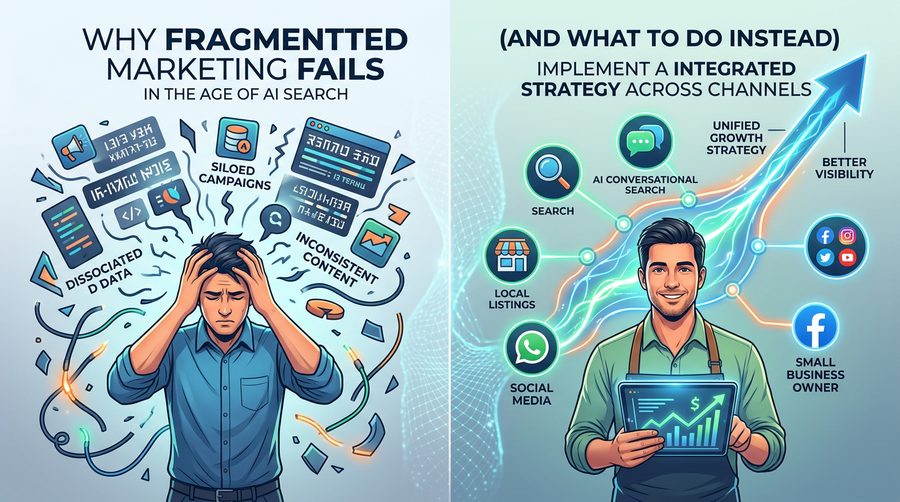
Fragmented marketing is when different parts of your online presence are telling slightly different stories, or when some parts barely exist at all. It’s surprisingly common among small businesses, and it’s not always obvious from the inside.
Some signs you might recognise:
- Your website talks about services you no longer offer, or misses ones you’ve added
- Your Google Business Profile hasn’t been touched in two years
- Your Facebook page is active but your Instagram account has three posts from 2021
- You’ve never asked a customer for a review, so you have two on Google and forty on a directory nobody reads
- Your email newsletter goes out four times a year when someone remembers to write it
None of these things are disasters on their own. But together, they paint a picture of a business that isn’t really paying attention. And AI search is very good at spotting that.
How AI Search Reads Your Business
Traditional search engines ranked pages. AI search tries to understand entities, meaning it builds a model of who you are, what you do, where you operate, and whether sources across the web agree about you. It’s closer to the way a person would research a business before hiring them.
Think about how you’d check out a local tradesperson. You’d look at their website, check their Google reviews, maybe glance at their social media, see if they’ve been mentioned anywhere. If the pieces fit together, you feel confident. If the website looks great but there are no reviews and no activity anywhere else, you start to wonder.
AI search works on similar logic, just at scale and at speed. A business with a consistent name, address, and phone number across directories, a steady stream of reviews, regular content on their website, and active social profiles sends strong, coherent signals. A business where each channel tells a slightly different story sends weak ones.
The Channels That Actually Matter
You don’t need to be everywhere. You need to be present and consistent in the places that are relevant to your business and your customers. For most UK small businesses, that means:
- Your website: Up to date, fast, mobile-friendly, and clearly describing what you do and where you do it
- Google Business Profile: Claimed, verified, and actively maintained with posts, photos, and responses to reviews
- Online directories: Consistent name, address, and phone number on Yell, Yelp, Bing Places, Apple Maps, and any industry-specific directories
- Reviews: A steady trickle of genuine reviews on Google, with responses from the business owner
- Social media: One or two platforms you actually use, not five you’ve abandoned
- Content: Regular blog posts, case studies, or updates that show expertise in your field
The key word is consistency. The same business name everywhere. The same services described the same way. The same location details. AI search correlates all of this, and inconsistencies create friction.
A Practical Way to Audit Your Own Presence
You don’t need a marketing degree to spot the gaps. Spend an hour doing what a potential customer would do.
- Google your business name and see what comes up. Are the top results accurate and up to date?
- Check your Google Business Profile as if you were a stranger. Is all the information correct?
- Search for the services you offer in your local area. Does your business appear? If not, who does?
- Look at your most recent website update. If it was more than six months ago, search engines may see your site as stale.
- Count your Google reviews. If you have fewer than ten, that’s worth addressing through a simple follow-up email to past customers.
Write down what you find. Even a rough list of gaps gives you something to work on, and tackling them one at a time is far better than leaving them all unaddressed.
Why This Matters More Than It Did a Year Ago
The shift toward AI-generated answers in search results means more users are getting summaries rather than clicking through to ten blue links. If an AI is going to include your business in a recommendation, it needs to feel confident about who you are. That confidence comes from finding the same, credible story about you in multiple places.
Businesses that have built that consistency, even without thinking of it as an AI strategy, are going to benefit. Businesses that have coasted on a single well-ranking page are going to find things getting harder.
This isn’t a reason to panic. It’s a reason to treat your marketing presence as a whole thing rather than a collection of separate jobs. Your website, your social media, your reviews, your local listings: they’re not independent. They work together, and they need to tell the same story.
Where to Start If This All Feels Overwhelming
Pick one thing and fix it properly. If your Google Business Profile is out of date, update it today. If you have no recent blog content, write one short, useful article this week about something your customers regularly ask you. If your directory listings have the wrong phone number, correct them.
Small, consistent improvements compound over time. The goal isn’t perfection, it’s coherence. A business with a complete, consistent presence across even a handful of channels will outperform one with a brilliant website and nothing else backing it up.
If you’d like a hand working out where your biggest gaps are, or you want someone to manage the whole picture for you, get in touch with the team at Samson Web Design. We work with small businesses across West Sussex and the UK, and this is exactly the kind of thing we help with every day.