If you run Google Ads for your business, you have probably noticed that the platform never stays still for long. Google has just rolled out a set of meaningful updates to how campaigns bid and spend, and for once, these changes are genuinely worth paying attention to rather than ignoring until something breaks.
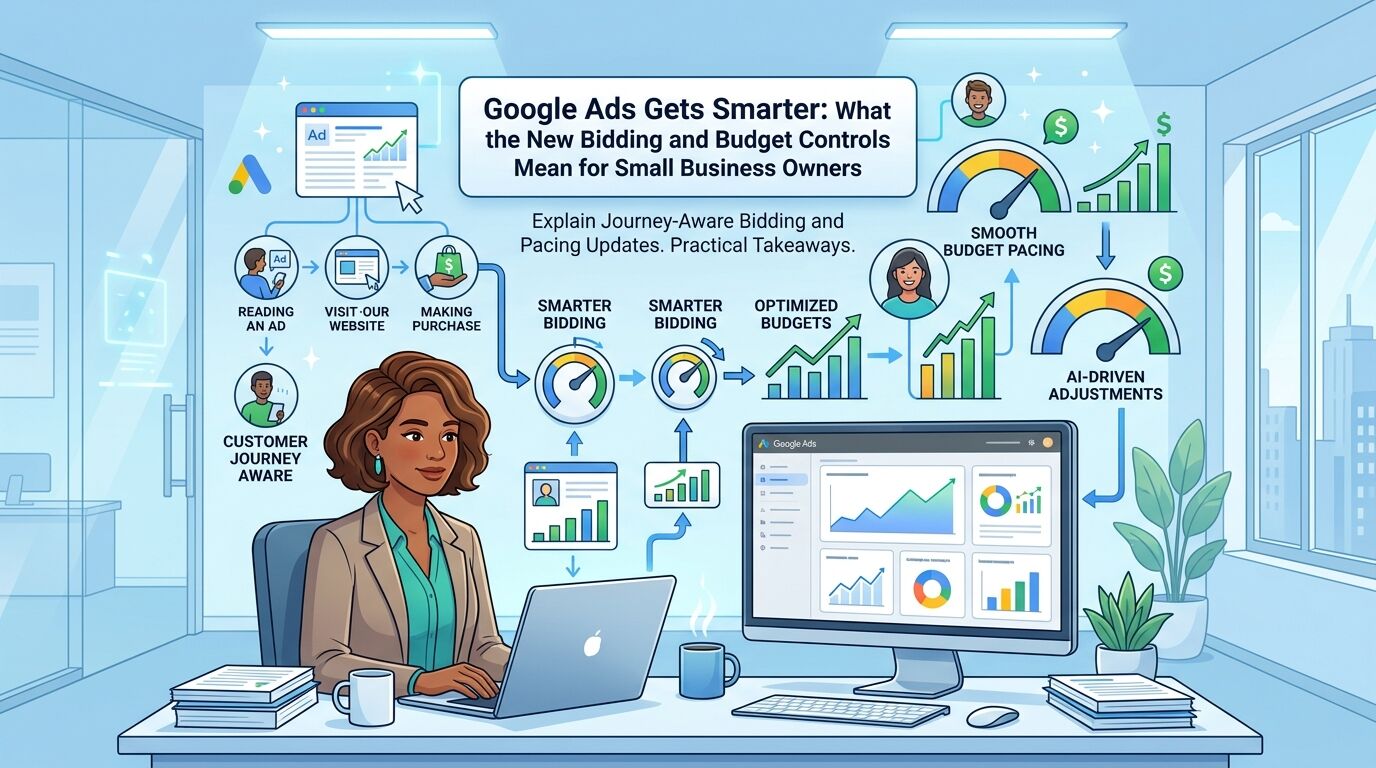
The headline features are journey-aware bidding, an expansion of Smart Bidding Exploration, and new budget pacing controls across Search, Shopping, and Performance Max campaigns. Let us break down what each of these actually means in plain English.
What Is Journey-Aware Bidding?
Traditional bidding in Google Ads looks at a single moment in time. When someone searches for, say, “plumber in Worthing”, the system calculates a bid based on signals like their device, location, and time of day. That is a fairly flat picture of a potentially complex situation.
Journey-aware bidding changes this by factoring in the user’s broader search history leading up to that moment. If someone has spent the past week searching for plumbing advice, comparing tradespeople, and reading reviews, Google now recognises that this person is further along in their decision-making. The system can then adjust your bid upward because this user is more likely to convert.
In practical terms, this means your budget should work harder. You are more likely to win impressions from people who are actually ready to pick up the phone or fill in a contact form, rather than those who are still casually browsing.
Smart Bidding Exploration: More Reach Without Losing Control
Smart Bidding Exploration has been around in a limited form, but Google is now expanding it more broadly. The idea is that automated bidding occasionally tries slightly riskier auctions, ones where the conversion probability is lower than usual, in order to gather data and find new pockets of demand you might otherwise miss.
Think of it like a cautious scout. It ventures into territory outside your usual comfort zone, tests the water, and reports back. If those riskier bids produce conversions at an acceptable cost, the algorithm learns and adjusts. If they do not, the system pulls back.
For small businesses with tighter budgets, this can feel unsettling. The key thing to understand is that Google builds guardrails into this process. Your target CPA (cost per acquisition) or target ROAS (return on ad spend) still anchors the strategy. The exploration happens within those boundaries rather than ignoring them entirely.
Budget Pacing Controls: Spending More Evenly Throughout the Day
Budget pacing is one of those behind-the-scenes mechanics that has a surprisingly big impact on results. In the past, campaigns could burn through a large chunk of their daily budget in the morning, leaving little left to compete during peak afternoon or evening hours.
The new pacing controls give advertisers more say over how their budget is distributed across the day. For Search and Shopping campaigns, you can now guide the system toward more consistent spending patterns. Performance Max campaigns are also getting updated pacing logic that better accounts for conversion lag, which is the delay between someone clicking your ad and actually completing a purchase or enquiry.
If you are a local business, this matters a lot. A solicitor’s practice, a restaurant, or a home improvement company often sees very different conversion behaviour at 9am compared to 7pm. Better pacing means you are not left with no budget precisely when your best customers are searching.
What Should Small Business Owners Actually Do?
These updates mostly happen automatically if you are already using Smart Bidding strategies like Target CPA or Maximise Conversions. But there are a few sensible steps worth taking to make sure you get the most from them.
- Check your conversion tracking is accurate. Journey-aware bidding is only as good as the conversion data feeding into it. If your contact form submissions or phone call clicks are not being tracked properly, the system is flying blind.
- Review your target CPA or ROAS targets. If these are set too aggressively tight, the system will have very little room to explore or pace effectively. A small adjustment can unlock significantly better performance.
- Look at your hourly performance data in Google Ads reports. Go to Campaigns, click the time segment breakdown, and see when your conversions actually happen. This gives you useful context for how pacing changes might affect you.
- Give campaigns time to settle. After any significant change from Google, Smart Bidding needs a learning period of roughly one to two weeks. Resist the urge to make multiple changes during this window.
- If you use Performance Max, audit your asset groups. Better pacing logic only helps if your ads are actually good. Weak headlines, vague descriptions, or low-quality images will still drag performance down regardless of how clever the bidding gets.
The Bigger Picture for Small Business PPC
Google is clearly pushing toward a future where more of the decision-making is automated. For small businesses without a dedicated marketing team, that can actually be a good thing. You do not need to manually adjust bids by the hour or obsess over keyword match types quite as much as you once did.
The trade-off is that you need to be feeding the machine well. Good conversion tracking, realistic targets, strong ad creative, and a well-structured campaign are all more important than ever. Automation amplifies what is already there, both the good and the bad.
If you are not sure whether your Google Ads account is set up to take advantage of these newer features, it is worth getting a professional review. Small structural issues, things like missing conversion actions or poorly grouped ad sets, can quietly cost you a significant amount of money month after month.
At Samson Web Design, we manage PPC campaigns for small businesses across West Sussex and beyond. If you want a second pair of eyes on your Google Ads account, get in touch and we will take a look.