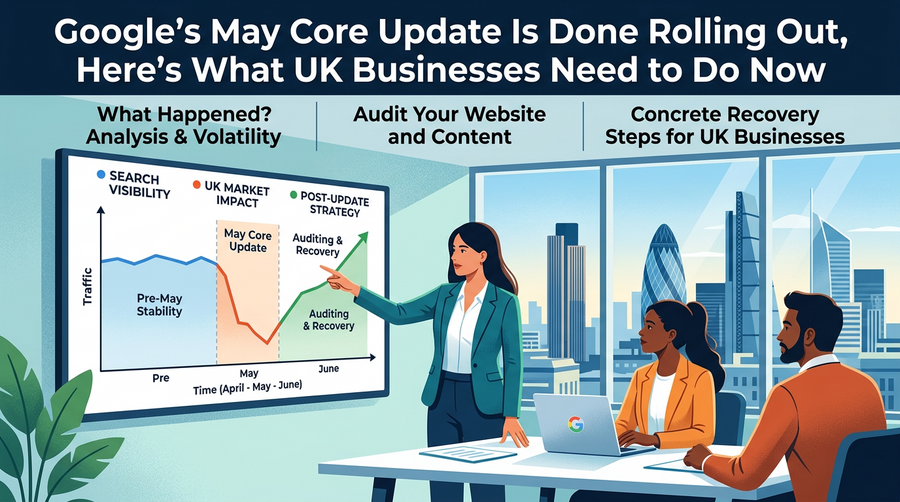
If you’ve checked Google Search Console recently and noticed your rankings have shifted, you’re not imagining it. Google’s May 2026 core update finished rolling out after roughly 12 days, and SEO professionals across the industry described it as heavier than the March update. Some sites saw significant drops; others gained ground. Either way, if your organic traffic looks different right now, this update is almost certainly why.
Google handles over 89% of web searches globally, according to Statcounter, so even a modest ranking drop can hit your enquiries and sales in a very real way. The good news is that core updates are not punishments. They are recalibrations of how Google assesses quality, and that means you can respond constructively.
What a Core Update Actually Does
Google runs core updates several times a year to improve how its algorithm ranks content. Unlike a spam penalty, a core update does not target specific rule violations. Instead, it adjusts the weight Google gives to various quality signals across its entire index. Pages that were ranking well might slip if Google now considers other pages more relevant or trustworthy. Pages that were underperforming might rise.
The volatility you see in the days during a rollout is normal. Rankings can bounce around before settling. The May update took around 12 days to fully roll out, so if your rankings felt unstable for two weeks, that is exactly what was happening behind the scenes.
How to Tell If You Were Affected
The first step is to get the data in front of you before you do anything else. Log in to Google Search Console and pull up the Performance report. Compare the last 28 days against the same period before the update started. Look at:
- Total clicks and impressions
- Average position for your key pages
- Which specific pages or queries have dropped most
Google Analytics will tell you whether the traffic drop corresponds to a drop in organic sessions specifically, which confirms the update is the cause rather than a seasonal dip or a technical issue. If you use a rank tracking tool like SE Ranking, Ahrefs, or Semrush, check those too. You want to know which pages fell and from what positions.
Audit Your Content Honestly
Once you know which pages took the biggest hits, you need to look at them with fresh eyes. Google’s core updates consistently reward content that is genuinely helpful, accurate, and written with a specific audience in mind. Ask yourself these questions about each affected page:
- Does this page actually answer the question a searcher would have when they land on it?
- Is the information accurate and up to date?
- Does it demonstrate real expertise, or is it thin filler content?
- Would someone trust this page, or does it look unpolished and rushed?
Thin pages, those with under 300 words that say very little, are particularly vulnerable in core updates. If you have lots of them, consider whether they can be improved, combined with related pages, or removed altogether. A smaller site with stronger pages consistently outperforms a larger site full of weak ones.
Check Your E-E-A-T Signals
Google talks a lot about E-E-A-T, which stands for Experience, Expertise, Authoritativeness, and Trustworthiness. For a small UK business, this is not as complicated as it sounds. It basically means: does your website give people good reason to trust you?
Practical things you can do right now include:
- Make sure your About page clearly explains who you are, how long you have been trading, and what you specialise in
- Add author names and brief bios to any blog posts or articles
- Display contact details prominently, including a physical address if you have one
- Make sure your Google Business Profile is complete and up to date
- Gather and display genuine customer reviews, whether on Google, Trustpilot, or directly on your site
These signals matter because Google’s quality raters, real humans who assess search quality, use criteria around trust and authority when evaluating sites. The update may have shifted how much weight those signals carry.
Look at Your Technical Foundations
Core updates sometimes expose technical weaknesses that were always there but not previously costing you rankings. While you are in audit mode, it is worth running a quick check on:
- Page speed, particularly on mobile (use Google’s PageSpeed Insights for a free report)
- Mobile usability via the Mobile-Friendly Test or Search Console’s Core Web Vitals report
- Crawl errors or pages blocked from indexing in Search Console
- Broken internal links that might be leaving important pages undiscovered
None of these will recover a ranking overnight, but fixing them removes friction and sends positive signals over time.
What Not to Do After a Core Update
It is tempting to start making sweeping changes the moment you see a traffic drop. Resist that urge for a few days after the rollout completes. Rankings often continue to settle for a week or two after Google calls an update done. Making lots of changes while things are still volatile makes it very hard to know what actually helped.
Also avoid:
- Deleting pages in a panic without checking whether they have backlinks or internal traffic
- Stuffing keywords into pages hoping to force rankings back up
- Buying links or using any shortcut that might trigger a separate manual action
Core update recovery is a slow process. Google itself has said that even well-executed improvements may not show results until the next core update, which could be months away. That is frustrating, but it is also how this works.
When to Ask for Help
If you have done an honest audit and genuinely cannot identify why your pages dropped, or if the traffic loss is significant enough to affect your business, it is worth speaking to an SEO professional. An experienced agency can look at your site alongside competitor data and give you a clear picture of where the gap is.
For small businesses in particular, organic search is often the most cost-effective long-term source of enquiries. A core update is a good reminder that search visibility is not something you set and forget. It needs regular attention, honest content, and a site that genuinely serves the people visiting it.
If you would like a straight-talking review of how your site is performing after the May update, get in touch with the team at Samson Web Design. We work with UK businesses every day on exactly this kind of thing.