If your SEO strategy still revolves around picking one keyword per page and hoping for the best, you are leaving a lot of traffic on the table. Search engines in 2026 are much smarter about understanding what a website is genuinely about, and they reward businesses that show real depth on a subject, not just a well-placed phrase.
The good news is that the technique behind this, keyword clustering, is something any small business owner can get to grips with. You do not need a marketing team or an expensive agency retainer. You just need a clearer way of thinking about your content.
What Is Keyword Clustering, Exactly?
Keyword clustering is the practice of grouping related search terms together and building content that covers them as a connected set, rather than treating each keyword as its own isolated target. Instead of writing one page about “plumber in Worthing” and leaving it at that, you build a web of content that covers the whole topic: emergency call-outs, boiler servicing, pipe repairs, costs, what to expect, and so on.
Search engines look at all of that content together. When they see that your site answers a wide range of questions within a given subject, they start to treat you as an authority on it. That authority compounds over time, which means the longer you build it, the harder it becomes for competitors to displace you.
Why Single Keywords Are No Longer Enough
For years, the standard advice was to find a keyword with decent search volume and low competition, write a page around it, and wait. That approach worked reasonably well when search engines were simpler. Now, Google and other search platforms prioritise intent clarity and topical depth. A single page targeting a single phrase signals very little about whether you actually understand the subject.
There is another shift worth knowing about. AI-powered search results, featured snippets, and zero-click answers mean that a number one ranking no longer guarantees a flood of clicks. What matters more now is being recognised as the trusted source on a topic, so that your content appears across multiple search formats, not just one result.
How to Build a Keyword Cluster for Your Business
The process does not have to be complicated. Start by picking one broad topic that sits at the heart of your business. A florist might choose “wedding flowers”. A bookkeeper might choose “small business accounting”. This becomes your pillar topic.
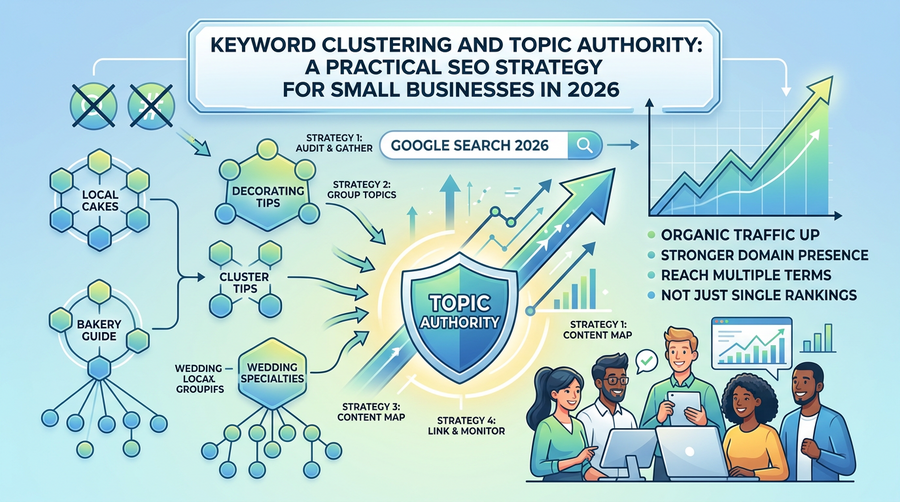
From there, think about every question a customer might ask around that topic. Some will be broad and some will be specific. Group the specific questions into clusters. Each cluster becomes either a page or a blog post, all of which link back to your main pillar page. Here is a simple example for a wedding florist:
- Pillar page: Wedding Flowers (overview, types, process, pricing)
- Cluster page: Bridal bouquet styles and what suits each dress type
- Cluster page: How much do wedding flowers cost in the UK?
- Cluster page: Seasonal wedding flowers: what is available month by month
- Cluster page: Table centrepiece ideas for wedding receptions
- Cluster page: How to choose a wedding florist: questions to ask
Each of these pages targets a slightly different search intent, but they all reinforce the same topic. Together, they tell search engines that this website genuinely knows wedding flowers inside out.
Understanding Search Intent Within Your Clusters
Not every keyword in a cluster deserves the same type of content. Before writing anything, ask yourself what someone typing that phrase actually wants. Are they comparing options? Ready to buy? Just starting to research? This is called search intent, and matching your content to it is what separates useful pages from ones that rank but never convert.
A page targeting “wedding florist Worthing” needs to be a local service page with clear calls to action. A page targeting “how far in advance should I book a wedding florist” needs to be genuinely helpful and informative. Getting the format right matters as much as getting the keywords right.
Practical Tools to Help You Cluster Keywords
You do not need to do this entirely by hand. Several tools can help you organise keywords by semantic similarity and spot gaps in your content. Some options worth exploring include:
- Google Search Console: Already free and already tracking your site. Look at which queries are bringing in impressions and group related ones together manually.
- Ubersuggest: Affordable for small businesses and good at generating related keyword ideas from a seed term.
- Ahrefs or Semrush: More powerful and more expensive, but both have keyword clustering features that can save hours of manual work.
- Answer the Public: Excellent for finding the questions people actually type into search engines around any topic.
Even a simple spreadsheet works if you are just getting started. List your keywords, note the intent behind each one, and then group them into themes. That structure alone will make your content planning much clearer.
Internal Linking: The Glue That Holds It Together
A cluster only works if the pages within it are properly connected. Every cluster page should link back to the pillar page, and the pillar page should link out to all of its cluster pages. Where relevant, cluster pages should also link to each other.
This internal linking structure does two things. First, it helps visitors navigate your site and find related information, which keeps them engaged longer. Second, it passes authority around your site in a way that strengthens all of the connected pages, not just the one someone landed on first.
How Long Does It Take to See Results?
Topic authority builds gradually, so do not expect overnight results. Most small businesses start seeing meaningful movement within three to six months of building out their first proper cluster, assuming the content is genuinely useful and the site is technically sound.
The key is consistency. Adding one or two well-targeted cluster pages per month is far more effective than publishing a burst of content and then going quiet. Search engines reward sites that grow steadily and maintain fresh, relevant material.
A Realistic Starting Point for Small Business Owners
If this all sounds like a lot, start small. Pick one topic your business is known for and build just three to five cluster pages around it over the next couple of months. Link them together properly and make sure each one answers a real question your customers have asked you in person or by email.
That is honestly enough to get going. Once you see the results, you can expand into a second cluster and then a third. Over time, your site becomes the go-to resource in your local area for whatever you do, and that is far more valuable than chasing a single keyword ranking that could disappear with the next algorithm update.
If you would like help mapping out a keyword cluster strategy for your business, the team at Samson Web Design works with small businesses across Worthing and West Sussex every day. Get in touch and we can talk through where to start.