Every small business owner faces the same question eventually. You know you need more customers online, someone pitches you SEO, another company offers Google Ads, and a third sends a cold email promising warm leads delivered straight to your inbox. They all sound convincing. They all cost money. So where do you actually start?
The honest answer is: it depends. But not in the wishy-washy way that phrase usually gets used. There are real, practical factors that should drive this decision, and most agency marketing glosses over them. Let's cut through that.
What Each Channel Actually Does
Before comparing them, it helps to be clear on what you're buying.
SEO (Search Engine Optimisation) improves where your website appears in unpaid Google results. Done properly, it brings in people who are already searching for what you offer. The catch is it takes time, typically three to twelve months before you see meaningful traffic, and results build gradually rather than switching on overnight.
PPC (Pay-Per-Click advertising), most commonly Google Ads, puts your business at the top of search results almost immediately. You pay each time someone clicks. Stop paying and the traffic stops. It's fast, controllable, and measurable, but the costs can add up quickly if campaigns aren't managed well.
Lead generation services are a different beast. You're buying contact details of people who have expressed some interest in a product or service like yours. Quality varies enormously. Some providers sell the same lead to five different businesses. Others are genuinely exclusive and well-qualified. You need to ask very specific questions before committing.
The Timeline Question
If you need enquiries in the next four weeks, SEO alone will not help you. That's not a criticism of SEO, it's just the reality of how search engines work. A brand-new site or one with little existing authority needs time to earn rankings.
PPC, by contrast, can generate clicks on day one. For a new business, a seasonal campaign, or a product launch, that immediacy has real value. You can test which messages resonate with customers, gather data, and start booking jobs while your SEO work builds in the background.
Lead generation can be even faster in theory, but speed isn't much use if the leads are cold, poorly qualified, or shared across competitors. Many tradespeople and service businesses have tried bought leads and found the conversion rates disappointing. If you go this route, ask the provider exactly how leads are sourced and whether they're exclusive to you.
The Budget Question
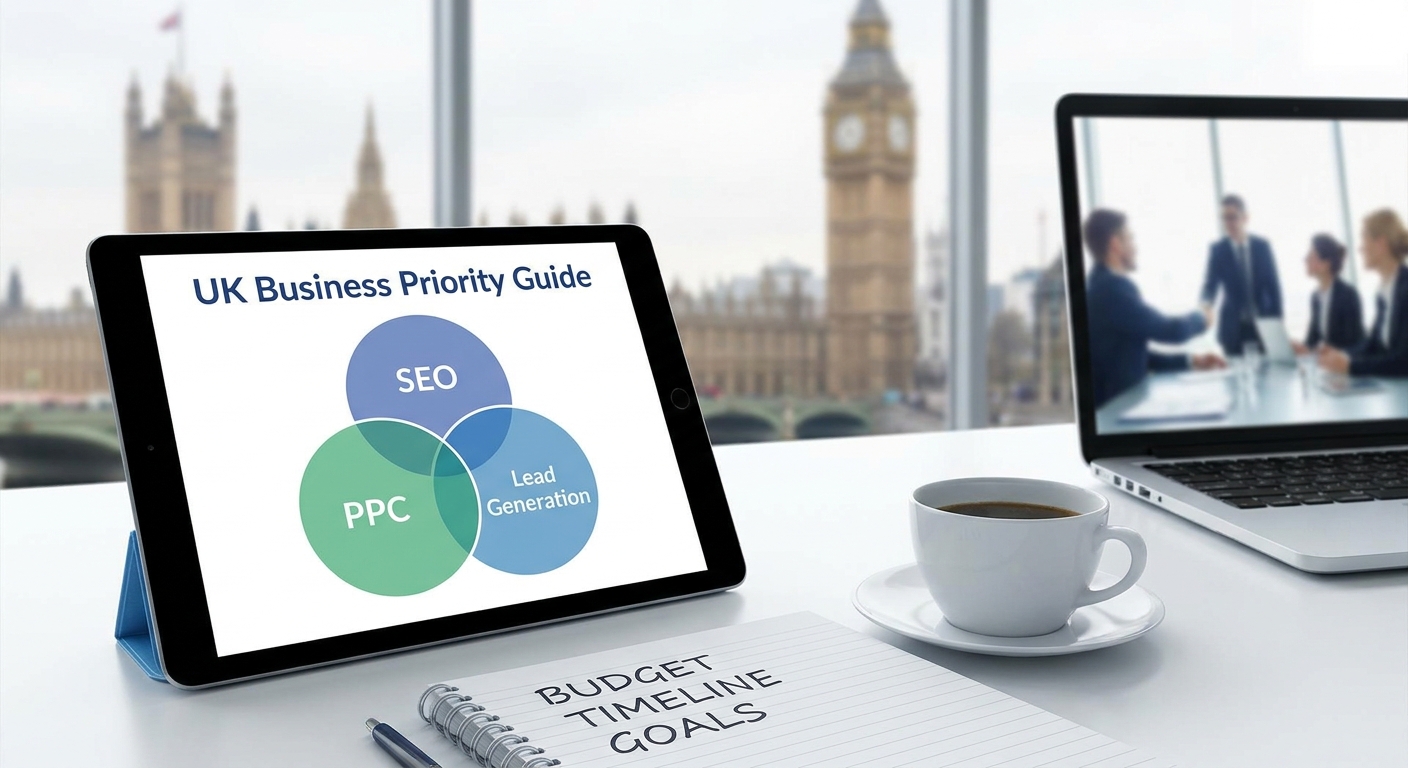
Your available budget should heavily influence where you start.
- Under £500 per month: A modest SEO retainer is likely your best use of funds. You won't see overnight results, but you're building something that compounds over time. PPC at this budget is possible for very niche, low-competition searches, but in most industries it won't stretch far enough to gather useful data.
- £500 to £1,500 per month: This is where a combined approach starts to make sense. One common approach is to run PPC to generate immediate leads while SEO builds momentum. According to research from Expertsure, a 60/40 split between SEO and PPC is a sensible starting point for UK small businesses in this range.
- £1,500 or more: At this level you have genuine flexibility. Running both channels properly, with good tracking in place, means you can use PPC data (which search terms convert, which landing pages work) to inform your SEO strategy. The two channels reinforce each other rather than competing.
The Goals Question
Budget and timeline matter, but your goals matter just as much. Ask yourself what success looks like in twelve months, not just next month.
If you want to build a sustainable pipeline that reduces your dependence on paid advertising over time, SEO is the foundation. Research from Whitehat SEO suggests B2B companies can see a median three-year ROI of around 748% from SEO, compared to roughly 200% from PPC over the same period. The upfront patience pays off.
If your goal is to test a new service, enter a new market, or simply survive the next quarter, PPC gives you data and customers faster. Use it as a runway while longer-term strategies get off the ground.
Lead generation tends to suit businesses with a very clear customer profile and a strong sales process. If you can close well on the phone and you know exactly who your ideal customer is, bought leads can work. If your sales process is still being refined, you're likely to burn through them without much return.
What Most Businesses Actually Get Wrong
The biggest mistake is treating these as permanent either/or choices. Most UK businesses that grow their online presence well start with one channel, learn from it, and then add others strategically.
Another common mistake is investing in PPC without a website that converts. Sending paid traffic to a slow, vague, or poorly structured website is expensive and demoralising. Before you spend a penny on ads, make sure your site clearly explains what you do, who you help, and how to get in touch. A well-designed, fast-loading site isn't optional here, it's the foundation everything else sits on.
Finally, watch out for agencies that push you toward whichever service they specialise in rather than what suits your situation. A good agency will ask about your goals, your budget, and your current position before recommending anything. If someone skips that conversation and goes straight to a proposal, that's worth noting.
A Simple Starting Framework
If you're not sure where to begin, these questions can help narrow it down.
- Do you need enquiries within the next 60 days? If yes, start with PPC or a small, targeted lead generation test.
- Do you have a website that clearly explains what you offer and makes it easy to contact you? If not, fix that first.
- Is there a consistent monthly budget you can commit to for at least six months? If yes, SEO will likely deliver the best long-term value.
- Are your customers actively searching for your service on Google? If yes, SEO and PPC both have a strong case. If no, social advertising may actually be a better fit.
There's no universal right answer, but there is almost always a right answer for your specific situation. The key is being honest about where your business is right now, not where you hope it will be in a year.
If you'd like a straightforward conversation about which channel makes sense for your business, get in touch with the team at Samson Web Design. We've been working with UK small businesses since 2006 and we'll give you a straight answer, not a sales pitch.