It sounds tempting. You sign up for an AI writing tool, set it going, and within a few hours you have fifty new pages on your website. Job done, right? Not quite. Businesses that have gone down this route are quietly watching their search traffic collapse, and Google is the reason why.
This isn’t about AI being bad. It’s about how most small businesses are using it, which is as a volume machine rather than a quality tool. There’s a big difference, and Google has become very good at telling them apart.
Google Cares About Helpfulness, Not Word Counts
Since the helpful content updates rolled out from 2022 onwards, Google has been applying what you might think of as a quality threshold. Pages that exist mainly to fill a website rather than genuinely help a reader tend to sink. Pages that actually answer questions, show real expertise, and give people a reason to stay get rewarded.
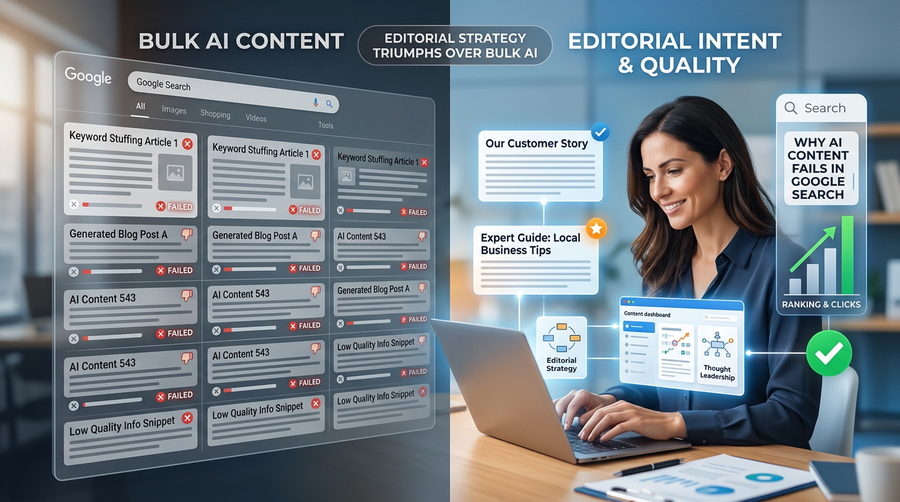
AI content at scale often fails this test because it’s written to match a keyword, not to help a person. The result is page after page that says similar things in slightly different ways, none of it particularly useful, none of it reflecting the real experience of the business behind it.
Google’s systems are specifically trained to spot this pattern. Low engagement, high bounce rates, thin information, no original perspective. These signals all feed into how a page ranks.
The “Mt. AI” Traffic Pattern
SEO professionals have started noticing a very recognisable shape in Google Search Console data for sites that went heavy on AI content. Traffic climbs quickly as new pages get indexed, then drops sharply, sometimes within a few months. The peak looks impressive until it falls off a cliff.
This happens because Google initially indexes new content without a full quality assessment. Over time, as user behaviour data comes in and algorithmic signals accumulate, pages that don’t hold up get demoted. The traffic spike was never real authority. It was just novelty that wore off fast.
For a small business, this is a serious problem. You’ve invested time, money, or both into content that eventually makes your site look worse than it did before you started.
What Editorial Strategy Actually Means
Editorial strategy doesn’t have to be complicated. It means every piece of content on your site has a clear reason to exist, a specific audience in mind, and something genuine to say. For a small business, that usually means drawing on what you actually know from doing your job every day.
Ask yourself a few questions before publishing anything:
- Is this answering a real question my customers ask me?
- Does it reflect genuine experience or knowledge from our business?
- Would someone reading this learn something they couldn’t get from a dozen other websites?
- Is there a clear next step for the reader?
If the answer to most of those is no, the content probably isn’t ready to publish.
AI Is a Tool, Not a Strategy
Using AI to help write content isn’t the problem. Plenty of good content gets a push from AI tools like ChatGPT, Claude, or Gemini. The issue is treating AI output as finished work rather than a starting point.
A sensible approach looks more like this:
- Decide on a topic based on what your customers genuinely need to know.
- Use AI to produce a rough draft or outline.
- Edit it heavily to add your own expertise, local knowledge, and specific examples.
- Make sure the tone sounds like your business, not like a generic chatbot.
- Check that it answers the question better than what already ranks for that term.
That process takes longer than just hitting publish on raw AI output. But it produces content that actually works, and it doesn’t put your whole site at risk.
Quality Over Quantity, Every Time
A small business website doesn’t need hundreds of pages. Most local businesses rank well with a tightly focused site of twenty to thirty well-written pages covering their services, their location, their expertise, and answers to common customer questions.
If you already have a pile of thin AI content on your site, it’s worth auditing it honestly. Some pages can be improved with proper editing and more detail. Others might be better off consolidated into a single stronger page, or removed entirely. Fewer, better pages consistently outperform a bloated site full of mediocre content.
Google’s own guidance on this is pretty clear. It favours content created for people, not for search engines. That principle hasn’t changed. What’s changed is how precisely Google can enforce it.
What This Means for Your Business
If you’re running a small business in Worthing, Brighton, or anywhere else in the UK, your competitive edge online isn’t going to come from outpublishing bigger competitors. It’s going to come from being more genuinely helpful and more authentically expert than the generic national sites that can’t match your local knowledge and personal service.
That’s actually good news. It means the most effective content strategy is also the most honest one. Write about what you know. Talk to your customers’ real concerns. Share the kind of advice you’d give someone who walked into your shop or called you for a quote. No AI tool can replicate that, but a good one can help you say it more efficiently once you know what you want to say.
If you’d like help auditing your existing content or building a strategy that holds up in search, get in touch with the team at Samson Web Design. We work with small businesses across West Sussex and the wider UK to build websites and content that bring in the right kind of traffic, and keep it.