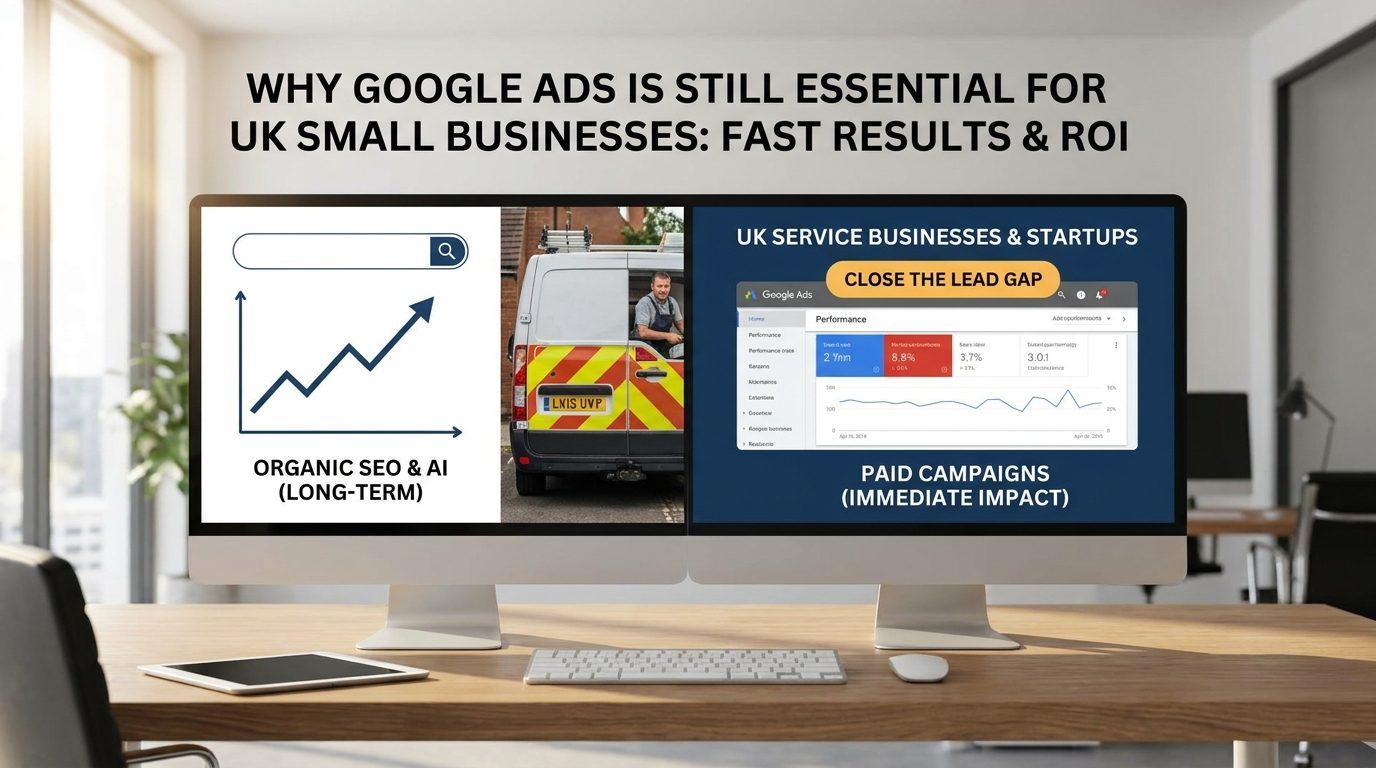
Ranking on Google organically is brilliant when it happens. But it can take six to twelve months of consistent effort before you see meaningful traffic, and for a startup plumber in Worthing or a new accountancy practice in Brighton, that timeline simply does not pay the bills. Google Ads fills that gap, putting you in front of people who are actively searching for exactly what you offer, today rather than next year.
That is not a reason to ignore SEO. The two approaches work well alongside each other. But if you are a small business owner unsure whether paid search is worth the budget, the honest answer is: for most trades, startups, and service businesses in the UK, it almost certainly is.
The Core Problem with Relying Only on Organic
Organic SEO rewards patience and consistency. Google needs time to crawl your site, assess your authority, and decide where you belong in its results. A new website with limited backlinks and a young domain is not going to outrank an established competitor on page one straight away, no matter how well-written the content is.
Meanwhile, your competitor who has been running Google Ads for two years is sitting at the very top of the same search results page, above the organic listings entirely. Their ad reads exactly what the customer typed: "emergency boiler repair Worthing" or "accountant for self-employed Brighton." The click goes to them, not you.
Google Ads does not wait. You set up a campaign, get it approved, and your ad can be live within hours. For businesses that need leads this month, that immediacy is extremely valuable.

How Google Ads Actually Works for Local Businesses
Most small businesses in the UK should start with Search campaigns, which show text ads to people typing specific queries into Google. You bid on keywords relevant to your service, set a daily budget, write a compelling ad, and direct clicks to a landing page that converts visitors into enquiries.
For trades and home services, Local Services Ads are worth knowing about separately. These sit above standard Google Ads and work on a pay-per-lead model rather than pay-per-click. A potential customer contacts you directly through the ad by phone call, message, or booking request. Because you only pay when someone reaches out, the budget efficiency is often higher than standard PPC for businesses like electricians, roofers, and cleaners.
The general guidance from performance marketing specialists is to prioritise in this order:
- Local Services Ads (for eligible trades and home services)
- Search campaigns (for direct keyword targeting)
- Performance Max (once Search is running profitably)
- Display and YouTube (later, once you have budget headroom)
Jumping straight to Display or YouTube before your Search campaign is profitable is one of the most common ways small businesses burn through their Google Ads budget without results. Start focused, prove the return, then expand.
What Kind of ROI Should You Expect?
Google frequently cites an average return of around £2 for every £1 spent on Google Ads across its advertiser base. For well-managed local campaigns targeting specific service areas with tight keyword lists, the return can be considerably higher. A Worthing-based kitchen fitter running a tightly managed Search campaign with a £500 monthly budget might generate six to ten qualified enquiries at a cost per lead of £50 to £80. If even three of those become jobs worth £1,500 each, the maths work comfortably.
That said, the ROI depends heavily on three things:
- How well the campaign is set up (keyword match types, negative keywords, ad copy)
- How good the landing page is at turning clicks into actual enquiries
- How competitive the keyword space is in your location and sector
A poorly set-up campaign with broad-match keywords and a landing page that dumps visitors on your homepage will drain money fast. A focused campaign with specific keywords, a clear call to action, and a page built to convert is a different story entirely.
Google Ads and SEO Are Not Rivals
A common misconception is that running Google Ads somehow helps your organic rankings. It does not. Google has confirmed that ad spend has no direct effect on where you appear in the organic results. The two systems are completely separate.
What PPC can do, indirectly, is support your SEO strategy. Running Search campaigns gives you real conversion data: which keywords actually lead to enquiries, not just clicks. That is genuinely useful information when deciding where to invest your SEO content effort. Instead of guessing which phrases to target, you know which ones convert.
Think of it this way. In the short term, Google Ads generates leads while your SEO builds momentum. Over twelve to eighteen months, as your organic rankings improve and start pulling in traffic on their own, you can scale back ad spend on the keywords where you now rank well organically and redirect budget toward more competitive terms or newer services. The two strategies mature together.
When Google Ads Makes the Most Sense
Paid search is not right for every situation, but for certain business types it is hard to argue against it. It tends to deliver the clearest value when:
- You are a new business with a brand new website and no organic presence yet
- You operate in a sector where customers search with high intent (plumbers, solicitors, accountants, dentists)
- You have a specific geographic target area and want to dominate it quickly
- You are launching a new service and want immediate feedback on demand
- A competitor is running ads and showing up above you for your key search terms
For a startup, Google Ads can be the difference between getting your first ten customers in three months or waiting a year for organic traffic to build. For an established trade business, it can keep the phone ringing through quieter seasons when word-of-mouth referrals slow down.
Avoiding the Most Common Mistakes
If you decide to run Google Ads yourself, a few basic principles will stop you from wasting budget. First, use phrase match or exact match keywords rather than broad match, at least to begin with. Broad match gives Google a lot of freedom to show your ad for tangentially related searches that will eat your budget without producing enquiries.
Second, build a proper negative keyword list from day one. If you are a commercial electrician who does not do domestic work, you want "domestic electrician" and "home rewire" blocked before your campaign goes live, not after you have spent £200 on irrelevant clicks.
Third, never send paid traffic to your homepage. Create a dedicated landing page for each campaign that mirrors the ad copy, answers the key objection, and has a single clear call to action: a phone number, a contact form, or a booking link. The click-to-enquiry rate on a well-built landing page versus a generic homepage can be three or four times higher.
Finally, check your campaign at least weekly in the early months. Look at search terms reports to spot irrelevant queries burning budget, review which ads are getting clicks versus which are getting conversions, and adjust bids based on what is actually working rather than assumptions.
Getting Started Without Overspending
You do not need a large budget to test Google Ads meaningfully. For most local service businesses in the UK, a starting budget of £300 to £500 per month is enough to gather real data within four to six weeks. That is enough clicks on a focused keyword list to see whether your landing page converts and whether the cost per lead makes commercial sense for your margins.
If managing campaigns yourself feels like too much alongside running a business, working with a local agency that handles PPC as part of a broader digital strategy is often a better use of time. The management cost is quickly offset if the campaign is set up properly from the start rather than going through weeks of expensive trial and error.
Google Ads is not a magic button. It rewards good setup, regular attention, and a website that does its job when visitors arrive. But for UK small businesses that need leads now, not in a year's time, it remains one of the most direct and measurable tools available.