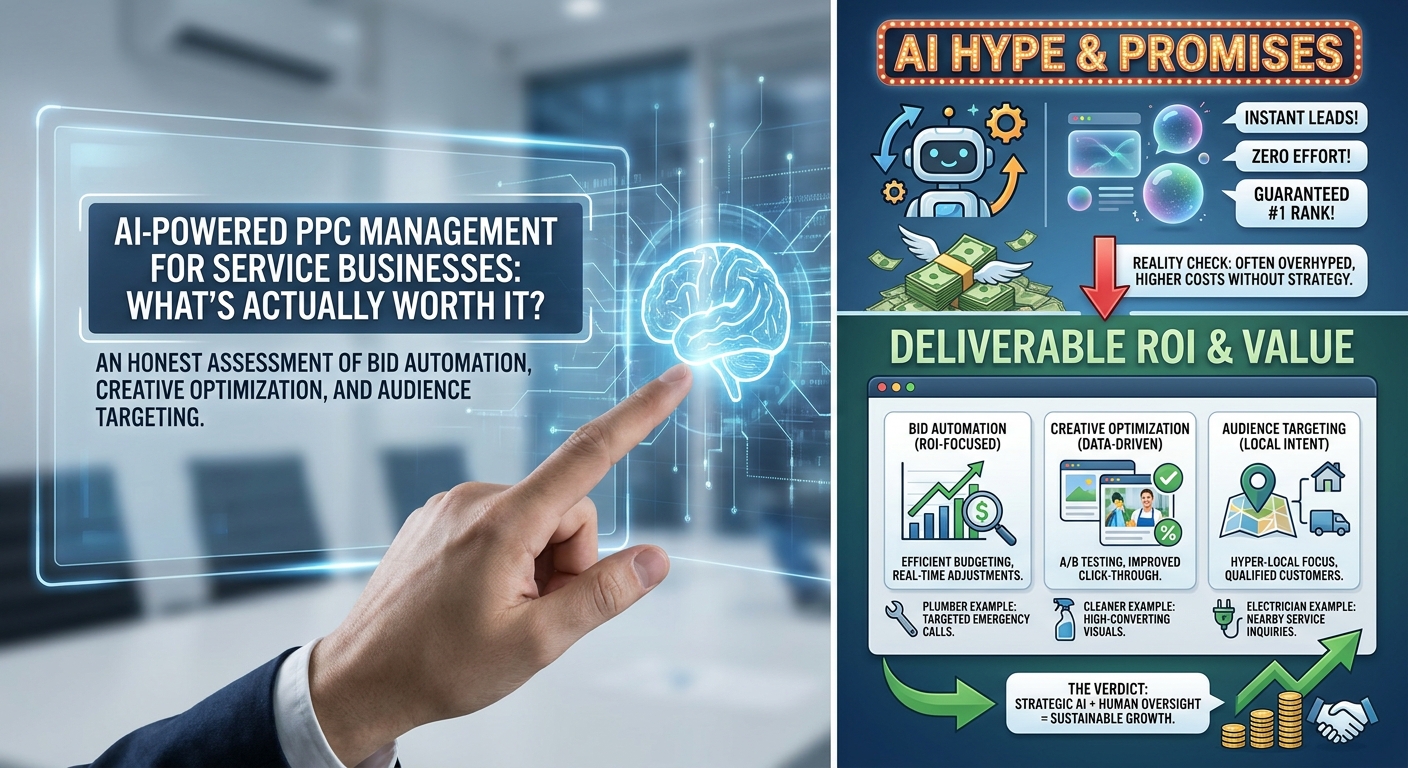
There's a lot of noise right now about AI transforming pay-per-click advertising. If you run a plumbing company, a cleaning business, or an electrical service, you've probably seen the promises: smarter bids, better ads, more calls for less money. Some of it is real. Some of it isn't. This article cuts through the marketing speak and looks at which AI-driven PPC features are genuinely useful for service businesses in the UK.
Why Service Businesses Are a Different Beast
Service businesses have very specific PPC needs. You're not selling a product someone can browse and buy at midnight. You're trying to get someone with a burst pipe or a broken boiler to call you in the next five minutes. That changes almost everything about how a campaign should be structured.
You care about phone calls, not clicks. You care about postcode coverage, not national impressions. And you care about cost per lead, not cost per click. Any AI tool that doesn't understand this distinction is going to waste your money fast.
Bid Automation: Genuinely Useful, With One Big Caveat
Automated bidding is probably the most mature and proven AI feature in PPC right now. Google's Smart Bidding strategies, for instance, use real-time signals like device, time of day, search query, and location to adjust what you pay for each auction. For a plumber targeting emergencies within a 10-mile radius of their depot, this kind of dynamic adjustment can make a real difference.
The caveat is data. Smart Bidding needs a meaningful volume of conversions to learn from, typically at least 30 to 50 per month, before it stops guessing and starts optimising. If your campaign is brand new or your budget is tight, the algorithm can spend a lot of money in the learning phase before it finds its feet. For smaller service businesses just getting started with ads, manual or enhanced CPC bidding often makes more sense until the data builds up.
The practical takeaway: bid automation is worth using once your campaign is established and generating consistent leads. Don't hand it the keys on day one.
Creative Optimisation: Useful, But Don't Switch Your Brain Off
AI tools can test ad copy variations quickly. Google's Responsive Search Ads (RSAs) let you feed in multiple headlines and descriptions, and the platform figures out which combinations perform best for different search queries. That's a genuine time saver and it does improve click-through rates over time.
Where service businesses go wrong is treating this as a set-and-forget feature. The AI can tell you that "Emergency Boiler Repairs" outperforms "Boiler Fixed Fast" as a headline, but it can't tell you that your offer needs to be stronger, your phone number should appear twice, or that your landing page is killing conversions after the click. You still need a human to look at the account and apply common sense.
For an electrician running ads, a good starting point is to write at least five distinct headlines covering different angles: urgency, local trust, qualifications, pricing transparency, and availability. Let the AI find the winning combinations, but give it quality ingredients to work with.
Audience Targeting: Where AI Earns Its Keep
This is arguably where AI-driven PPC has the most practical upside for service businesses right now. Modern platforms can layer audience signals onto your campaigns in ways that were genuinely difficult to manage manually a few years ago.
Some examples of what this looks like in practice:
- Showing higher bids to people who visited your website in the last 30 days but didn't call (remarketing lists for search ads)
- Targeting homeowners or people who recently moved, via in-market audience segments
- Adjusting bids by postcode performance using location bid modifiers informed by conversion data
- Excluding audiences that consistently don't convert, such as certain age brackets or devices
A cleaning company, for example, might find that its best converting customers come from specific suburbs and are browsing on mobile between 7am and 9am. AI tools surface that pattern faster than manual analysis would. The question is whether someone is actually acting on those insights or just letting the dashboard gather dust.
What the AI Still Can't Do
AI tools are good at optimising within a campaign. They're poor at setting one up correctly in the first place, and they're hopeless at the strategic decisions that determine whether your advertising makes financial sense at all.
There are things no algorithm will do for you:
- Decide the right monthly budget for your service area and competition level
- Write a landing page that actually converts visitors into calls
- Identify that your target keywords have commercial intent but terrible margins
- Flag that your Google Business Profile is dragging down your Quality Score
- Tell you that your phone isn't being answered and that's why cost per acquisition is climbing
These are human problems. They require someone who understands your business, not just your campaign data.
Red Flags When Evaluating AI PPC Tools or Agencies
Because AI is fashionable right now, a lot of agencies and tools have slapped the label onto things that aren't especially clever. Here's what to watch out for when someone pitches you an AI-powered PPC solution.
- Promises of guaranteed results or specific cost-per-lead figures before seeing your account
- No clear explanation of what the AI is actually doing or optimising
- Monthly reports that show impressions and clicks but never show calls or enquiries
- A platform that doesn't let you see or own your own Google Ads account
- Zero human contact after onboarding
The best AI tools amplify good human decision-making. They don't replace it. If an agency can't explain the thinking behind your campaign in plain English, that's a problem regardless of how sophisticated their software is.
The Bottom Line for Tradespeople and Local Service Businesses
AI-assisted PPC is not a magic button. But it is genuinely useful when applied to the right parts of a campaign by someone who knows what they're doing. Bid automation works well once you have data. Responsive ads improve creative performance over time. Audience targeting helps your budget find the right people faster.
What hasn't changed is the basics. You still need a clear offer, a fast-loading page, a phone that gets answered, and someone keeping an eye on where the money is going. The AI handles the repetitive number-crunching. The strategy still needs a person behind it.
If you're a service business in the UK spending money on Google Ads and not sure whether you're getting value, it's worth having an independent review before adding more tools to the mix. Sometimes the problem isn't the technology. Sometimes it's just the fundamentals that need sorting first.