Picking a website builder feels simple until you actually try to do it. Suddenly you're comparing pricing tiers, reading about SEO tools you've never heard of, and wondering whether you really need a drag-and-drop editor or a full e-commerce suite. The honest answer is that the best builder depends entirely on what your business actually needs, not on which one has the flashiest homepage.
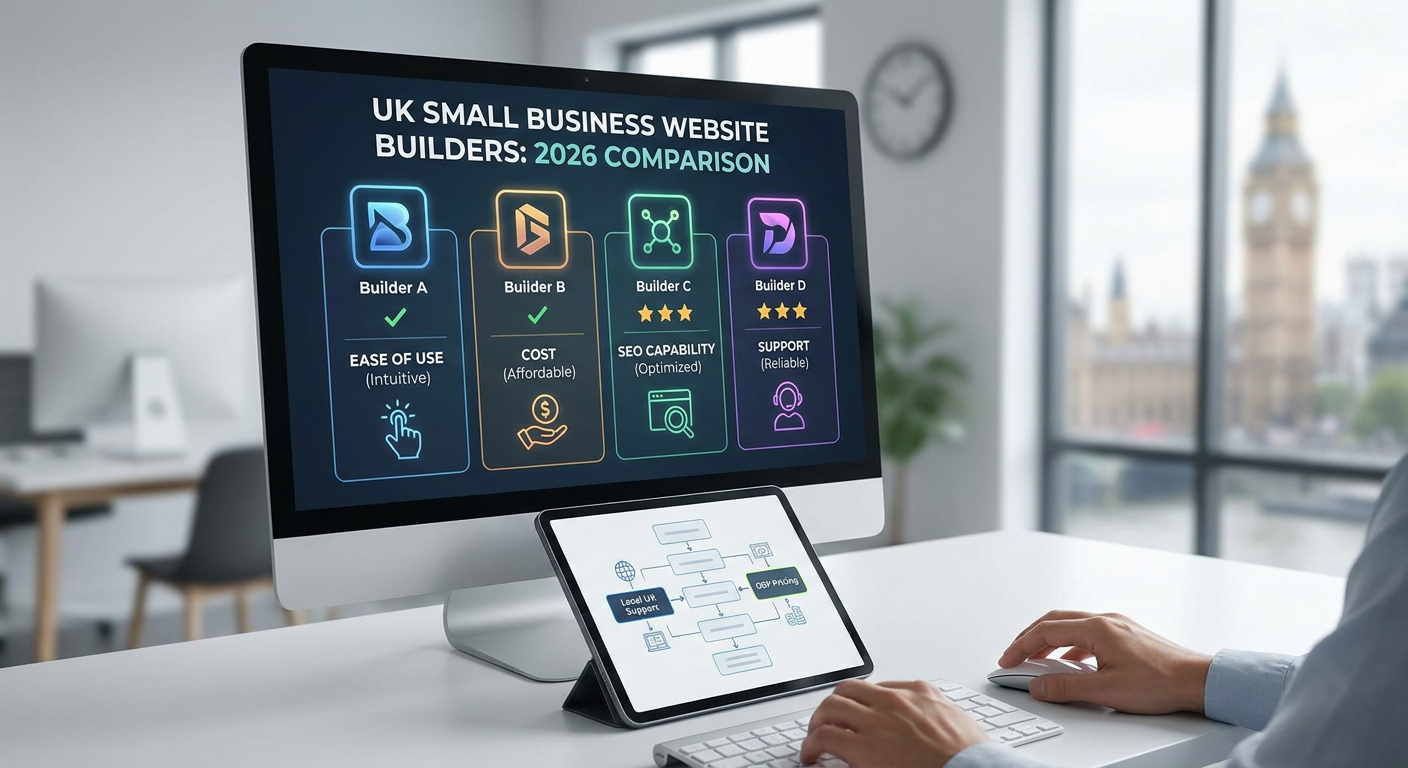
This comparison focuses on four things that matter most to UK small business owners: ease of use, cost, SEO capability, and the quality of support when things go wrong.
Wix: The Most Flexible Starting Point
Wix remains one of the most popular choices for small businesses starting from scratch. Its drag-and-drop editor lets you place elements freely on the page, which gives you a lot of creative control without needing to touch any code. The learning curve is genuinely gentle.
Pricing starts at around £9 per month for a basic plan, though you will need at least the Core plan (roughly £17 per month) to remove Wix branding and connect a custom domain properly. SEO tools are solid for a builder, including editable meta titles, alt tags, and a structured data setup, though you will not get the depth of control a hand-built site offers. Support is available via live chat and a comprehensive help centre, which is more than some rivals manage.
The main downside is that once you choose a template in Wix, switching to a different one later means starting your content from scratch. Worth knowing before you commit.
Squarespace: Best for Businesses Where Looks Matter
If your business lives or dies by its visual presentation, whether you are a photographer, an interior designer, or a restaurant, Squarespace is worth serious consideration. Its templates are genuinely attractive out of the box, and over 200 hours of testing by Startups.co.uk found it to be the easiest website builder to use overall, largely due to its clean, consistent editing experience.
Plans start at around £11 per month (billed annually) for the Personal plan, with the Business plan at roughly £17 per month adding features like promotional pop-ups and basic e-commerce. SEO capabilities are decent, with clean URLs, automatic sitemaps, and SSL included. The trade-off is less flexibility than Wix. Squarespace works within a more structured grid, which keeps things looking polished but limits how much you can customise individual layouts.
Support is email and live chat only, with no phone option. For straightforward questions that is usually fine, but if you run into a technical problem on a busy Saturday, you may find yourself waiting longer than you would like.
Shopify: The E-Commerce Specialist
If selling products online is your primary goal, Shopify is in a different league from the general-purpose builders. Its inventory management, payment processing, and checkout flow are built for commerce from the ground up rather than bolted on as an afterthought.
The Basic plan starts at around £19 per month, which is higher than Wix or Squarespace, but includes robust features like abandoned cart recovery, discount codes, and integration with most UK payment providers. Transaction fees apply unless you use Shopify Payments, so factor that into your cost calculations.
SEO on Shopify is functional but has some known quirks, including duplicate content issues with paginated collections and a less flexible URL structure compared to a custom-built site. It is manageable, but worth being aware of. Support is available 24 hours a day, 7 days a week via live chat, phone, and email, which is a genuine advantage if e-commerce downtime costs you real money.
GoDaddy: The Speed Play
GoDaddy's website builder does not get the same attention as Wix or Squarespace, but it deserves a mention for one specific reason: it is very fast to set up. If you need a serviceable online presence within a day, particularly a simple brochure site with your contact details, services, and a map, GoDaddy can get you there quickly.
Pricing is competitive, starting at around £6.99 per month. The trade-off is depth. GoDaddy's editor is more limited than Wix or Squarespace, and its SEO tools are fairly basic. It is a reasonable short-term solution or a placeholder while you work on something more substantial, but growing businesses tend to find themselves restricted by it within a year or two.
How Do These Compare on SEO?
SEO is where website builders as a category consistently fall short compared to custom-built sites. That is not a knock on any individual platform; it is a structural limitation of working within a predefined system.
Here is a quick summary of where each builder stands:
- Wix: Good SEO tools, schema markup support, editable URLs. Strong for most small businesses.
- Squarespace: Clean code output, automatic sitemaps, SSL included. Limited control over advanced settings.
- Shopify: Solid for product pages, but URL structure and duplicate content need active management.
- GoDaddy: Basic meta tag editing and little else. Not recommended if SEO is a priority.
None of these platforms give you the fine-grained control over site architecture, page speed optimisation, or structured data that a professionally built site can deliver. For competitive industries in particular, that gap is noticeable in search rankings over time.
The Hidden Costs Worth Knowing About
The monthly headline price is rarely the whole picture. Before committing to any builder, check for these additional costs:
- Domain registration (usually charged separately, often around £10 to £20 per year)
- Premium templates or themes beyond the free selection
- Third-party app integrations, which can add up quickly on Wix and Shopify
- Transaction fees on sales if you are not using the platform's own payment system
- Higher-tier plans to unlock features like removing platform branding or accessing advanced analytics
It is worth totalling up your realistic monthly spend before you sign up, not just looking at the entry-level plan.
When a Website Builder Is the Right Choice
Website builders make genuine sense for certain situations. If you are just starting out, have a very limited budget, and need something live quickly, a builder gives you a presentable online presence without a big upfront investment. They are also useful for landing pages, simple portfolio sites, or temporary campaign pages.
Where they start to show their limits is when your business grows, your SEO ambitions increase, or you need specific functionality that does not fit neatly into a template. Customisation has a ceiling on every platform, and moving away from a builder later can be more work than starting with a proper site in the first place.
A Word on Getting Proper Help
Many small business owners start with a builder, do their best, and end up with a site that looks decent but does not convert visitors or rank in search results. The builder is not always to blame; it is often a question of design decisions, site structure, or missing on-page SEO basics.
If you are not confident in those areas, it is worth at least having a conversation with a web design professional before you invest significant time into a DIY build. A site that looks good and works hard for your business is worth more than a free plan you set up in an afternoon.