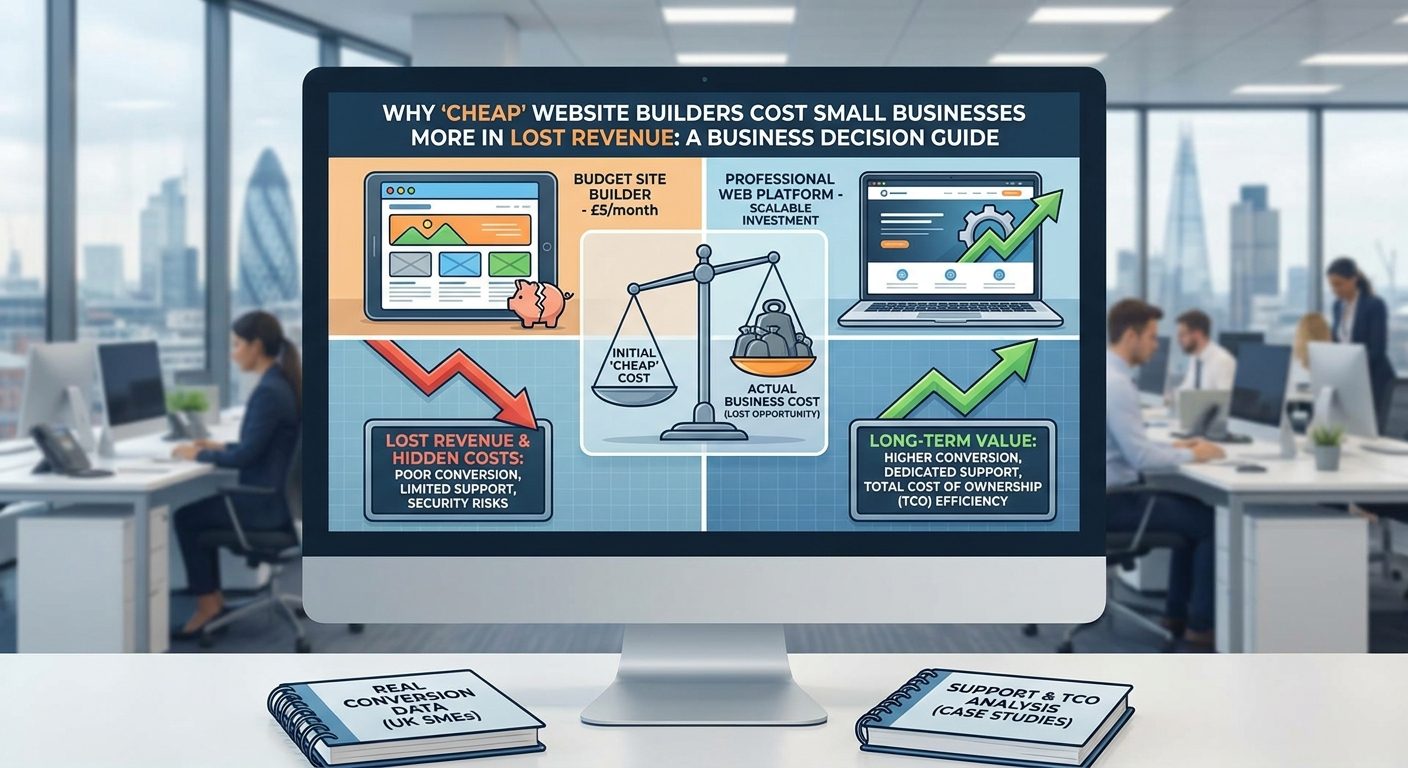
A £10-a-month website builder feels like responsible budgeting. You get something live quickly, the monthly fee is predictable, and you've avoided a four-figure invoice from a web designer. The problem is that this calculation only counts what you pay out, not what you fail to bring in. For most small businesses, the gap between those two numbers is enormous.
The Price Tag You See Versus the Cost You Don't
Budget website builders advertise their cheapest tier prominently. Wix, Squarespace, GoDaddy Website Builder and similar platforms all have entry plans that look affordable at a glance. What those headline prices rarely include is the full picture.
Once you need a custom domain (usually excluded from the base plan), e-commerce functionality, removal of platform branding, or priority support, you're upgrading. Many users of entry-tier plans end up on mid or premium tiers within six months. That pushes the annual cost to somewhere between £150 and £400 before you've spent a penny on marketing.
More significantly, some platforms charge transaction fees on every sale you make. A small product-based business turning over £50,000 a year could be handing over hundreds of pounds annually in fees that simply wouldn't exist on a properly built independent site.

Conversion Rate: Where the Real Money Disappears
Conversion rate is the percentage of visitors who take the action you want, whether that's calling you, filling in a form, or buying something. Even a modest improvement here has a disproportionate effect on revenue.
Template-based sites built on cheap platforms tend to underperform on conversion for several reasons:
- Generic layouts don't communicate your specific value proposition clearly enough to a visitor who arrived with a particular need.
- Mobile performance is often inconsistent, and Google's own data consistently shows that slow mobile pages lose visitors within seconds.
- Trust signals (testimonials, accreditations, local contact details prominently placed) are harder to implement well within rigid template structures.
- Calls to action tend to be wherever the template puts them, not where testing and strategy suggest they should go.
Suppose your site gets 500 visitors a month and converts at 1.5%. That's 7-8 enquiries. A professionally designed site focused on conversion might realistically push that to 3% or higher. That's 15 enquiries from the same traffic. If your average client or order is worth £200, the difference is an extra £1,500 in potential revenue every single month, from the same number of visitors.
SEO Limitations That Keep You Invisible
Getting found on Google isn't just about writing good content. Technical SEO plays a significant role, and this is where many drag-and-drop builders fall short.
Common technical shortfalls on cheap builder platforms include:
- Limited control over page titles, meta descriptions, and heading structure.
- Poor Core Web Vitals scores caused by bloated, platform-generated code.
- No ability to implement structured data (schema markup) for local business or product listings.
- Restricted URL structures that aren't clean or keyword-friendly.
For a trade business in Worthing trying to rank for searches like "electrician near me" or "bathroom fitter West Sussex", these technical limitations can mean sitting on page two or three of Google instead of page one. The traffic difference between those positions is not small. Studies consistently show that the first page of Google captures over 90% of clicks. If you're not there, you're largely invisible to anyone who doesn't already know your name.
Lock-In: The Trap You Don't Notice Until It's Sprung
One of the most frustrating aspects of many cheap website platforms is that you don't own what you've built in any meaningful sense. Your content, your design, and sometimes your customer data sits inside a proprietary system that doesn't export cleanly.
There are well-documented cases of business owners who couldn't integrate tools they needed because their platform didn't support them. One couldn't connect their developer documentation system. Another couldn't link their preferred booking or payment tools. These aren't niche requirements. They're the kinds of integrations that growing businesses routinely need.
When you eventually outgrow a budget builder (and most businesses do), you face a rebuild from scratch rather than a migration. You lose any SEO equity you'd built up if URLs change. You start over on content, design, and structure. What felt like a low-cost start ends up being the first of two website spends rather than a foundation you build on.
Support When Something Goes Wrong
Website problems have a talent for occurring at the worst possible moment. A form stops working the day before a campaign goes out. A payment gateway breaks on a busy Saturday. The site goes down during a local event that's driving traffic.
With a budget platform, your support options typically look like this:
- A knowledge base you have to search yourself.
- A support ticket queue with no guaranteed response time.
- A live chat that routes to a general helpdesk rather than anyone who knows your site.
A web design agency that built your site knows its structure, your goals, and your business. When something breaks, the fix is faster because the context is already there. That kind of relationship has real commercial value that doesn't appear in any pricing comparison.
The Honest TCO Calculation
Total cost of ownership (TCO) is the metric you should be using when comparing a budget builder to a professionally built site. It accounts for everything over a realistic time period, typically three years.
For a budget builder, a realistic three-year TCO might include:
- Platform subscription fees totalling £400 to £900.
- Upgrade costs when you hit feature limits.
- Transaction fees on sales.
- A rebuild cost when you outgrow the platform.
- Lost revenue from poor conversion rates and weaker SEO.
That last item is the one that makes the comparison stark. A professional site costing £1,500 to £3,000 upfront that converts at twice the rate and ranks higher in search is not more expensive than a cheap builder over three years. In most cases it pays for itself within the first few months, purely from the leads it captures that the budget site would have lost.
When a Builder Does Make Sense
It would be dishonest to suggest that website builders are always the wrong choice. For a brand-new side project testing whether there's a market, or a pop-up event that needs a single-page presence for four weeks, a quick builder serves a purpose. There are also situations where a small business genuinely doesn't need more than a digital brochure with contact details, and where traffic expectations are low.
The mistake is using that logic for a business where the website is meant to actively generate enquiries, bookings, or sales. Once your site is supposed to work for you rather than simply exist, the investment in getting it built properly pays off faster than most business owners expect.
What to Ask Before You Decide
If you're weighing up a builder against a professional site, ask yourself these questions before defaulting to the cheaper-looking option:
- How many leads or sales per month would justify the difference in cost?
- Do I need to integrate any booking, CRM, or payment tools now or in the next 12 months?
- Am I relying on local search to bring in customers?
- If my site goes down or breaks, how much does a day without enquiries cost me?
For most small businesses asking those questions honestly, the case for a professionally built site becomes clear quickly. The upfront cost is real. The opportunity cost of the alternative is just less visible, until you start doing the maths.