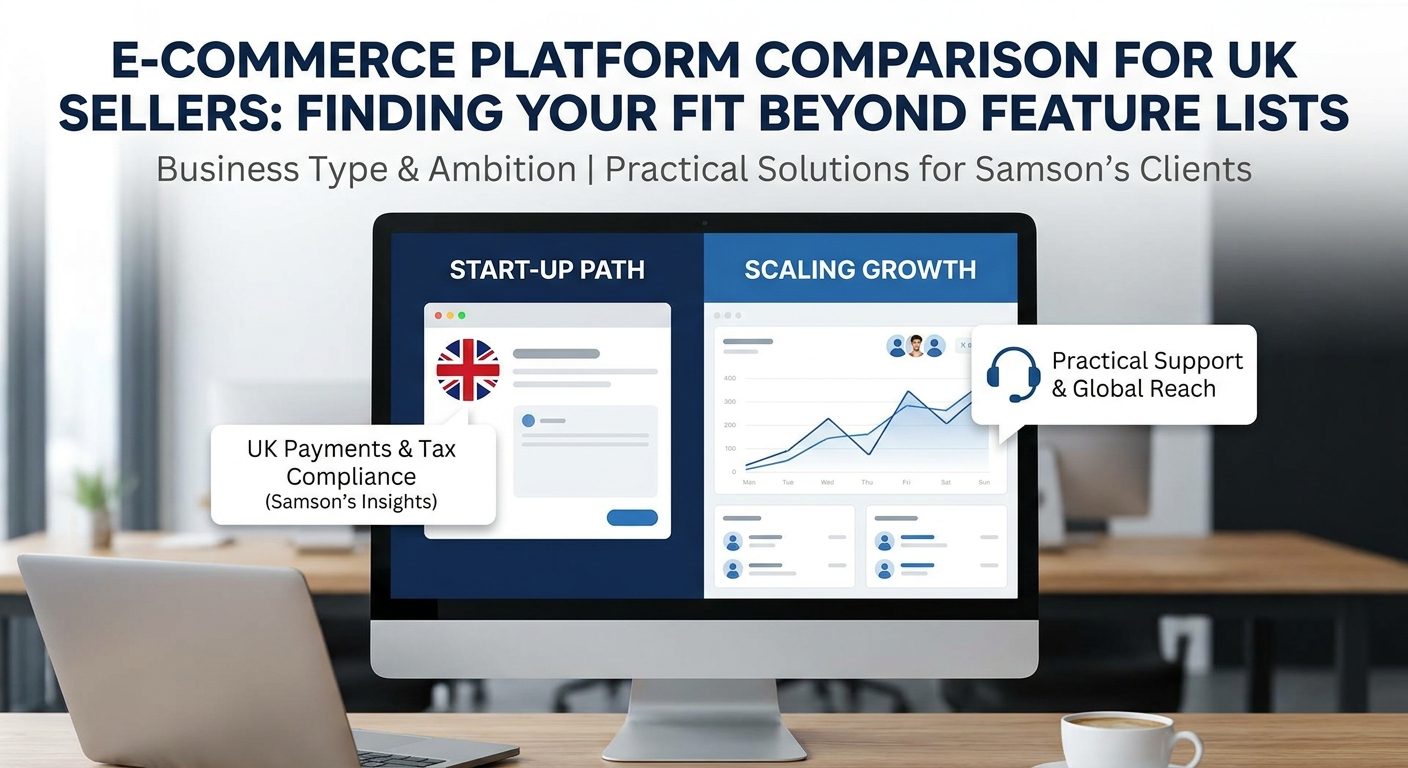
Most platform comparison guides hand you a table of ticks and crosses and leave you to figure out what it means for your actual business. This one works differently. Whether you're a sole trader just getting started or a growing retailer ready to scale, the right platform isn't the one with the longest feature list. It's the one that fits how you sell, who you sell to, and where you want to be in two years.
Start With Your Business Stage, Not the Platform's Marketing
The single most useful filter when comparing platforms is ambition level. A start-up selling 20 handmade products a month has completely different needs from a business shifting 500 orders a week and thinking about wholesale. Picking an enterprise-grade platform on day one means paying for complexity you don't need. Picking something too simple means rebuilding sooner than you'd like.
Think honestly about three things before you look at any platform: how many products you'll list, how much technical involvement you want, and whether you'll need to integrate with stock management, accounting software, or a booking system. Getting clear on those three questions cuts the shortlist down quickly.

Shopify: The Safe Default for Most UK Sellers
Shopify is the closest thing to a consensus pick for UK small businesses that want a reliable, hosted solution without needing a developer on call. You pay a monthly fee (plans start from around £25 a month in the UK), and in return you get hosting, security, automatic updates, and a marketplace of thousands of apps that extend what the platform can do.
For sellers who want to get a store live quickly and focus on marketing rather than maintenance, Shopify earns its popularity. It handles VAT display well, supports UK payment processors out of the box, and its checkout is consistently one of the highest-converting available. The main downside is cost: transaction fees apply unless you use Shopify Payments, and app subscriptions stack up fast once you start customising.
Shopify suits you well if you're a product-based business, you don't have strong opinions about code, and you want something that scales without a rebuild when you hit a hundred orders a day.
WooCommerce: Power and Flexibility for the Hands-On Seller
WooCommerce is a free plugin that turns a WordPress site into a fully functional shop. That word "free" needs context: you'll still pay for hosting, a theme, premium plugins, and someone to maintain it. But if you want genuine control over every corner of your store, WooCommerce delivers it in a way that hosted platforms simply can't match.
It's particularly well suited to businesses that already have a WordPress content site and want to add selling capability, or to anyone whose product catalogue is unusual enough that off-the-shelf templates don't fit. Trades, service businesses selling digital downloads, and consultants offering paid workshops all tend to find WooCommerce a comfortable fit.
The trade-off is ongoing maintenance. WordPress and WooCommerce both require regular updates, and if you're not confident doing that yourself, you need a developer or a managed hosting plan. That cost is real, even if the software licence is free. For businesses that want to focus on running a business rather than running a website, Shopify's all-in-one model often wins on total effort even if it loses on flexibility.
Squarespace and Wix: Good Starting Points With Limits
Both Squarespace and Wix offer e-commerce functionality bolted onto their website builder products. They're genuinely excellent for getting something professional-looking online fast, and both are far less intimidating than WordPress for non-technical users.
Wix supports up to 50,000 products and includes features like abandoned cart recovery on its higher plans, according to Coursera's platform comparison. Squarespace's commerce tools are clean and well-designed, and both platforms handle basic VAT display for UK stores.
Where they fall short is at scale. Neither has the app ecosystem of Shopify or the raw extensibility of WooCommerce. If you're planning to run a large catalogue, complex discount rules, or integrations with fulfilment partners, you'll hit the ceiling fairly quickly. Use them as a starting point if budget is tight and simplicity matters most, but go in with eyes open about when you might need to migrate.
BigCommerce: For Sellers Who Are Already Scaling
BigCommerce positions itself at the more serious end of the market. It offers more built-in features than Shopify at equivalent price points, charges no transaction fees regardless of payment processor, and handles complex product catalogues without relying heavily on third-party apps.
For UK businesses with significant sales volume, BigCommerce's tiered plans (Core, Growth, Scale) give a reasonable growth path without platform changes. You can compare BigCommerce plans based on your sales volume and start building immediately without going through a sales process. The downside is that the learning curve is steeper and the template ecosystem is smaller than Shopify's, which can slow down early setup.
UK Payment Processors: What Actually Matters
Platform choice and payment processor choice are separate decisions, but they're connected. Most UK sellers land on Stripe or PayPal as their primary gateway, and both work across all the major platforms. Stripe integrates cleanly into custom checkouts and tends to offer slightly lower fees than PayPal for card-present transactions. PayPal brings the advantage of buyer familiarity, particularly for customers who are cautious about entering card details on a site they haven't used before.
GoCardless is worth considering if your business model includes recurring payments or large invoice amounts, since it's built around Direct Debit and suits subscription models, service retainers, or B2B billing better than either Stripe or PayPal. You can read more about how payment processors fit different small business models to decide which combination works for your setup.
One thing to watch: some platforms charge an additional transaction fee (typically 0.5% to 2%) if you use a third-party gateway instead of their own. Shopify is the most notable example. On high volumes, that fee adds up quickly and shifts the real cost comparison between platforms significantly.
VAT Compliance: Non-Negotiable for UK Online Sellers
If you're selling online in the UK and your turnover is above the VAT threshold (currently £90,000), you need to charge 20% VAT on most goods and services, keep proper records, and file returns accurately. Even below the threshold, getting your price display and checkout totals right matters for customer trust and future compliance readiness.
Shopify and WooCommerce both handle UK VAT well with the right settings configured, but neither does it entirely automatically out of the box. You need to set your tax region correctly, decide whether prices are displayed inclusive or exclusive of VAT, and make sure your invoices include the right information. Payhip is worth a mention for digital product sellers specifically: it handles automated VAT for UK, EU, US, and Canada, removing a significant admin burden for anyone selling courses, downloads, or memberships, as noted by ecomm.design's beginner platform picks.
Whichever platform you use, connect it to your accounting software (Xero and QuickBooks both have solid integrations across the main platforms) so your VAT figures reconcile without manual data entry. Mistakes in VAT records don't just create compliance issues; they eat directly into margin.
Support Quality: The Factor Most Comparisons Underweight
Feature lists tell you what a platform can do. They don't tell you what happens at 9pm on a Friday when your checkout breaks before a product launch. Support quality varies wildly, and it matters far more to a small business without an in-house developer than most comparison guides acknowledge.
Shopify offers 24/7 support across all plans via chat and email, and its help documentation is genuinely good. WooCommerce support, because it's open-source, mostly means community forums, premium plugin-specific support, or paying a developer. Wix and Squarespace both have reasonable help centres and email support, but response times can vary.
If you're working with a web design agency to build and maintain your store, the support equation shifts. A good agency relationship means you have someone to call who knows your specific setup rather than a generic helpdesk reading from a script. For most of the small UK businesses we work with, that human relationship is worth more than the platform's own support tier.
Making the Call: A Simple Framework
Rather than treating this as a features race, run through these questions and let the answers point you toward a shortlist:
- How technical are you (or your team)? Low: Shopify or Wix. Medium: Shopify or WooCommerce. Comfortable with code: WooCommerce or BigCommerce.
- How many products are you listing? Under 100: any platform works. 100 to 1,000: Shopify or WooCommerce. Over 1,000 with complex variants: BigCommerce or WooCommerce.
- Do you sell digital products or subscriptions? WooCommerce with the right plugins, Shopify with a subscription app, or Payhip for pure digital delivery.
- What's your monthly budget for platform costs? Under £20: WooCommerce on shared hosting. £20 to £70: Shopify Basic or Wix Business. Higher: Shopify or BigCommerce mid-tier plans.
- Do you need strong content marketing alongside your shop? WooCommerce on WordPress gives you the best blogging and SEO foundation by a significant margin.
There is no universally correct answer, and any agency or consultant who tells you one platform is always best is either simplifying for convenience or selling you something. The honest truth is that Shopify, WooCommerce, and BigCommerce all power successful UK businesses at every scale. What separates the stores that grow from the ones that stall is usually execution, not platform choice.
If you're unsure where to start or you're looking at migrating from a platform that's no longer serving you, getting a conversation with a developer or agency who knows the UK market well is worth the time before you commit. The cost of picking the wrong platform and rebuilding in 18 months is far higher than a good conversation now.