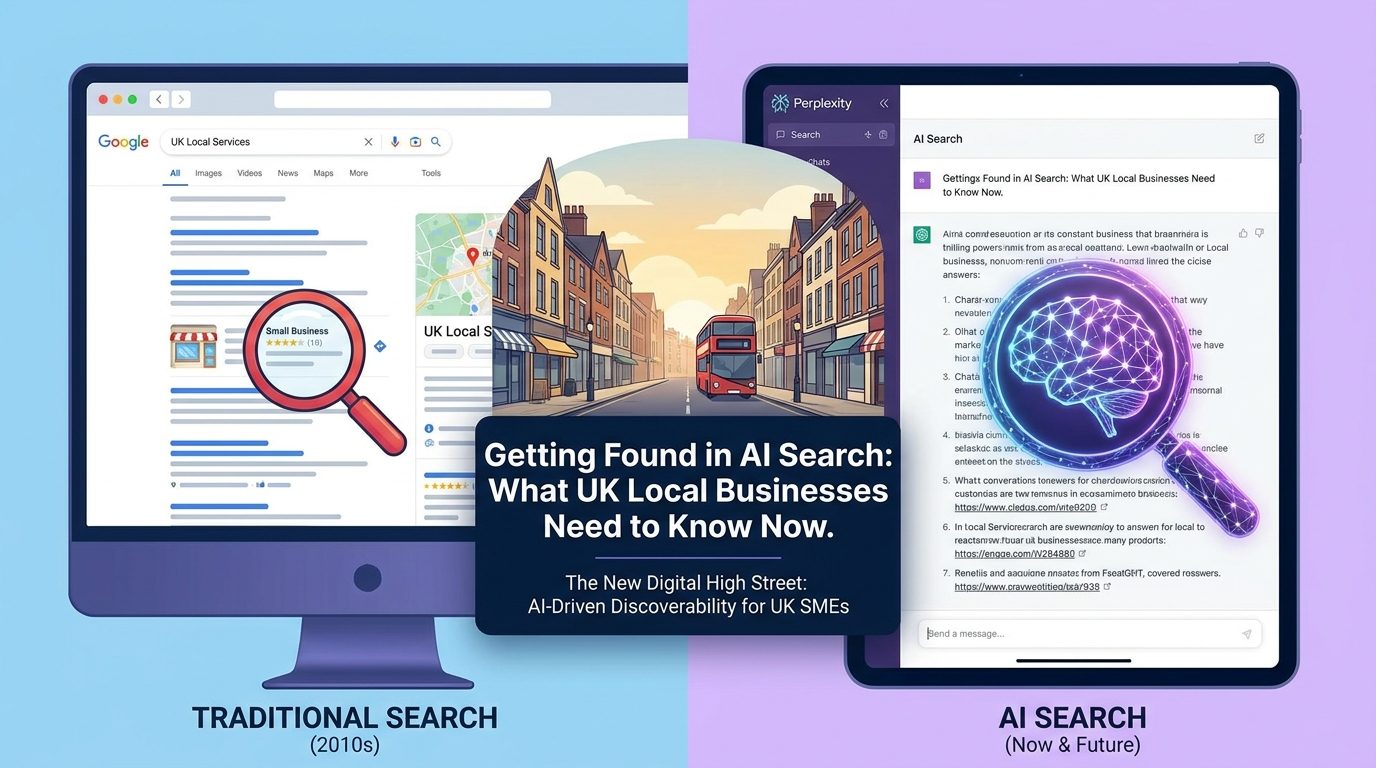
Customers are starting their search for a local plumber, accountant or web designer by typing a question into ChatGPT or Perplexity rather than scrolling through Google results. If your business isn't structured in a way that AI can read, understand and cite, you simply won't come up. That's a real problem for small businesses across the UK, and it's happening right now.
This isn't a distant trend to prepare for eventually. Google's AI Mode launched in the UK in July 2025 and sits as a separate, opt-in tab that delivers fully conversational answers rather than a traditional list of blue links. AI Overviews, which pull a summarised answer directly above the organic results, have been live longer and are already affecting click-through rates for many local search terms. Between these two Google features alone, plus the growing number of people using ChatGPT and Perplexity to research services, the way customers discover businesses has shifted considerably.
Why This Matters More for Local Businesses Than Anyone Else
National brands have marketing teams, PR agencies and thousands of backlinks working in their favour. A local business in Worthing, Wigan or Worcester often relies on appearing in the local pack, on Google Maps, or near the top of a results page for a handful of key phrases. AI search changes those odds, but not necessarily against smaller businesses.
According to research published by LocalIQ, AI Mode and AI Overviews draw on similar signals to traditional local SEO, including a strong Google Business Profile, consistent business information across the web, and clear, well-structured website content. The businesses winning recommendations in AI answers aren't always the biggest ones. They're the ones whose online presence gives AI models enough clear, trustworthy information to feel confident citing them.
In professional services especially, people are increasingly asking ChatGPT or Gemini for a recommendation before they ever open a search results page. If your website isn't readable and credible to an AI, you're invisible in those conversations before a potential customer even considers clicking anywhere.
How AI Search Tools Decide What to Recommend
AI search tools don't work like a directory lookup. They read and synthesise content from across the web, then construct an answer. For a local business, that means the AI is likely pulling from your website, your Google Business Profile, review platforms like Trustpilot or Google Reviews, local news mentions, and any other place your business is discussed online.
The key factors that influence whether you get cited include:
- Clear, specific content on your website that describes exactly what you do, where you do it, and who you help
- A complete and regularly updated Google Business Profile, including services, opening hours, photos and responses to reviews
- Consistent NAP data (Name, Address, Phone number) across your website, social profiles, directories and citations
- Genuine customer reviews that mention specific services and locations
- Structured data markup on your website that helps machines understand your business type, location and offerings
- Authoritative mentions from local press, industry bodies or relevant websites
Perplexity and ChatGPT also use web browsing to pull live information, so the same principles apply across platforms. If a source consistently describes your business accurately and positively, you become a credible candidate for citation.
The Content Problem Most Small Business Websites Have
Many small business websites are built around what the owner wants to say rather than what the customer is asking. A homepage that says "family-run business with 20 years' experience" doesn't give an AI model much to work with when someone asks "who does loft conversions in Brighton?"
AI models are looking for specificity. That means your website should clearly state the geographic areas you cover, the specific services or products you offer, and answers to the kinds of questions your customers actually ask. FAQ sections, service pages broken down by type or location, and detailed descriptions of your process all give AI systems more to work with.
This approach is sometimes called non-commodity content, meaning content that only your business could have written, content rooted in real expertise, local knowledge and genuine experience. Generic filler text that could apply to any business in any town is exactly the kind of content AI tends to overlook. A roofing company in Chichester that publishes a detailed page about common roof problems caused by the South East's coastal weather patterns is far more likely to get cited than one with a homepage that just says "quality roofing services at competitive prices."
Practical Steps to Improve Your AI Search Visibility
There's no single fix here, but there are clear, actionable steps any UK business can take. Start with the basics and build from there.
- Audit your Google Business Profile. Make sure every section is filled in, your service list is accurate, and you're posting updates regularly. This is often the first thing an AI model checks for a local query.
- Create dedicated service or location pages. If you cover multiple towns or offer several distinct services, each one deserves its own page with clear, specific content rather than a single jumbled "what we do" page.
- Add structured data markup. Schema markup for local businesses (LocalBusiness schema) helps search engines and AI tools understand your business type, address, phone number, opening hours and services in a machine-readable format. A web developer can add this to your site relatively quickly.
- Build your review presence actively. Ask satisfied customers to leave Google Reviews and mention the specific service they used. Reviews that say "great electrician in Horsham, fixed our fuse box within the hour" are more useful for AI citation than "lovely, very professional."
- Get listed in reputable directories. Yell, Checkatrade, FreeIndex, and industry-specific directories all contribute to consistent business information across the web. AI models treat these as corroborating sources.
- Write content that answers real questions. Think about what a potential customer would type into ChatGPT. "Best window cleaner in Guildford" or "who does commercial cleaning in Leeds?" Write content that directly answers those kinds of queries.
- Earn local links and mentions. Getting mentioned in a local newspaper, a community newsletter or a regional business association adds credibility that AI models pick up on.
AI Overviews vs AI Mode: They're Not the Same Thing
It's worth understanding the difference between Google's two main AI features, because they work slightly differently and optimising for one doesn't automatically cover you for the other.
AI Overviews appear automatically at the top of standard Google results for many informational and local queries. Google generates a summary answer and pulls citations from websites it considers authoritative on the topic. Having strong traditional SEO signals, good structured data, and genuinely useful content gives you the best chance of appearing here.
AI Mode, the conversational tab that launched in the UK in July 2025, works more like ChatGPT. It generates a full, dialogue-style answer and draws on a somewhat different source set. LocalIQ's research suggests the same core signals apply, but AI Mode tends to reward businesses with a wider, more consistent web presence rather than just a well-optimised single page.
For most small businesses, the practical advice is the same for both: focus on accuracy, specificity and consistency across every place your business appears online.
Don't Abandon Traditional Local SEO
It's tempting to read about AI search and assume traditional SEO is finished. That's not what's happening. The majority of local searches still happen on Google in the conventional way, and appearing in the local three-pack and on Google Maps remains critically important for driving phone calls and footfall. AI search is an additional layer, not a replacement.
The good news is that almost everything that helps you rank well in traditional local search also helps you get cited by AI tools. A well-maintained Google Business Profile, a fast and mobile-friendly website with clear content, genuine reviews and consistent business information are the foundation for both. You're not starting from scratch, you're building on what should already be in place.
What AI search does demand, more than traditional SEO, is that your content is genuinely readable and informative rather than optimised around keyword density. An AI model isn't counting how many times you've written "plumber in Worthing" on a page. It's assessing whether your page gives a reliable, specific, trustworthy answer to a question a real person might ask.
The Businesses That Will Fall Behind
Any local business that relies entirely on word of mouth and hasn't invested in its online presence is already losing ground to competitors. As AI search becomes a bigger part of how customers discover services, that gap will widen. A business with a thin website, no structured data, an unclaimed Google Business Profile and few online reviews is essentially invisible to AI, regardless of how good its actual service is.
For UK SMEs right now, the priority isn't to become AI search experts overnight. It's to make sure your digital foundation is solid. Clean, accurate, specific content on your website. A properly maintained Google Business Profile. Active review generation. Consistent information everywhere your business appears online. Get those right and you're well positioned for both traditional and AI-driven discovery.
If you're not sure where your business currently stands, a basic local SEO audit will show you the gaps. From there, fixing the fundamentals is entirely achievable without a massive budget, and it's one of the highest-return investments a small business can make right now.