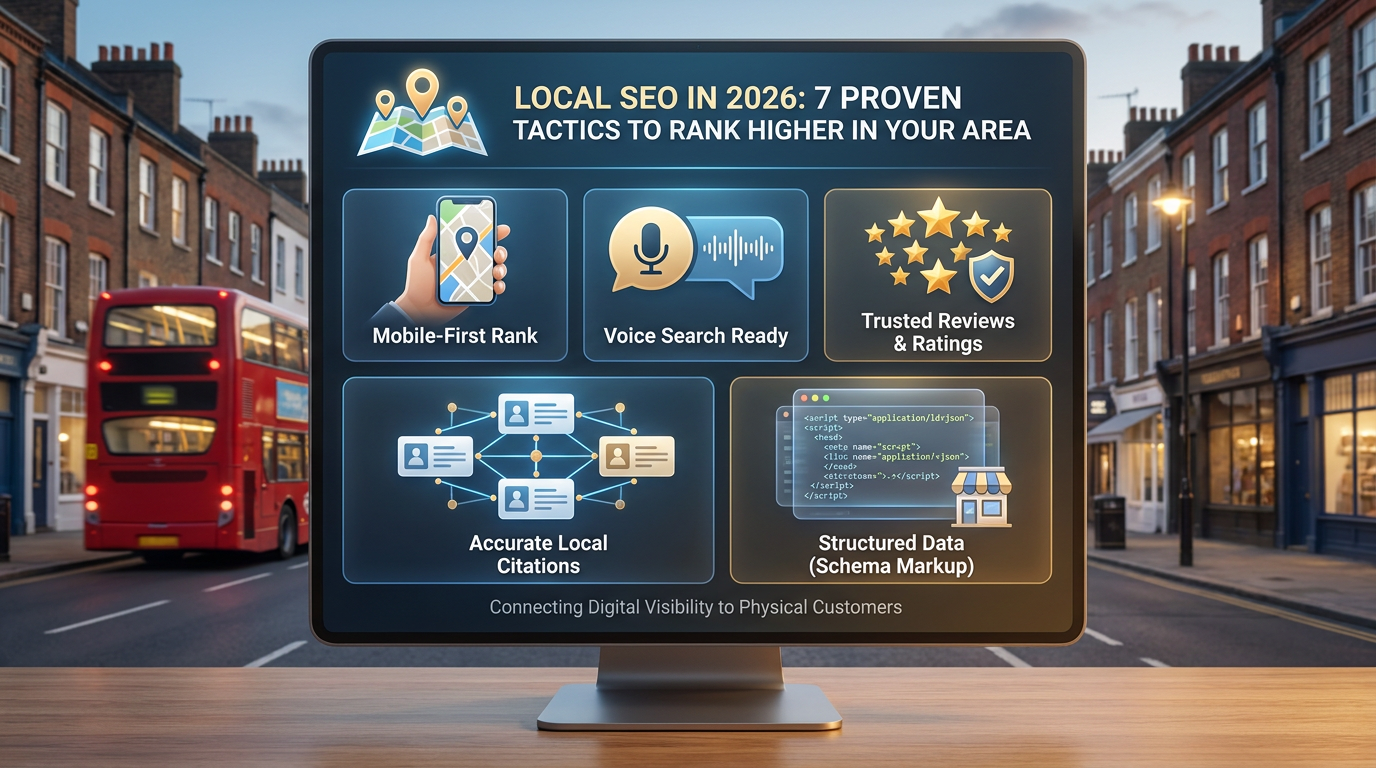
If your business relies on customers in a specific town or region, showing up in local search results is one of the most valuable things you can do online. The good news is that local SEO is still very much a level playing field, and smaller businesses can outrank bigger competitors by doing the basics well and staying consistent.
Here are seven tactics that are working right now for UK businesses in 2026.
1. Get Your Google Business Profile Properly Set Up
Your Google Business Profile (formerly Google My Business) is the single most important asset in local SEO. It controls what appears in the map pack, those three prominent results that appear at the top of Google when someone searches for a local service.
Make sure every section is filled in completely: your business category, hours, services, photos, and a description that includes your location and what you do. Choose your primary category carefully since this has a big impact on which searches you appear for. If you are a plumber in Worthing, your primary category should be Plumber, not Home Services.
2. Add Location Keywords to Your Title Tags and Page Content
On-page SEO still matters a great deal in local search. Your title tags (the text that appears in the browser tab and in Google results) should include both your service and your location. For example, Electrician in Brighton | Fast Response | Your Business Name is far more useful than just Home | Your Business Name.
Beyond title tags, mention your town, city, or region naturally throughout your page content. If you serve multiple areas, consider building a dedicated page for each location rather than cramming them all onto one page. A focused page for web design in Worthing will almost always outperform a generic page trying to target the whole of Sussex.
3. Keep Your NAP Consistent Everywhere
NAP stands for Name, Address, and Phone Number. Google cross-references your business details across the web, and inconsistencies confuse both search engines and customers. Make sure your NAP is identical on your website, Google Business Profile, social media profiles, and any directory listings.
Even small differences matter. If your website says 43 High Street but Yell.com says 43, High St, that counts as a mismatch. Audit your listings periodically and correct anything that has drifted.
4. Build Local Citations on UK Directories
A citation is any online mention of your business name, address, and phone number. Getting listed on reputable UK directories sends trust signals to Google and helps verify that your business is real and established.
Key directories to target include:
- Yell.com
- Thomson Local
- Yelp UK
- Checkatrade (for trades)
- FreeIndex
- Bing Places for Business
- Apple Maps Connect
Local and regional directories also carry weight. A listing in your local chamber of commerce or a community business directory can be genuinely useful, both for SEO and for actual referrals.
5. Collect and Respond to Customer Reviews
Reviews are one of the strongest local ranking signals Google uses, and they also directly influence whether someone chooses to call you. Businesses with a steady stream of genuine, recent reviews consistently outperform those with a handful of old ones.
The easiest way to get more reviews is simply to ask. Send a follow-up email after a job is done, include a link to your Google review page on your invoices, or ask happy customers in person. When reviews come in, respond to all of them including the negative ones. A polite, professional response to a critical review often does more for your reputation than the review itself.
6. Add LocalBusiness Schema Markup to Your Website
Schema markup is structured data you add to your website's code that helps Google understand exactly what your business is, where it is, and what it offers. For local businesses, LocalBusiness schema is the one to focus on.
It tells Google your business name, address, phone number, opening hours, and more in a format the search engine can read directly. You do not need to be a developer to add it. Tools like Google's own Structured Data Markup Helper make it straightforward, and most modern website platforms have plugins or built-in options for this. If you are unsure, ask your web designer to handle it for you.
7. Optimise for Mobile and Voice Search
Most local searches happen on mobile devices, often from someone who is out and about and looking for something nearby. If your website loads slowly or is difficult to use on a phone, you will lose those visitors to a competitor whose site works better.
Run your site through Google's PageSpeed Insights tool to identify any issues. Common culprits are large uncompressed images, too many plugins, and slow hosting. A site that loads in under three seconds on mobile gives you a meaningful edge.
Voice search is also worth thinking about. When someone asks their phone who are the best builders near me, Google pulls answers from sources that are conversational and direct. Write a short FAQ section on your website that answers the questions your customers actually ask out loud, and make sure your Google Business Profile has a clear, plain-English description of what you do and where you do it.
Putting It All Together
Local SEO does not require a huge budget or technical expertise. It requires consistency. Update your Google Business Profile regularly, keep your business details accurate across the web, ask for reviews, and make sure your website is fast and clearly tells Google what you do and where you are.
If you are not sure where to start, begin with your Google Business Profile and your title tags. Those two changes alone can make a noticeable difference within a few weeks. From there, work through the list and build on each improvement over time.
Need help getting your website set up for local search? Get in touch with the team at Samson Web Design and we can take a look at where you are and what would make the biggest difference for your business.