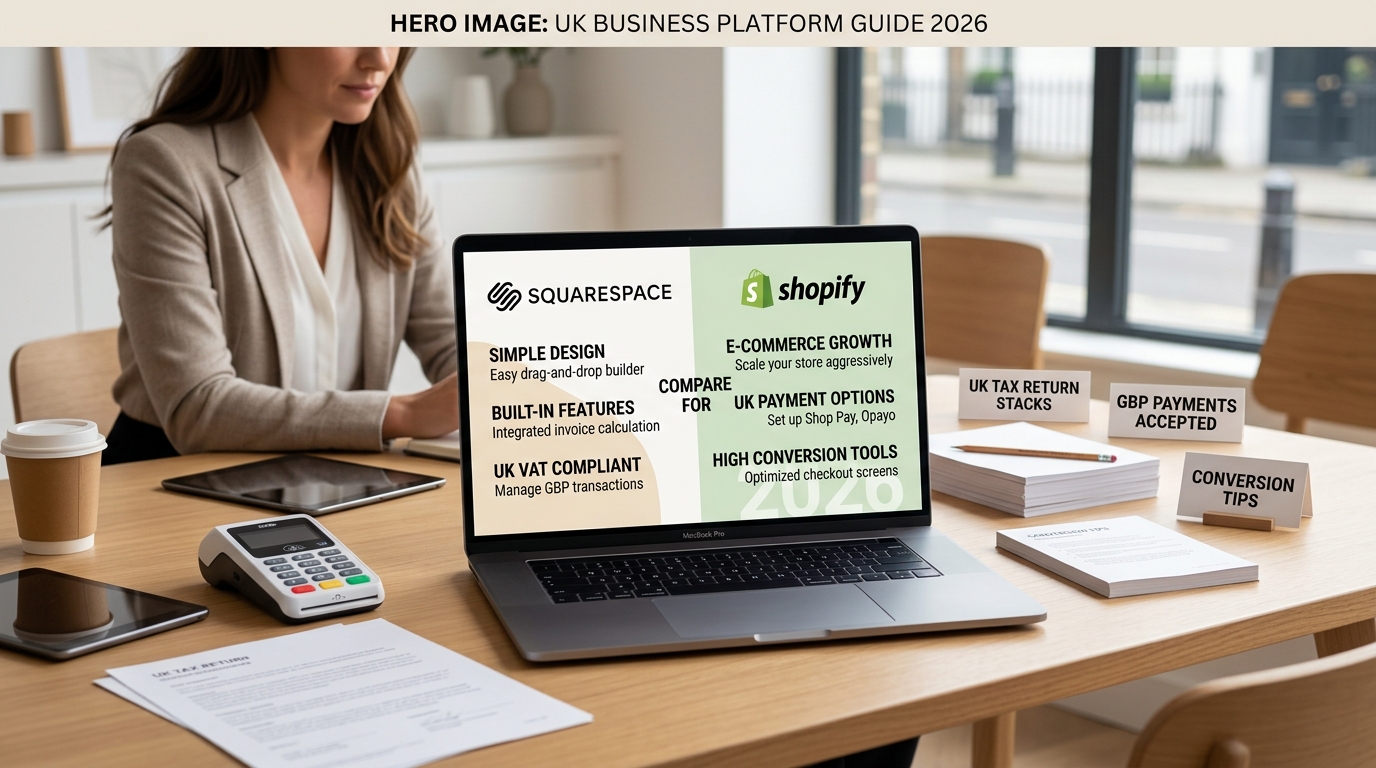
Both Squarespace and Shopify have grown into polished, capable platforms. If you search for a comparison, you'll get tables full of tick boxes and star ratings. What you won't always get is an answer to the question that matters most: which one is right for a UK business trying to actually make money online in 2026?
This article skips the feature bingo and focuses on the three things that tend to trip up UK business owners the most: VAT and tax compliance, payment processing, and turning visitors into customers.
What Each Platform Is Actually Built For
It helps to start with an honest framing. Shopify is, at its core, an e-commerce engine. Everything on the platform, from its checkout to its reporting, is built around selling products. It currently holds around 28% of the global e-commerce market share, which tells you a lot about where its priorities lie.
Squarespace is a website builder that also sells things. It started as a tool for creatives, photographers, and service businesses, and that DNA is still very much there. Think of Squarespace as Canva with a shop bolted on, and Shopify as a shop with a website bolted on. Neither description is unfair.
That distinction matters more than any individual feature comparison.
UK VAT and Tax Compliance
VAT is one of those areas where UK businesses get caught out. If you're VAT-registered, or approaching the threshold (currently £90,000 turnover), your platform needs to handle tax correctly without you having to think about it constantly.
Squarespace has made genuine improvements here. You can configure UK VAT rates, apply them per product, and the checkout will display prices correctly. For most straightforward retail situations, this works well enough. The limitation is that Squarespace's tax tools are relatively basic. If you sell digital goods across the EU (where VAT rules vary by customer location), you'll need to handle a fair amount of that manually or through a third-party integration.
Shopify gives you more control and more complexity. You can set tax rules by product type, apply reduced or zero rates where appropriate (think children's clothing or books), and integrate with specialist tax tools like Avalara or TaxJar for cross-border selling. The trade-off is that you'll need to set this up properly. Out of the box, Shopify doesn't automatically configure UK VAT for you. It requires some manual attention during setup, which is easy to get wrong if you're not sure what you're doing.
For a small UK business selling physical goods domestically, both platforms can handle VAT adequately. If your tax situation has any complexity at all, Shopify's flexibility is worth the extra setup effort.
Payment Processing: What You'll Actually Pay
Both platforms accept the major UK payment methods, including Visa, Mastercard, Apple Pay, and Google Pay. But the costs and integrations differ in ways that add up quickly.
Squarespace uses Stripe as its primary payment processor and also supports PayPal. The transaction fees are straightforward: 0% transaction fees on the Commerce plans, and a 3% fee on the lower-tier Business plan if you want to sell. Stripe's standard processing rate (around 1.5% plus 20p for UK cards as of 2025) applies on top of that. It's clean and uncomplicated.
Shopify Payments is available to UK merchants and removes Shopify's own transaction fees entirely. If you use a third-party payment provider instead (say, you prefer Worldpay or Opayo for business reasons), Shopify charges an additional transaction fee depending on your plan, ranging from 0.5% to 2%. That can sting if you're doing decent volume.
Shopify does support a wider range of payment integrations overall, which matters if your business needs something beyond Stripe and PayPal. Buy now, pay later options like Klarna and Clearpay also integrate more naturally with Shopify, which some UK retailers find useful for higher-value items.
Conversion Optimisation: Which Platform Actually Sells Better
Getting traffic to your site is one thing. Converting that traffic into sales is where the platforms really diverge.
Shopify's checkout is widely regarded as one of the highest-converting in the industry. It's fast, familiar to returning Shopify customers (who can check out with saved details across any Shopify store), and fully customisable on higher plans. You also get access to a huge library of apps for upselling, cross-selling, abandoned cart recovery, and loyalty programmes. Tools like ReConvert, Bold Upsell, and Klaviyo all integrate directly.
Squarespace's checkout is decent but more limited. Abandoned cart recovery emails are available on Commerce plans, and you can run basic discount codes and promotions. What you won't find is the same depth of app integrations. Squarespace has a much smaller third-party ecosystem, so if you want sophisticated upsell flows or detailed A/B testing of your product pages, you'll hit a ceiling fairly quickly.
Where Squarespace does win is on design quality. Its templates are genuinely excellent, and a well-designed store that loads quickly and presents products beautifully will outperform a cluttered Shopify store every time. Good design is a conversion tool in its own right, and Squarespace makes it easier to achieve without a developer.
Which Type of Business Should Choose Which Platform
Rather than a single answer, it's more useful to think about what kind of business you're running.
Squarespace tends to suit:
- Service businesses, consultants, and freelancers who want a professional site with a shop as a secondary feature
- Creative businesses selling a small, curated range of products (prints, courses, memberships)
- Businesses where brand presentation matters as much as selling volume
- Owners who want to manage the site themselves without touching code or apps
Shopify tends to suit:
- Retailers with a growing product catalogue and serious sales ambitions
- Businesses selling across multiple channels (online, in-person via POS, marketplaces)
- Shops that need detailed inventory management, fulfilment integrations, or wholesale pricing
- Anyone planning to scale and needing room to grow without switching platforms later
The Honest Bottom Line
Neither platform is universally better. Shopify is the stronger choice if selling online is the core of your business model and you expect to grow. Squarespace is a better fit if you need a polished, professional web presence and e-commerce is one part of a bigger picture.
That said, many UK small businesses find that neither platform is quite the right fit once their needs get specific. A bespoke website built around your actual customers, your actual products, and your actual sales process will almost always outperform a template-based solution in the long run.
If you're not sure which direction makes sense for your business, it's worth having a conversation with someone who builds for UK businesses day in, day out. We've been doing exactly that since 2006, and we're happy to give you a straight answer.