Every few months, a new roundup appears ranking the best website builders for small businesses. Wix gets a mention. Shopify. Squarespace. Maybe Webflow. They all have their merits, and for getting something online quickly, they genuinely do the job.
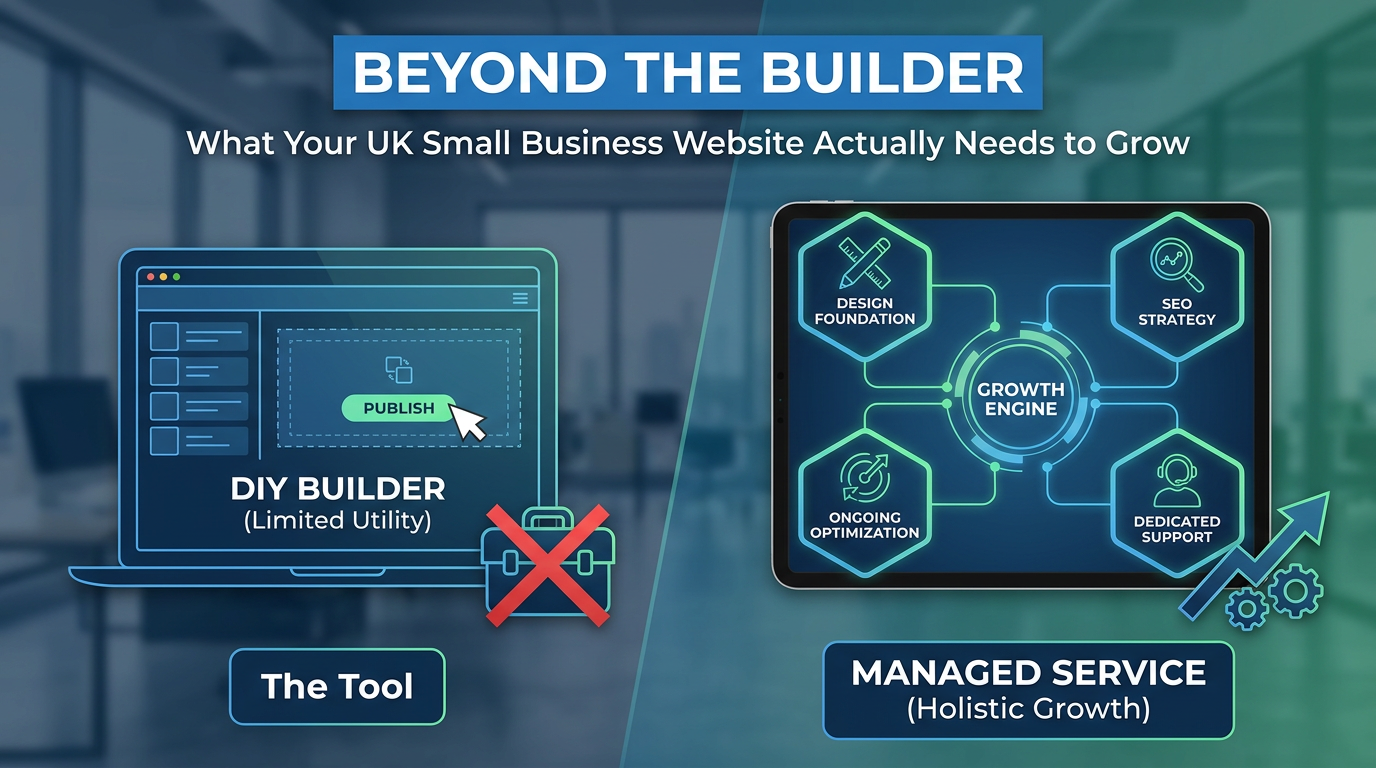
But here's the thing nobody says loudly enough: the builder you choose is not what grows your business. What grows your business is what happens after you hit publish.
The Gap Between 'Online' and 'Visible'
Most small business owners launch a website and wait. Traffic doesn't arrive. Enquiries don't come in. The phone stays quiet. Then someone suggests the site needs SEO, or a redesign, or better copy, and the cycle starts again.
This is the builder trap. These platforms are designed to make launch easy. They are not designed to make your business findable, competitive, or profitable over time. That requires a different kind of thinking from the start.
Getting a site live is the beginning of the work, not the end of it.
What Good Foundations Actually Look Like
Before you pick a platform or a template, it's worth being clear on what a business website needs to do. A useful way to think about it is in layers:
- Design that converts: Not just looks good, but guides visitors toward an action. A clear headline, obvious contact details, and a logical page structure matter more than a clever font.
- Technical SEO from day one: Page speed, mobile responsiveness, clean URLs, proper heading structure, and meta data. These aren't extras you bolt on later.
- Content built around real search terms: The phrases your customers actually type into Google, not just the phrases you think sound professional.
- Ongoing attention: Google rewards sites that are updated, maintained, and improved. A site left untouched for two years sends a quiet signal that nobody's home.
Builders can support some of these things. But they rarely handle all of them well, and they almost never handle the ongoing piece at all.
Where Builders Fall Short
Wix and Squarespace have improved their SEO tools significantly. Shopify is a solid choice for e-commerce. These are fair observations. But there are consistent limitations that matter to UK small businesses trying to compete locally or nationally.
First, template-based design tends to look like template-based design. Visitors have seen these layouts hundreds of times, and trust is harder to build when your site looks like everyone else's in your sector.
Second, SEO on a builder is largely DIY. You can fill in the meta description boxes and install a plugin, but knowing what to write, which pages to prioritise, and how to build authority over time requires knowledge that a drag-and-drop interface cannot give you.
Third, when something goes wrong or you want to make a meaningful change, you're largely on your own. Forum threads and chatbots are not the same as a person who knows your site and your business.
The Case for a Managed Approach
A managed website service works differently. Instead of handing you a set of tools and wishing you luck, someone builds the site with your goals in mind from the outset, handles the technical side, and continues working on it as your business evolves.
This matters for several practical reasons:
- Local SEO for UK businesses requires specific knowledge of how Google ranks service-area businesses, and that knowledge needs applying consistently over months, not days.
- Conversion optimisation is an ongoing process. Small changes to button placement, page headlines, or contact form design can meaningfully affect how many visitors get in touch.
- When Google updates its algorithm (which it does several times a year), a managed service can respond. A builder account cannot.
For trades, service businesses, and local retailers, these differences tend to show up in the gap between a competitor who ranks on page one and one who doesn't.
What to Ask Before You Build
Whether you're starting from scratch or reconsidering an existing site, it's worth asking some honest questions before committing to any approach:
- Do I have the time and knowledge to handle SEO myself, consistently, every month?
- Is my current site generating enquiries, or just sitting there?
- If I search for my own services in my town, do I appear?
- When I last changed something on the site, was it easy or did it take hours?
If the answers make you uncomfortable, a builder might not be the right fit. Not because builders are bad, but because what you need is probably more than a builder provides.
Getting the Balance Right
None of this means avoiding modern platforms entirely. WordPress, for example, sits at the heart of a huge number of professionally managed websites and offers the flexibility that most UK small businesses need to scale.
The point is not which builder wins a feature comparison. The point is that a website is a business asset, and like any asset, it performs better with proper investment and ongoing care.
Starting with the right strategy, design, and technical setup takes more effort upfront. But it tends to pay off far more reliably than a quick launch followed by years of wondering why the phone isn't ringing.
If you'd like a straightforward conversation about where your site stands and what it would take to get it working harder for your business, get in touch with the team at Samson Web Design. No jargon, no pressure.