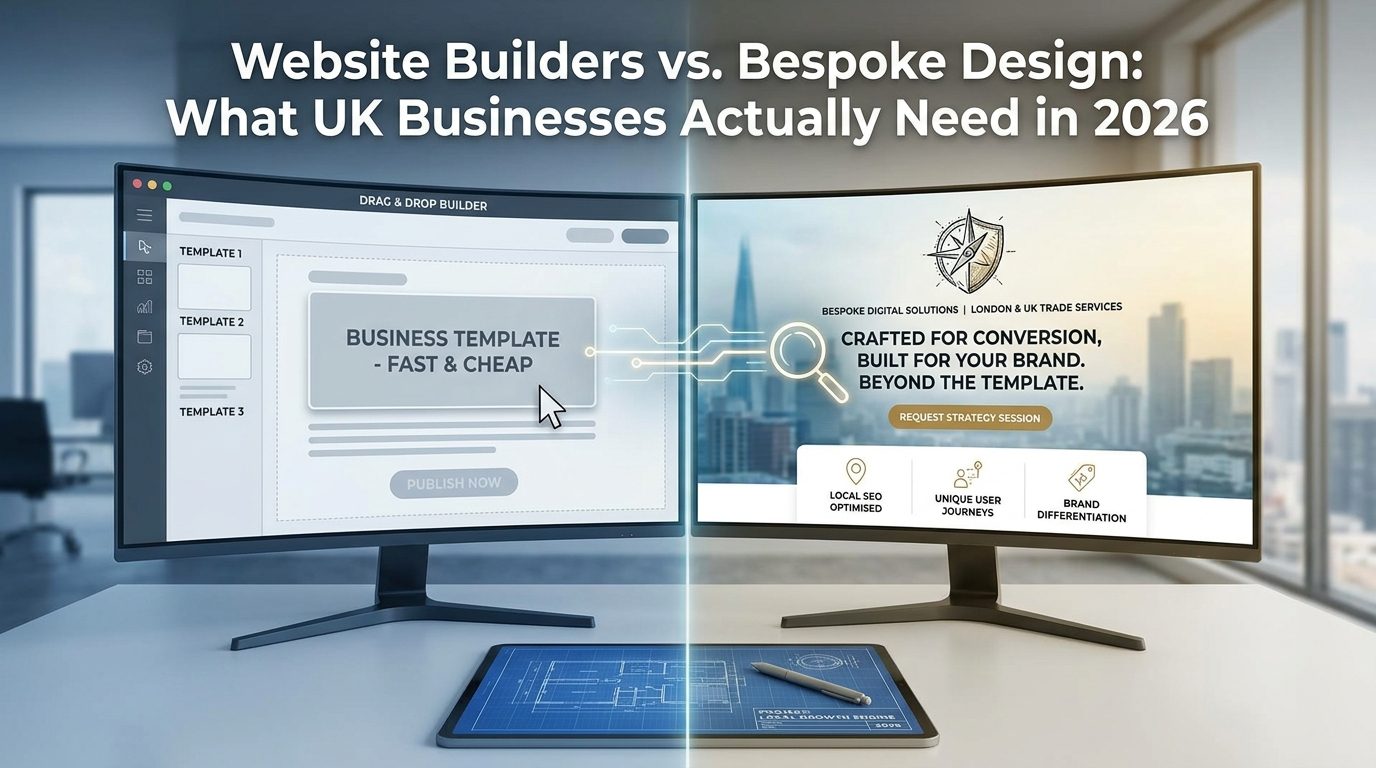
A plumber in Worthing and a plumber in Manchester are not competing with each other. They never were. Yet in 2026, both may be running websites built on the same Wix template, with the same heading structure, the same stock photography of a wrench, and the same three-column layout. That is not a coincidence. It is a systemic problem with how the builder model approaches local business, and it costs real enquiries every week.
The question of which website builder has the slickest drag-and-drop interface is genuinely interesting if you are a tech journalist. If you run a kitchen fitting business in West Sussex, it is almost entirely the wrong question to be asking.
Why the Builder vs. Bespoke Question Hits Differently for UK Service Businesses
Service and trade businesses in the UK compete within tight geographic boundaries. A roofer covering Worthing, Shoreham, and Lancing is fighting for the same pool of customers as two or three other local roofers, not the entire UK market. That hyper-local reality means differentiation cannot be vague. It has to be visible, immediate, and convincing within seconds of a page loading.
The 2026 web is more saturated with template sites than at any point before. Wix alone hosts tens of millions of websites globally. Squarespace, GoDaddy, and Jimdo add millions more. When the dominant template designs are shared across industries and postcodes, a roofing company in Worthing can end up with a layout almost indistinguishable from a personal trainer in Bristol. Generic design no longer signals anything useful to a local visitor. It has become background noise.
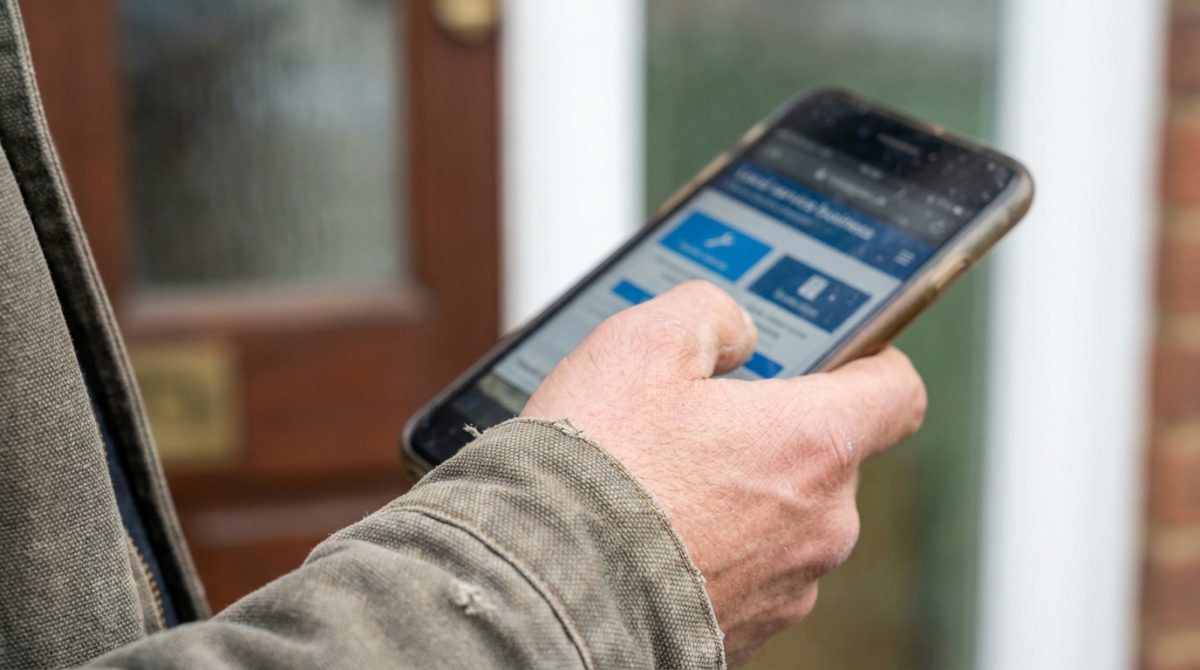
Visitors arriving at a local tradesperson's website are not browsing. They have a problem right now: a boiler that stopped working, a bathroom that needs fitting, a garden that needs landscaping before summer. High intent, low patience. Research consistently shows that users make a credibility judgement about a website within the first few seconds, and for a local service business, that snap decision directly determines whether the phone rings or the back button gets pressed.
This article is not a review of which builder has better ecommerce features or which one offers the most free stock images. It is about a more fundamental question: does the builder model serve the conversion and credibility needs of a business that lives or dies on local trust? For most UK trade and service businesses, the answer shapes every decision that follows.
What Website Builders Actually Give You, and Where They Hit a Ceiling
To be fair to the platforms, the value proposition is real at entry level. Wix, Squarespace, and GoDaddy Website Builder let you get something online in a matter of hours. Pricing typically starts between 9 and 17 pounds per month, hosting is included, SSL certificates are automatic, and basic mobile responsiveness comes out of the box. For a sole trader who needs a digital placeholder while they get established, that is a legitimate option.
The platforms also remove the technical anxiety that stops many small business owners from doing anything at all. You do not need to understand what a nameserver is. You do not need to configure a server or install software. You pick a template, fill in your text, and publish. That genuinely lowers the barrier, and it would be dishonest to dismiss it.
The ceiling, though, arrives faster than most people expect. The first place it shows up is SEO. Every site built on the same platform inherits the same structural patterns: similar heading hierarchies, the same JavaScript rendering approach, comparable page speed profiles at the platform level. Google processes thousands of pages with near-identical technical DNA, which flattens the ranking potential of any individual site sitting on that infrastructure. Standing out in organic search becomes harder, not easier, the more crowded each platform gets.
Wix has worked hard to address its historical crawl limitations, and the platform is meaningfully better than it was five years ago. But its JavaScript-heavy rendering still creates indexing delays compared to a purpose-built CMS like WordPress configured with proper server-side rendering. Pages that take longer to be crawled and indexed are pages that take longer to rank. For a local business trying to win position one for "kitchen fitter Worthing", those delays matter.
The cost argument erodes faster than the pricing pages suggest. A basic Wix plan handles simple pages, but trade businesses typically need booking functionality, quote request forms with conditional logic, or customer-facing portals. These require third-party Wix apps. A booking app might cost 15 pounds per month. A review integration adds another 10. A quote calculator tool pushes the total further. A business that started at 17 pounds per month can find itself paying 60 to 80 pounds once the apps needed to make the site actually functional are stacked on top, without the performance or flexibility that a bespoke build would provide at a similar or lower total cost over time.
It is worth running those numbers against a realistic bespoke alternative. A professionally built WordPress site from a UK agency typically starts at around 1,500 to 2,500 pounds for a small service business, with ongoing hosting and support at 30 to 60 pounds per month. Over three years, the total outlay is roughly 2,500 to 4,700 pounds. A Wix or Squarespace setup with the app stack a trade business actually needs can reach 70 to 90 pounds per month before you factor in any agency time for updates, which puts the three-year cost at 2,500 to 3,200 pounds, on a platform you do not own and cannot fully customise. The gap is smaller than the upfront numbers suggest, and the bespoke site compounds in value as it ranks, converts, and can be modified without platform restrictions.
The deepest ceiling, though, is brand. Every Wix and Squarespace template is used by tens of thousands of businesses across every conceivable sector. A roofing company in Worthing may share its exact layout, colour treatment, and navigation structure with a yoga studio in Leeds and a dog groomer in Glasgow. The template was not designed for any of them specifically. It was designed to be inoffensive and usable by everyone, which means it communicates nothing distinctive about any one of them. For a business where local trust is the primary purchase driver, that homogeneity is a real commercial problem.
The Edge Case Most Builder Users Miss
There is one scenario where the builder ceiling becomes immediately and expensively obvious: when a business tries to scale its local reach by building area-specific pages. A drainage company that wants to target Worthing, Horsham, Crawley, Brighton, and Chichester individually needs five separate landing pages, each with unique content, a locally relevant title tag, and properly implemented LocalBusiness schema that references the correct service area. On a bespoke WordPress build, this is straightforward: duplicate a page template, adjust the location variables, update the schema JSON, publish. On Wix, each page has to be manually rebuilt in the editor because the platform has no native templating system for duplicating structured pages at scale. With Squarespace, schema is largely handled at platform level and cannot be customised per page without injecting raw code into the page header, a process that breaks whenever Squarespace updates its editor. Businesses that skip this step and rely on a single homepage to rank across multiple towns are typically losing to competitors who have even a basic multi-location structure in place.
How Bespoke Design Turns Your Website into a Conversion Tool, Not Just a Brochure
A bespoke build starts somewhere a template cannot: with the specific journey your customer takes before they contact you. Take a homeowner searching for a kitchen fitter on a Saturday morning. They are on a mobile phone. They have probably looked at two or three other sites already. They want to see that you work in their area, that real people have used you and been happy, and that getting a quote involves minimal effort. That is a specific, mappable journey, and every design decision on a bespoke site should serve it.
Custom design allows trust signals to be placed exactly where attention lands. Eye-tracking research has long established that users on a service business page look first at the hero section, then scan left-to-right for a contact mechanism, then look for evidence that the business is credible. A bespoke layout puts a local phone number above the fold, places customer reviews immediately adjacent to the primary call-to-action, and positions accreditation badges (Gas Safe, NICEIC, TrustMark) next to any mention of pricing or service scope. On a template, those elements go where the template allows. On a bespoke site, they go where the customer's eye goes.
Page speed is a design decision as much as a technical one. A bespoke build can be optimised from the ground up, stripping unnecessary JavaScript, using properly sized images, and configuring caching at the server level to consistently score 90 or above on Google PageSpeed Insights. Template platforms add their own overhead: scripts that power the editor, app integrations, platform-level tracking. That overhead is largely outside your control. On a bespoke build, nothing is loaded that does not need to be there.
Structured data markup, commonly called schema, is another area where bespoke builds create a measurable advantage. A trade business needs LocalBusiness schema that specifies service area, opening hours, and review aggregates precisely. This data feeds directly into Google's local pack results, the three-business listing that appears above organic results for searches like "emergency electrician near me". Getting schema right is not difficult for a developer building from scratch. On a template platform, it requires workarounds, plugins, or app add-ons that may not implement the markup cleanly.
The conversion rate difference between professionally designed, conversion-focused sites and generic template sites is meaningful for local service businesses. Consumer intent research consistently shows that design quality directly influences trust decisions, and industry data suggests conversion-focused bespoke sites outperform template equivalents by 30 to 50 percent on lead form completions for local service businesses, because every element is intentional rather than inherited from a layout designed for an unknown use case.
Practical conversion elements that bespoke builds handle cleanly include click-to-call buttons that are prominent on mobile without requiring a plugin, multi-step quote forms that ask no more than four questions before confirming receipt, and area-specific landing pages targeting individual towns within a service radius. None of these are technically impossible on a builder platform. All of them require workarounds, compromises, or additional paid tools that add friction and cost, while still producing a result that sits inside the platform's structural constraints rather than being built around the customer's actual behaviour.
Consider what a poorly converting site costs in real terms. If a bespoke site converts at 4 percent of visitors to enquiries and a template site converts at 2.5 percent, and the business receives 600 visitors per month from local search, that is a difference of nine enquiries per month. At an average job value of 800 pounds for a kitchen fitter or 400 pounds for a plumber, the revenue gap compounds quickly. The design investment pays for itself not because bespoke sites are inherently magical, but because they are built around the one thing a template never accounts for: the specific reasons your specific customers hesitate before picking up the phone.
For a local service business, the website is not a brochure that people happen to find. It is the first and sometimes only interaction a potential customer has before they decide whether to pick up the phone. A site that is merely present is not the same as a site that is built to convert, and local SEO for small UK businesses is increasingly about the quality and specificity of what your site does, not just whether it exists.