Most UK business owners check their Google rankings the same way they used to check their bank balance: reassuring when the numbers look good, alarming when they slip. The problem is that position one is no longer the finish line. A business ranking third for "boiler repair in Brighton" might be getting cited in AI-generated answers dozens of times a day, while the business sitting in first position gets skipped entirely. That gap is widening fast, and most small businesses have not noticed it yet.
The shift is not theoretical. It is happening right now across the searches your customers are running, and the businesses winning are often not the ones with the strongest traditional SEO.
Why Your Google Rankings No Longer Tell the Whole Story
Google AI Overviews now appear across a significant share of UK searches, particularly for informational and comparison queries. Instead of sending every user to the top-ranked page, they pull a synthesised answer from one or more cited sources and display it before the user ever reaches the organic results. Your position one ranking may still exist, but if you are not being cited inside that AI Overview, a large chunk of your potential traffic is resolving its question without clicking through to you at all.
Then there are the platforms operating entirely outside Google's world. ChatGPT Search draws on Bing's index. Perplexity runs its own crawl. A page that ranks number one on Google may receive zero citations from either of those platforms, because they are consulting a different set of sources entirely. For UK businesses that have spent years building Google authority, this is an uncomfortable reality: your hard-won rankings do not automatically transfer.

The data makes this concrete. Only 38% of AI Overview citations come from pages that rank in the top ten for the original query. That means the majority of AI citations are going to pages that a traditional rank tracker would not even flag as performing well. Mid-ranking pages with tightly focused, well-structured content are winning citation slots over pages that have dominated Google for years.
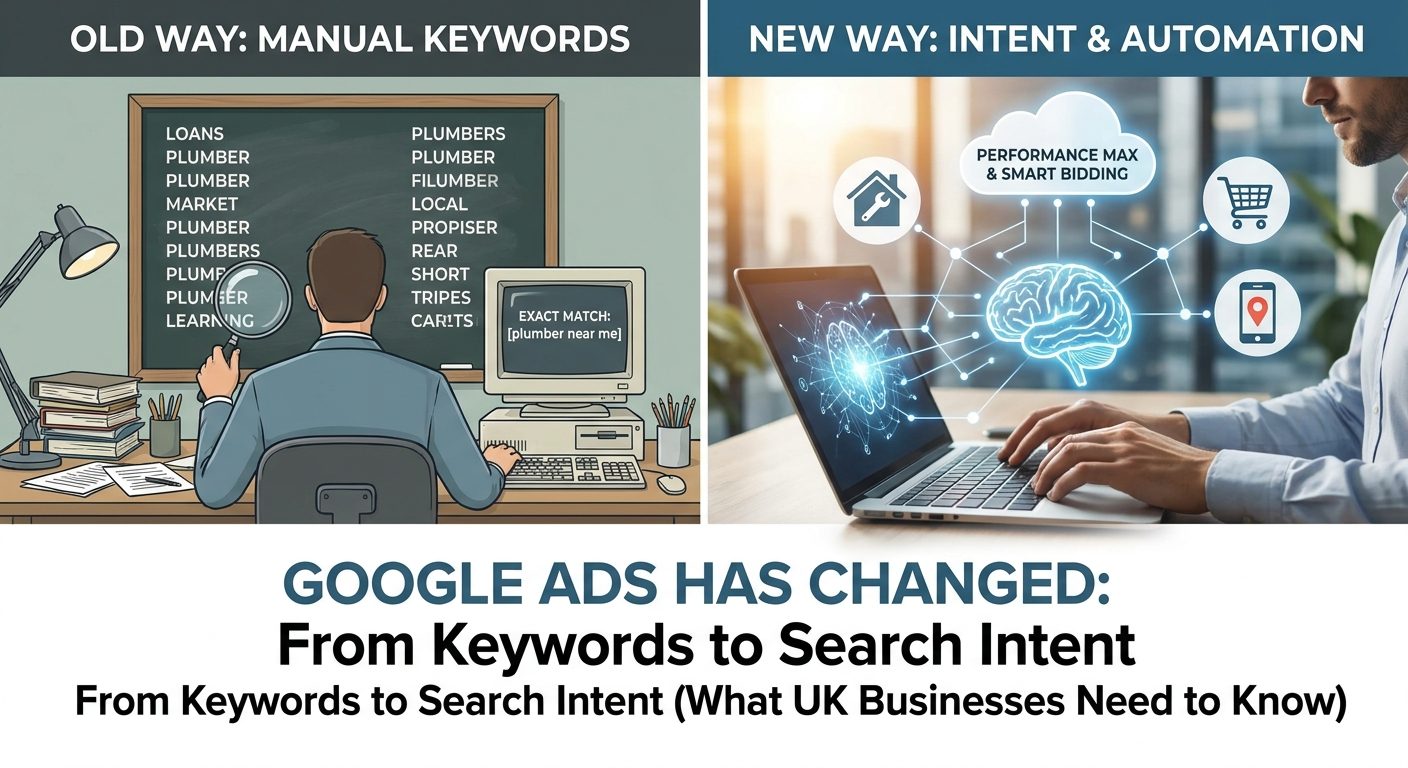
This is a structural change in how visibility works, not a passing algorithm update. The metric that drove search strategy in 2015 was impression share: how often your ad or listing appeared relative to the total available searches. The metric that drives AI search strategy now is citation share, meaning how often your business is actually named or quoted as a source inside an AI-generated answer. These are very different things, and chasing one while ignoring the other is an increasingly expensive mistake.
UK businesses fixated on position one are measuring the old race. The new one started without a formal announcement, and the businesses pulling ahead are the ones that realised early enough to change what they were tracking.
How AI Search Engines Actually Decide Who to Cite
Understanding why you do or do not appear in AI answers requires understanding how these systems actually process a question. They do not simply find the top-ranking page and summarise it. The mechanism is more interesting than that, and once you understand it, you can work with it deliberately.
Google AI Overviews: sub-query decomposition
When a user types a query into Google, the AI Overview system breaks it down into multiple sub-queries and retrieves citations for each one separately. If someone asks "how much does it cost to repoint a chimney in Sussex," the system may be running separate retrievals for chimney repointing costs, chimney repointing in Sussex, how long chimney repointing takes, and whether it needs planning permission. A page that answers one of those sub-questions clearly and specifically can earn a citation even if it ranks nowhere near the top for the original broad phrase.
This is why a focused 600-word page answering a single specific question can outperform a sprawling 4,000-word guide that tries to cover everything. Specificity is a citation signal, not a weakness.
ChatGPT Search: it runs on Bing, not Google
This is the fact most UK businesses miss entirely. ChatGPT Search draws on Microsoft Bing's index. If your site has never been submitted to Bing Webmaster Tools, there is a good chance ChatGPT cannot see it at all, regardless of how strong your Google presence is. The two indices overlap but they are not identical, and a site that has been carefully maintained in Google Search Console for years may still have crawl issues on Bing that nobody has ever looked at. Fixing this takes about ten minutes, and it is covered in detail in the audit section below.
Perplexity: authorship and external references matter
Perplexity blends its own independent crawl with licensed data from sources including Wikipedia and established news publishers. It places higher weight on pages that demonstrate clear authorship, have named authors with verifiable credentials, and are referenced by other credible sources. A service page with no author attribution and no external links pointing to it is a weak candidate for a Perplexity citation, even if it is technically well-optimised for Google.
Topical authority beats single-page optimisation
All three systems share one characteristic: they reward topical depth across a cluster of related content over single pages trying to do everything. A roofing company with five tightly related pages covering flat roof replacement, flat roof maintenance, flat roof costs in West Sussex, how to spot flat roof damage, and a case study of a recent job will outperform a single long page trying to cover all of those angles at once. Each page in the cluster answers its own sub-query, giving the AI system multiple reasons to cite you across multiple related searches.
Structured data gives AI crawlers explicit signals
FAQ schema, HowTo schema, and LocalBusiness schema are not just technical decorations. They are explicit machine-readable signals that tell AI crawlers what a page answers and who is providing the answer. A page with FAQ schema listing specific questions and answers is far easier for an AI system to decompose and cite than a page of flowing prose that covers the same ground. If you have not implemented schema on your key service pages, you are making the AI system do extra work to understand you, and it will often take the easier route and cite someone else instead.
The CTR uplift from appearing as an AI Overview source is modest but real. Semrush research across 7,800 queries found that being cited inside an AI Overview lifts click-through rate from approximately 0.6% to 1.08%. For a small business, that compound effect across dozens of queries adds up. More importantly, citation builds the kind of brand familiarity that influences purchasing decisions even when the user does not click through immediately.
The Baseline Audit Every UK Business Must Do Before Day One
Before you change a single thing on your website, you need to know where you actually stand. Most businesses skip this step and spend months improving things that were not the bottleneck. The audit below takes a few hours, costs nothing, and gives you a clear before-and-after benchmark to measure your 90 days against.
Step 1: run your business through all three AI systems
Open ChatGPT, Google (checking for AI Overviews), and Perplexity. Run your business name through each one and record what comes back. Then run your three most important service queries, for example "emergency plumber in Worthing" or "bespoke kitchen fitter West Sussex," and record whether you are cited, mentioned in passing, ignored completely, or in the worst case, contradicted with incorrect information. Screenshot everything. This is your citation baseline, and it is the single most revealing document you will produce in this entire process.
Pay particular attention to which competitors do appear in those answers. Write down every business that gets cited for your target queries. This becomes your citation gap report and sets a concrete competitive benchmark for the next 90 days.
Step 2: check Google Search Console for crawl blockers
Log into Google Search Console and work through three specific reports. Check the Coverage report for crawl errors and soft 404s, pages that technically load but return no useful content. Check the URL Inspection tool on your five most important service pages to confirm Google can actually render them. Look for any pages marked noindex that should not be. AI crawlers follow many of the same access rules as Googlebot, so a page that is being blocked or deprioritised by Google is likely invisible to AI systems too.
Step 3: register with Bing Webmaster Tools if you have not already
This takes ten minutes if you already have Search Console set up, because Bing lets you import your Google Search Console property directly. Go to bing.com/webmasters, sign in with a Microsoft account, and import your site. Submit your sitemap. That is genuinely it. This single action opens up ChatGPT's index to your content and is the most overlooked quick win available to UK businesses right now. The number of established businesses that have spent years on Google SEO and never done this is surprisingly high.
Step 4: audit your Google Business Profile properly
Google AI Overviews pull heavily from Google Business Profile data for local queries. Log into your GBP and check each of the following:
- Primary and secondary categories are accurate and specific, not just "contractor" when "flat roofing contractor" is available
- Opening hours are current, including any holiday adjustments
- Service descriptions are complete and use the natural language your customers actually search with
- You have at least 10 photos, including photos of your work, your team, and your premises if applicable
- Your phone number, address, and website URL exactly match what appears on your website
Inconsistencies between your GBP and your website create confusion for both Google's AI and for Perplexity's independent crawl. They are easy to miss and disproportionately damaging to local AI visibility.
Step 5: export your GA4 baseline
Go into Google Analytics 4 and export your organic landing page data for the past three months. Record your total organic sessions, your top ten landing pages by organic traffic, and if you can see it, the queries driving traffic to each page via the Search Console integration. This is your pre-plan benchmark. Without it, you will have no reliable way to measure whether anything you do over the next 90 days is working. Save the export somewhere you will not lose it.
Once you have completed these five steps, you have a clear picture of your current AI citation status, your technical crawlability, your Bing presence, your local data quality, and your organic traffic baseline. That is everything you need to start the 90-day plan with confidence rather than guesswork.
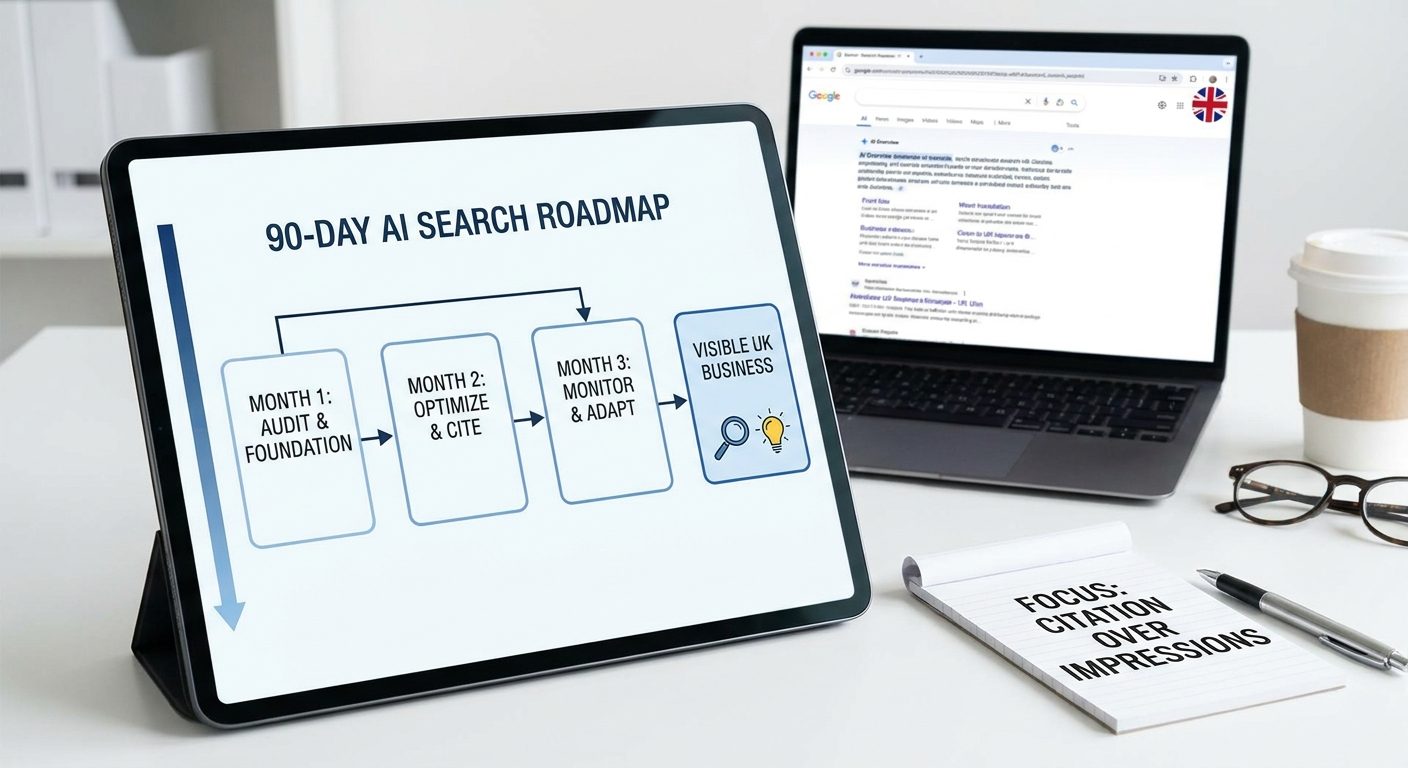
Days 1 to 30: Fixing the Foundation So AI Crawlers Can Find You
Before you write a single word of new content, your website needs to be technically readable by AI crawlers. These systems cannot cite what they cannot cleanly access, parse, and verify. The first 30 days are about removing every obstacle between your site and the systems that decide who gets mentioned.
Start with Core Web Vitals. Your Largest Contentful Paint must be under 2.5 seconds and your Cumulative Layout Shift must be under 0.1. These are the thresholds Google uses internally, and pages that fail them are deprioritised when Google assembles AI Overview sources. Run your key pages through PageSpeed Insights and fix the obvious culprits: uncompressed images, render-blocking scripts, and fonts loaded without a display swap directive.
Next, add LocalBusiness structured data to your homepage and each service page. This markup should include your business name, address, phone number, opening hours, and geo-coordinates. Once it is in place, paste each URL into Google's Rich Results Test and confirm there are no errors. Structured data is how AI systems build a verified picture of who you are, not just what you say.
Implement FAQ schema on your five most-visited pages. Write the questions in the exact conversational phrasing your customers actually use, not the formal language you might use internally. A plumber's customer asks 'How much does it cost to fix a leaking pipe in Worthing?' not 'Pipe repair pricing structure'. AI systems match natural-language queries to FAQ markup, so your phrasing needs to mirror theirs.
Create or update your XML sitemap and submit it to both Google Search Console and Bing Webmaster Tools. Bing powers a significant share of ChatGPT's web browsing, and it is the most overlooked quick win for UK businesses who assume Google is the only feed that matters. Use the URL Inspection tool in both consoles within two weeks to confirm every important page is indexed.
Set up a simple citation-tracking spreadsheet on day one. Twice a week, open ChatGPT and Perplexity, type your target queries, and log three things: whether your domain appears, which specific URL is cited, and what surrounding text the system uses. This baseline log becomes your before-and-after evidence as the 90 days progress.
Fix any NAP inconsistencies across directories including Yell, Checkatrade, Thomson Local, and FreeIndex. AI systems cross-reference these sources to verify that a business entity is real and consistent. A phone number that differs between two directories is a trust signal failure, not a minor formatting issue.
Think of it this way: a Worthing-based plumber who completes this phase correctly gives AI crawlers a clean, verifiable, structured picture of their business before a single word of new content is written. Every subsequent step in this plan builds on that foundation. Without it, even excellent content sits in a fog.

Building a Content Cluster That AI Systems Actually Quote
A single well-written page rarely gets cited consistently by AI tools. What gets cited is a site that demonstrates it genuinely understands a topic from multiple angles. That is what a content cluster does, and it is the most important content investment you will make during this 90-day plan.
How the cluster structure works
One pillar page covers the broad topic at around 1,500 words. Four to six supporting pages each answer a specific sub-question at 600 to 800 words. Internal links connect all of them, flowing in both directions between the pillar and each supporting page. Topical authority built this way means AI tools find multiple reinforcing signals when they evaluate your site, rather than a single page trying to do everything at once.
Take a Worthing accountant as a concrete example. The pillar page is titled 'Small Business Tax Guide for UK Sole Traders' and covers the whole landscape at a useful depth. The supporting pages each own one specific question: 'How Much Can I Earn Before Paying Tax in 2025', 'What Expenses Can a Sole Trader Claim', 'How to Register for Self Assessment', and 'HMRC Late Filing Penalties Explained'. Each of those is a query someone types into ChatGPT or Google, and the accountant's site now has a page that answers it directly.
Lead with the answer, not the preamble
Each supporting page must open with a direct two-sentence answer to its title question before any background, context, or introduction. AI systems extract the first clear answer they find rather than reading the whole page. If your answer is buried in paragraph five after a lengthy introduction about why tax matters for sole traders, the system will move on to a competitor who put the answer at the top.
This is not about dumbing content down. Write the direct answer first, then go deeper below it. The reader who wants more gets more, and the AI system gets a clean, quotable response right at the start.
Include something no one else can replicate
Include at least one original data point, local statistic, or case example per cluster. It could be a figure from your own client work, a reference to local council data, or a specific outcome from a named project. AI systems and the journalists who influence them favour sources that say something that cannot be found anywhere else. Generic, reshuffled content from other sites gives AI crawlers no reason to choose yours over the dozens of similar pages already indexed.
Format headings as questions
Use subheadings formatted as questions throughout every supporting page. 'What does a boiler replacement cost in West Sussex?' outperforms 'Pricing' as a heading because it mirrors the conversational queries that AI tools receive. The same logic applies to every service and trade. 'How long does planning permission take in Worthing?' is a heading that matches real search behaviour. 'Planning' is not.
One topic per page, every time
Avoid the temptation to combine multiple services on one page to save time or reduce the volume of content needed. A page titled 'Web Design, SEO, and PPC Services' gives AI crawlers no clear topic signal and will be cited for nothing specifically. The system cannot confidently attribute expertise in any one area to a page that covers three unrelated disciplines. Separate pages, separate topics, separate chances to be cited.
During days 31 to 60, aim to publish two new cluster pages per week, prioritising the queries where you found a citation gap in your baseline audit. That pace produces 16 to 18 new pages over the period, which is enough to establish genuine topical depth in most niches a UK small business operates in.
Why Local Signals Are Your Unfair Advantage Against Bigger Competitors
Large national brands have bigger budgets, more backlinks, and entire teams working on their search presence. What they consistently fail to do is get specific. They optimise for broad national queries and leave hyper-local territory almost entirely uncontested.
A West Sussex builder who mentions specific towns, postcodes, and local landmarks throughout their content wins local AI citations that a London agency with ten times the budget simply cannot replicate without doing genuine local work. The geographic specificity has to be authentic, and national brands rarely have the patience or local knowledge to fake it convincingly at postcode level.
Google AI Overviews for queries with local intent pull almost exclusively from Google Business Profiles and locally-anchored web pages. The query 'best electrician in Worthing' is a far easier citation to earn than 'best electrician in England' because the competition is genuinely smaller and the signals required are within reach of any local business that does the basics properly. Local intent queries are your fastest path to appearing in an AI-generated answer.
Reviews are a part of this that most businesses underestimate. Ask satisfied customers to leave Google reviews that mention the specific service and location. A review that says 'fitted a new boiler in our home in Shoreham-by-Sea, done in a day and no mess' is indexed text that appears in AI-generated local summaries. A review that says 'great service, would recommend' gives the system nothing geographic to work with. Brief customers on what to include, or include a polite prompt in your follow-up message.
Create a dedicated landing page for each town or borough you serve. These should not be thin duplicates of your main service page with the town name swapped in. Each page should reference local context: nearby roads, recognisable landmarks, area-specific considerations, or local planning rules relevant to your trade. A roofing company covering Worthing, Lancing, Shoreham, and Steyning has four different opportunities to be cited for location-specific queries, each page pulling in different geographic signals.
Consistent citations on UK-specific directories strengthen the geographic entity signals that AI tools use to confirm a business is genuinely local. Yell, Yelp UK, and your local council's business directory are the most important. Some councils in West Sussex maintain active business directories that carry real authority with local search systems. These are free to list on and take under an hour to set up, yet most small businesses never bother.
The Author Trust Problem and How to Solve It in 60 Days
Google's Helpful Content guidelines and AI Overviews both operate on the same core principle: content produced by a named, credentialled individual with real-world experience in their subject ranks higher, gets cited more, and earns more trust from AI systems than anonymous posts published under a generic company name. This is the E-E-A-T framework: Experience, Expertise, Authoritativeness, and Trustworthiness. If your service pages say "written by the Samson Web Design team" or carry no author credit at all, you are scoring poorly on three of those four signals before the AI even reads a word of the content.
The fix is straightforward. Create a dedicated author bio page for the business owner or the lead expert at your company. It should carry their full name, a professional photo, a short professional history (years in the trade, qualifications, previous employers or projects), and any relevant trade memberships. Depending on your sector, that might be FMB membership for builders, CHAS accreditation for contractors, ICAEW registration for accountants, or RICS affiliation for surveyors. These are exactly the kinds of verifiable credentials that AI systems use to confirm that an author is a real, qualified person rather than a content farm.
Once that bio page exists, connect your content to it using author schema markup. This is a small piece of structured data that tells AI crawlers which human being wrote or reviewed each page. Without it, even a well-written author bio sits in a different corner of your site, invisible to the crawler as a meaningful connection. With it, every piece of content you publish points back to a verifiable human identity that the system can cross-reference.
During this same period, aim for one or two mentions from credible UK websites. A piece in your local newspaper, a guest post on a trade association blog, or a member feature on your local Chamber of Commerce website all carry authority signals that AI systems recognise and weigh. You do not need coverage in national publications. A short profile in the Worthing Herald or a contributed article on the Federation of Small Businesses website is genuinely useful at this stage.
Finally, add a "Last reviewed" date to each content page and make sure the date is accurate. AI systems deprioritise stale content, particularly on topics that change regularly: pricing guides, planning regulations, tax thresholds, legal requirements. Updating a page on permitted development rights in West Sussex and adding a genuine "Last reviewed: June 2025" note is not a cosmetic trick. It signals to the AI that a qualified human has recently verified the information, which directly improves the page's chances of being cited.
Days 31 to 60: Accelerating with Structured Answers and Schema
By the start of week five you should have your foundation in place: crawlable structure, author trust signals, and at least the beginning of a content cluster. Days 31 to 60 are about making that content as easy as possible for AI systems to extract, quote, and present inside generated answers. That means schema markup, and more of it than most UK SMEs currently deploy.
Expand FAQ Schema Across Every Service Page
Many businesses add FAQ schema to the homepage and leave it there. That is not enough. Every service page and every cluster support page should carry at least three FAQ entries. The key is how you write the answers: each one should be a standalone paragraph of roughly 40 to 60 words that makes complete sense when read aloud without any surrounding context. An AI Overviews response might lift just that answer and display it directly to the user. If your answer requires the reader to know what came before it in the page, it will not be chosen.
A useful test: read each FAQ answer to a colleague without showing them the question. If they cannot understand what the answer is about, rewrite it. That is the bar AI systems are effectively applying when they select passages to cite.
Add HowTo Schema to Process Pages
If any of your pages explain a process, HowTo schema is one of the most effective structured data types you can add right now. A loft conversion specialist in West Sussex could mark up a page titled "How to Get Planning Permission for a Loft Conversion in West Sussex" with proper HowTo schema, breaking the process into numbered steps with a clear name and description for each. Step-by-step answers are among the most common formats AI systems produce in response to conversational queries, and HowTo schema explicitly flags your content as a pre-packaged version of exactly that format.
Use Speakable Schema on Conversational Pages
Speakable schema tells Google which specific passages on a page are suitable for audio playback or AI reading. Most voice-search queries and many conversational AI queries are answered using short, clearly defined passages. Marking your most direct, jargon-free passages with Speakable schema means the crawler does not have to guess which part of your 800-word page you most want cited. You are labelling it.
Fix Every Image's Alt Text
Google's multimodal AI systems index images alongside the text around them. An image of a completed loft conversion in Worthing with alt text that reads "loft-conversion.jpg" contributes nothing. The same image with alt text reading "completed loft conversion in Worthing, West Sussex, showing dormer window and fitted storage" contributes a local signal, a service signal, and a geographic signal simultaneously. Go through every image on your service pages and update alt text to include the specific service and location. It takes an afternoon and it improves both traditional image search and AI citation signals.
Request Re-Crawls Actively
Once you have updated pages with new schema and revised content, do not wait for Google and Bing to find the changes on their own. Submit each updated URL via the URL Inspection tool in Google Search Console and request indexing. Then do the same in Bing Webmaster Tools using the fetch-and-render function. Passive re-indexing can take weeks. Active submission typically brings crawlers back within 24 to 72 hours. When you are trying to hit citation targets within a defined 90-day window, that difference matters.
By the end of day 60, open your citation tracking spreadsheet and check your progress. At this point you should be able to see measurable movement. A realistic target is that at least two of the five query phrases you identified in your baseline audit are now producing results where your domain appears in at least one AI platform's answer, whether that is Google AI Overviews, ChatGPT, or Perplexity. If you are not seeing that, the most common reason is that the underlying content is still not answering the query directly enough, or that schema markup has not been validated correctly in Google's Rich Results Test.
Measuring Citation Share Without an Enterprise Budget
One of the practical blockers for UK SMEs trying to compete in AI search is the assumption that meaningful measurement requires expensive enterprise software. It does not. You can build a working citation tracking system for close to nothing, and scale it with affordable tools only when the business case justifies the spend.
The Free Manual Method
Set up a recurring weekly task, ideally the same time each week so your data is consistent, to manually test your ten most important query phrases across three platforms: ChatGPT Free, Google Search with AI Overviews enabled, and Perplexity Free. Type each query in as a natural conversational question, the way a real customer would ask it. Log whether your domain appears in the response, what position it is cited in (first, second, or further back), and whether the description of your business or service is accurate.
Record everything in a shared Google Sheet with one row per query per week. Over four to six weeks you will have a dataset that shows you which queries you are gaining ground on, which ones are not moving, and whether any platforms are consistently ignoring you. That is actionable intelligence, built entirely on free tools.
Affordable Paid Tools Worth Considering
If you want to automate the monitoring rather than spending 30 minutes a week on manual checks, there are SME-appropriate options. Semrush's AI Toolkit costs from around 99 USD per month as part of a broader Semrush subscription and tracks AI Overview appearances across a keyword set. SE Ranking's AI Overview tracker is cheaper, typically around 44 GBP per month depending on your plan, and is a reasonable starting point for a business with a modest keyword list. Neither of these is essential in the first 90 days, but if you are running paid search alongside this programme, the overlap in keyword data makes one of them worth considering.
The Three Numbers That Matter
Whether you are tracking manually or using a paid tool, focus on three metrics each week:
- Citation count: how many times your domain appears across all platforms and all queries in that week's check.
- Citation position: whether you are the first source cited, the second, or buried further down where click-through drops significantly.
- Surrounding sentiment: the description the AI places around your citation. Is it accurate and positive, neutral, or factually wrong?
That last point matters more than most businesses realise. AI systems sometimes misread source material and produce citations that misrepresent what your business does, your pricing, or your location. A factually incorrect citation is not a neutral event. It is actively misleading potential customers at the exact moment they are making a decision.
Set Up Google Alerts as a Passive Net
Create Google Alerts for your business name combined with your primary service keywords, for example "Samson Web Design Worthing" and "web design Worthing". These alerts catch new third-party mentions of your business the moment they appear online, often before you know they exist. A local journalist quoting you, a trade directory adding your listing, or a customer review mentioning you by name on a forum can all become useful authority signals if you know about them and can respond to or amplify them quickly.
Handling Incorrect AI Citations
If your weekly check turns up a citation where the AI has stated something factually wrong about your business, treat it as urgent rather than a minor annoyance. Use Google's Search feedback option (the thumbs down icon beneath an AI Overview) and Perplexity's feedback button to flag the error directly. Then go back to the source page that the AI is misreading and rewrite the relevant passage to be more explicit. If the AI says your service covers Brighton when you cover Worthing and surrounding areas, your page probably contains ambiguous location references. Replace them with a clear, direct sentence that leaves no room for misinterpretation. AI systems update their understanding as they re-crawl, and a clearer source page will gradually overwrite the earlier incorrect reading.
Days 61 to 90: Earning Third-Party Citations That Reinforce Your Authority
By day 61, your technical foundations are solid and your content cluster is growing. The final sprint shifts focus outward. AI systems do not just read your website and make a judgement. They weigh what the rest of the web says about you, and a business that only appears on its own pages looks thin compared to one that is referenced, quoted, and named across credible external sources. Off-page citation building is where authority solidifies.
Write one original piece and pitch it to a trade publication
Set aside time in week nine to write a genuine thought-leadership article of around 800 words. Not a sales piece. Something that shares a useful perspective: a pattern you see in your industry, a common mistake your clients make, a practical technique that works. Pitch it to a relevant UK trade publication or a local business magazine such as your regional Business Insider title, a sector-specific journal, or a county chamber of commerce newsletter.
A single bylined article in a credible outlet can generate more AI citation authority than ten pages on your own site. The reason is entity association. When a trusted publication names you as a contributor, AI systems treat that as an external endorsement of your expertise, not just self-reported credentials. One published piece in the right place does real work.
Use ResponseSource to get quoted by journalists
Register a free or paid profile on ResponseSource, which is the UK equivalent of HARO. Journalists from national newspapers, trade magazines, and regional BBC outlets post queries looking for expert comment. When a query matches your area of expertise, respond quickly with a concise, quotable answer of two or three sentences. Do not pad it out. Journalists want usable quotes, not essays.
A single quoted comment in a BBC regional news piece or a national trade magazine is a high-authority citation that AI tools treat as a trust signal. These mentions are especially powerful because they combine topical relevance with the domain authority of a well-known media outlet. Set aside 20 minutes twice a week to check your ResponseSource dashboard throughout this phase.
Submit to data aggregators
ChatGPT and Perplexity do not rely solely on crawled web pages to resolve business entity information. They also draw on structured business data from aggregators including Data Axle and Acxiom UK. If your business name, address, phone number, or trading description is inconsistent across these databases, the AI cannot confidently resolve your entity and may suppress or omit your citations entirely.
Go through the submission or correction process for both Data Axle and Acxiom UK during week ten. It is not glamorous work, but it closes a gap that many UK businesses never think to check. Treat it the same way you treated directory consistency in the first 30 days: a one-time fix with ongoing compound benefit.
Publish structured client testimonials
Ask five happy clients for a testimonial during this phase. The format matters. Publish each one on your website with the person's full name, their company name, and their location. A testimonial from "Sarah, Director of a Brighton accountancy firm" is far more useful than "S.T., happy customer." AI systems are increasingly cross-referencing social proof as part of their trustworthiness assessment, and named, verifiable testimonials carry more weight than anonymous ones.
Adding Review or Testimonial schema markup to these entries makes them machine-readable and ensures AI crawlers can interpret the structure correctly rather than guessing at it.
Show up in public professional conversations
Aim to engage genuinely in one or two LinkedIn posts or industry forum discussions each week throughout days 61 to 90. Answer a question in a Facebook group for your trade. Respond to a LinkedIn post in your sector with a useful, specific comment. Post a short observation from your own experience on your LinkedIn profile.
Public professional conversations where you give useful, substantive answers create indexable content about your expertise. AI crawlers can find these exchanges, attribute them to you, and use them to build a picture of what you are knowledgeable about. The key word is genuine. Generic agreement adds nothing. A specific, useful answer that someone could act on is the thing that gets noticed.
What Can Go Wrong and How to Avoid the Three Costliest Mistakes
Most businesses that follow a plan like this will see real progress. But there are predictable failure modes, and a few of them are costly enough to set you back further than if you had done nothing at all.
Mistake one: building content before fixing crawlability
The single most common error is jumping straight to content production because it feels productive. If Googlebot or Bingbot cannot reliably access and index your pages, no amount of well-structured content will earn AI citations. The audit in phase one is not optional preparation. It is the thing that determines whether everything else works. A page that is blocked by a robots.txt error or sitting behind a slow server load does not get cited, regardless of how good the writing is.
Fix your technical foundations first. Every time, in that order.
Mistake two: thin location pages
Many small businesses, especially trades and service providers, try to build AI visibility by creating a separate page for every town they serve, swapping out the place name while keeping everything else identical. Google's Helpful Content system actively suppresses these pages. Worse, a cluster of thin, near-duplicate pages can drag down the perceived quality of your entire domain, reducing citation likelihood across pages that were actually useful.
If you serve multiple locations, each page needs genuinely distinct content: local landmarks, specific service context, real customer references from that area. If you cannot write something meaningfully different, combine the locations into a single regional page rather than diluting your domain authority across ten empty ones.
Mistake three: stopping measurement after month one
The citation landscape is not static. New content enters the index constantly. AI systems retrain on updated data. A query where you appeared in week six might return a different answer in week fourteen because a competitor published something better, or because the AI model weighted a new source more heavily. Businesses that check their citation spreadsheet diligently for 30 days and then abandon it lose the ability to spot these shifts before they compound.
The tracking habit built in days 31 to 60 must continue beyond day 90 as standard practice. Treat it like checking your Google Search Console impressions: a routine, not a one-off project.
The five-minute registration error with months of consequence
A business that skips Bing Webmaster Tools registration will never appear in ChatGPT Search-cited answers, regardless of content quality. ChatGPT Search uses Bing's index as its primary crawl source. If Bing has not verified and properly indexed your site, you are invisible to it. Registration takes five to ten minutes. The cost of skipping it is exclusion from the entire ChatGPT Search index for as long as you leave it undone. There is no workaround. Just do it on day one.
Spreading citation monitoring across platforms from the start
Businesses that built their entire AI visibility strategy around Google SGE in 2023 found themselves exposed when the product changed significantly. Concentrating all your effort and measurement on a single AI platform creates a fragility that one product update can destroy. From day one, monitor your citation presence across at least three platforms: Google AI Overviews, ChatGPT, and Perplexity. They use different sources, weight signals differently, and update on different cycles. Diversity here is not extra work. It is basic risk management.
Your 90-Day Checklist and What Comes Next
Use this as a working document. Print it, copy it to a Notion page, or paste it into a shared Google Doc. Tick things off as they are completed, not as they are started. The goal is a clear record of what has actually been done, because that is what you will need when you review progress at the end of each phase.
Days 1 to 30: the foundation checklist
- Bing Webmaster Tools registered and site verified
- Core Web Vitals passing in Google Search Console (all three metrics green)
- LocalBusiness schema live on all key pages
- FAQ schema added to your top five pages
- Citation gap report completed across six major UK directories (Google Business Profile, Bing Places, Yell, Thomson Local, Scoot, Foursquare)
- NAP (name, address, phone number) consistent and identical across all six directory listings
Days 31 to 60: the content and structure checklist
- Two cluster pages published per week throughout this phase
- HowTo schema added to any step-by-step content
- Speakable schema added to key FAQ and answer sections where relevant
- Author bio page live with Person schema markup
- Citation tracking spreadsheet showing at least four weeks of weekly data across three AI platforms
- At least one external mention or link secured from a relevant source
Days 61 to 90: the authority-building checklist
- One bylined article pitched to or published in a relevant UK trade or local business publication
- ResponseSource profile active with at least two query responses submitted
- Five client testimonials published on site with full name, company, and location, plus Review schema markup
- Data Axle and Acxiom UK listings verified and consistent
- Citation count improved on at least three of your ten target queries compared to your day-one baseline
After day 90: what the work looks like from here
The 90-day sprint ends, but the advantage you have built only holds if it is maintained. Review your content cluster once per quarter and identify gaps: new questions your audience is asking, topics a competitor has published on, or areas where your existing pages are starting to feel dated. Refresh any page that contains prices, regulations, or industry statistics at least once a year, because outdated specifics are one of the fastest ways to lose citation trust.
Add one new content cluster per quarter, targeting emerging queries in your sector. If you serve the trades and a new building regulation is due to come into force, publish ahead of the change. If you are an accountant and HMRC updates a threshold, be the first clear explanation in your local market. Timing relevance is an edge that bigger competitors are often too slow to exploit.
The shift from impression share to citation share is not a passing trend. It reflects a permanent change in how people retrieve information, driven by a genuine shift in user behaviour rather than a platform experiment. Search is increasingly conversational, and conversational search rewards businesses that have demonstrated expertise, consistency, and trustworthiness across the whole web, not just on their own homepage. UK small businesses that build citation authority now will compound that advantage as AI search grows, because early, well-structured authority is harder to displace than late, hurried catch-up work.
If any part of this process feels unclear or you are not sure where your business currently stands, Samson Web Design works with UK businesses at every stage: technical audits, schema implementation, content strategy, directory clean-ups, and ongoing citation monitoring. You do not need to work through this alone, and you do not need an enterprise budget to do it properly. A clear plan, applied consistently, is what separates the businesses that show up in AI answers from the ones that do not.