If you run a building or trades business in the UK, most of your best customers start their search on Google. They type something like "builder in Worthing" or "kitchen fitter near me", scroll past a couple of results, and call whoever looks most credible. If your business is not showing up in those results, you are handing jobs to your competitors before the phone even rings.
Local SEO is the process of making your business more visible to people searching in your area. It does not require a huge budget or technical expertise. What it does require is consistency and knowing where to focus your energy.
Why Local Search Matters More for Trades Than Almost Any Other Industry
Construction and trades are intensely local by nature. A homeowner in Brighton is not going to hire a builder based in Manchester, no matter how good the reviews are. That means the competition in your area is finite, and ranking well locally is genuinely achievable for most businesses that put in the work.
According to research from MDM Marketing, "near me" searches for construction services have grown over 900% in recent years. That is not a typo. And 87% of people searching for construction services contact only one company. So being visible at the top matters enormously. Second place is often no place at all.
Start With Your Google Business Profile
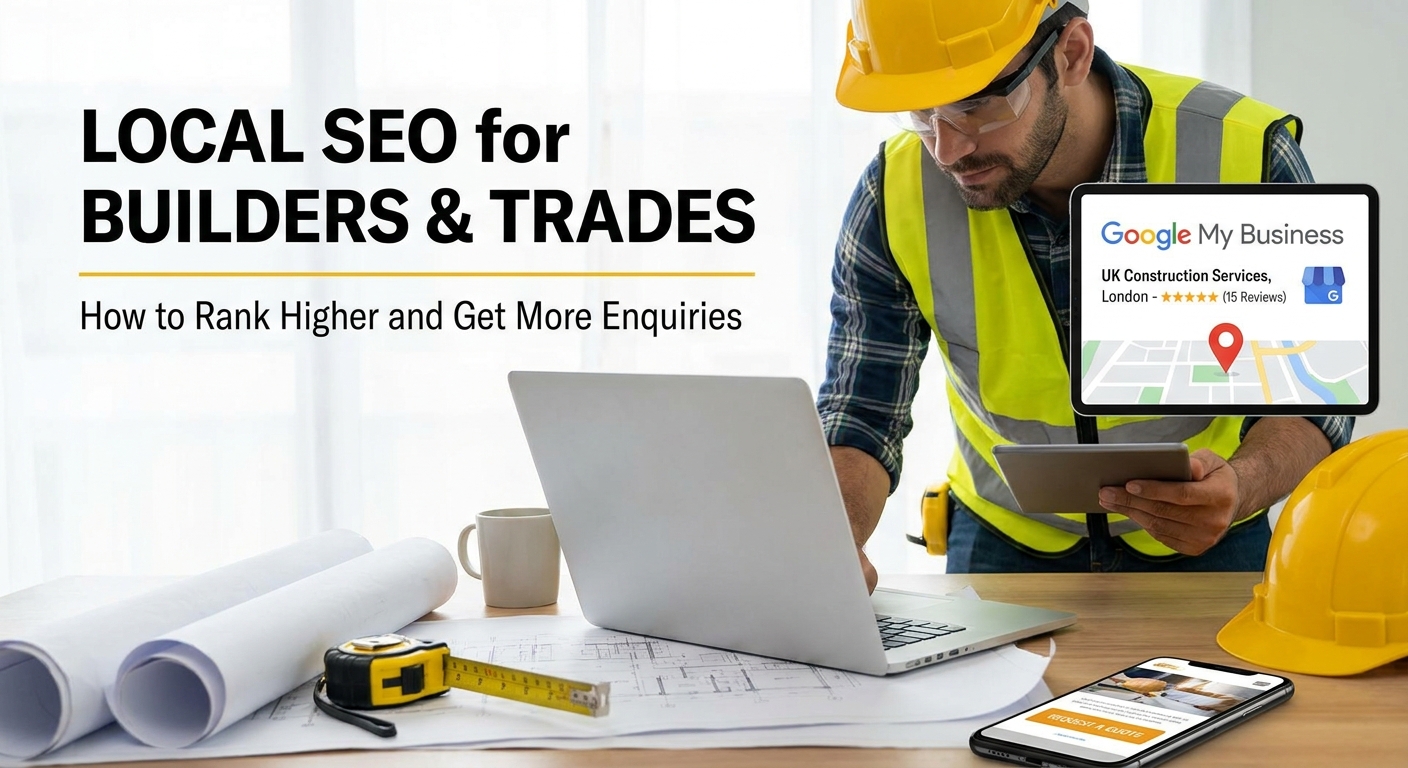
Your Google Business Profile (previously called Google My Business) is the single most important local SEO asset you have. It is what powers the map results that appear when someone searches for a builder in your town. If you have not claimed your profile yet, go to google.com/business and do it today.
Once you have access, here is what to focus on:
- Fill in every section completely, including your business category, service areas, opening hours, and a full description of what you do.
- Upload genuine photos of your completed projects. Real photos of real work convert far better than stock images.
- Add your services individually, with short descriptions and prices where you can.
- Keep your Name, Address, and Phone number (NAP) identical to what appears on your website and any other directory listings.
Google rewards profiles that are active and complete. Post updates occasionally, such as a recent project or a seasonal offer. It signals that the business is live and engaged.
Reviews Are Not Optional, They Are Fundamental
For trades, trust is everything. A homeowner letting a builder into their property is taking a risk, and they want reassurance before they pick up the phone. Reviews on your Google Business Profile provide exactly that reassurance, and they also improve your rankings directly.
The businesses that dominate local search in the trades sector tend to have significantly more reviews than their competitors, and they respond to every single one. Getting reviews does not have to be awkward. A simple follow-up message to a happy customer, with a direct link to your Google review page, works well. Aim to collect them consistently rather than in one big burst.
When a negative review does appear (it happens to everyone eventually), respond calmly and professionally. A measured reply shows prospective customers that you take your work seriously and handle problems like an adult.
Target the Right Local Keywords on Your Website
Your website needs to talk in the same language that your customers search in. That means being explicit about where you work and what you do. A page that simply says "we offer building services" is not going to rank for much. A page that says "loft conversion specialists serving Worthing, Brighton, and Chichester" gives Google (and your visitors) something concrete to work with.
Some practical ways to build local keywords into your site:
- Create individual service pages for each main trade or project type you offer (extensions, loft conversions, bathroom fitting, etc.).
- Mention the towns, boroughs, and areas you cover naturally throughout the page content.
- Add a dedicated "areas we cover" page if you work across multiple locations.
- Use your town name in page titles and meta descriptions, for example: "Kitchen Fitter in Worthing | Smith Joinery".
Avoid stuffing keywords in awkwardly. Write for the reader first, and the search engine will follow.
Get Listed on Directories and Trade Platforms
Beyond Google, there are several directories that carry genuine weight for UK trades. Checkatrade, Rated People, TrustMark, and the Federation of Master Builders (FMB) membership directory all pass credibility to your business both in terms of trust with customers and in terms of SEO signals. These external links pointing back to your website tell Google you are a real, established business.
Make sure your business name, address, and phone number are consistent across all of them. Even small differences (like "St" versus "Street") can dilute the signal. There are free tools like BrightLocal's citation tracker that can help you audit this.
Your Website Needs to Convert, Not Just Rank
Getting to the top of Google is only half the job. Once someone lands on your site, it needs to give them a reason to get in touch. A surprising number of trades websites lose enquiries because they make it too difficult for a visitor to take action.
Here are the basics that every builder or trades website should have:
- A clear phone number at the top of every page, clickable on mobile.
- A simple contact or quote request form that does not ask for more information than necessary.
- Photos of your actual work, ideally before and after shots.
- A few sentences about who you are, how long you have been trading, and the areas you cover.
- Social proof: a handful of reviews or testimonials visible on the homepage.
Mobile experience matters too. Most people searching for a local builder are doing so on their phone. If your site loads slowly or is hard to navigate on a small screen, you will lose them to a competitor within seconds.
Building a Local Reputation Takes Time, But It Compounds
Local SEO is not a one-off task. It is an ongoing process of keeping your Google Business Profile active, collecting reviews, updating your website, and staying consistent across directories. The good news is that most of your competitors are not doing all of this well, which means there is real opportunity for trades businesses willing to put in regular effort.
Start with the Google Business Profile and reviews, since those two things will have the most immediate impact. Then work on your website content and directory listings over time. If you are not sure where your site currently stands, a quick audit from a local web design or SEO agency can highlight the gaps and help you prioritise.
Done properly, local SEO becomes one of the most cost-effective sources of new work a trades business can have. No referral network required. Just you showing up where your customers are already looking.