Type 'how much does a boiler service cost' into Google right now and watch what happens. Before you reach a single link to a local heating engineer or a trade association page, you will see a block of text at the top of the screen that answers the question directly, completely, and for free. That block is a Google AI Overview, and it is already live in the UK. For small businesses that have spent years climbing search rankings, it changes everything about how customers find them.
The rules that governed SEO for the last decade were written for a results page that no longer exists. If your strategy was built around ranking on page one and capturing traffic from informational searches, you are optimising for a page your customers are no longer actually seeing.
The Search Page Your Customers Are Actually Seeing in 2025
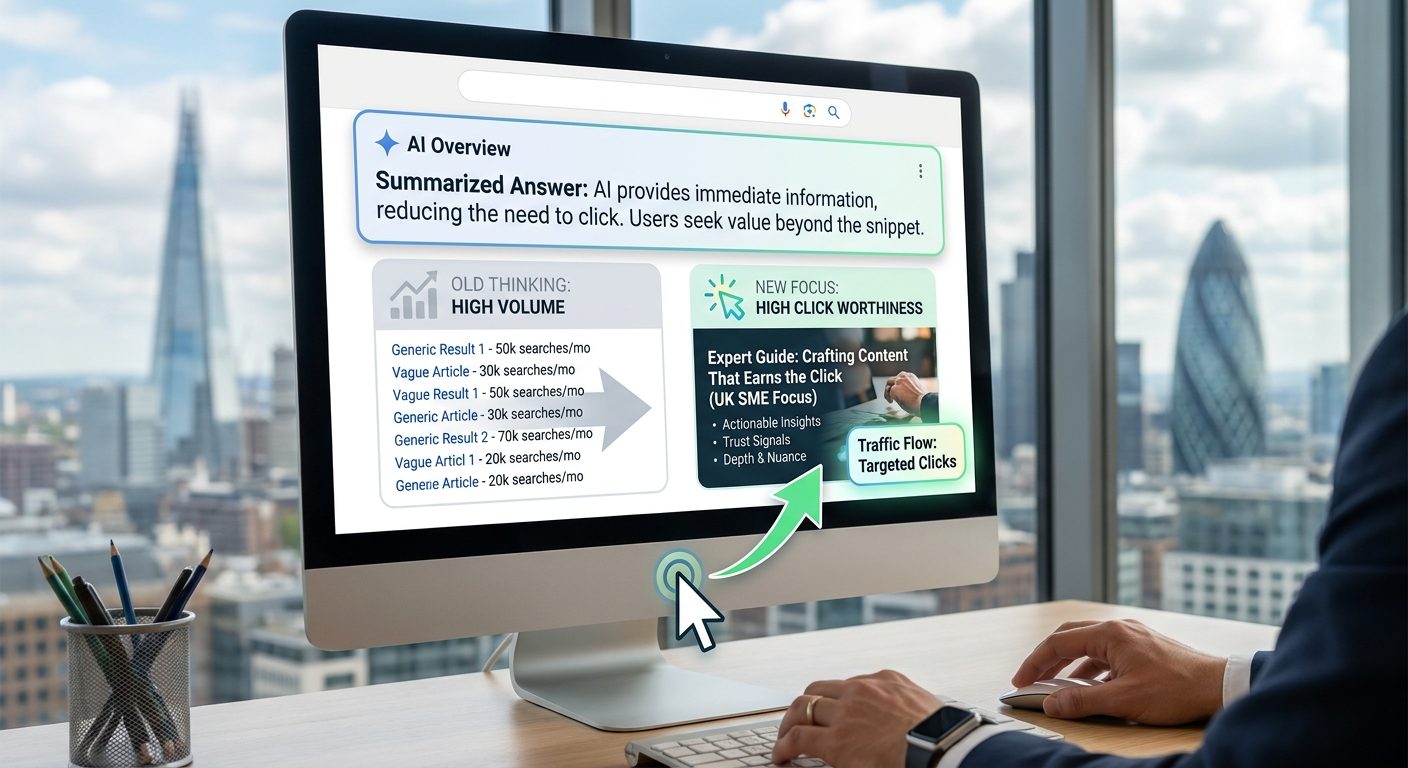
Google AI Overviews are fully live in both the US and the UK as of 2025. They sit at the very top of a search results page, above every organic ranking, above every paid ad in many cases, and they present a synthesised, conversational answer to the user's question before a single blue link is shown. The experience looks less like a list of results and more like a knowledgeable assistant who has already read every relevant page on the internet and summarised it for you.

For a UK plumber, a solicitor, or a florist, the practical effect is immediate. A customer searching 'how much does a boiler service cost' can now read a complete, credible answer before they ever reach your website. The AI Overview will typically state a price range, explain what the service includes, and note what factors affect the cost. Many users will read that, feel satisfied, and close the tab. They got what they came for. You got nothing.
The same pattern applies across almost every common informational query a small business might have historically targeted. 'Do I need planning permission for a loft conversion?' 'What does a no-win no-fee solicitor actually charge?' 'How long do cut flowers last?' These are questions that used to drive steady traffic to well-optimised blog posts. Today, the answer is handed to the user before they even glance at the organic results below.
It is worth noting that Google's own position on this is more nuanced than a simple 'AI kills clicks' story. Google confirmed in a blog post that people are actually searching more often and asking longer, more complex questions partly because AI Overviews encourage follow-up queries. When someone gets a quick answer to a simple question, they often ask a deeper one next. That does create new opportunities, but it also means the nature of the traffic that reaches your site is shifting, and volume alone no longer tells you whether that traffic will materialise at all.
What is equally clear is that this is not a future-tense concern for UK businesses. BBC News has reported on businesses already scrambling to rethink how they present information online, not preparing for a change that is coming but responding to one that has already arrived. The businesses that are struggling are the ones who built their content strategy around answering the questions their customers type into Google. That was smart advice in 2018. In 2025, it can mean producing content that feeds the AI rather than feeding your own traffic.
The page your customers are actually seeing now has a fundamentally different structure from the one your SEO strategy was designed for. Understanding that gap is the starting point for everything else covered in this article.
Why Search Volume Has Become a Misleading Compass
Search volume is a count. It tells you how many times a query was typed into Google in a given month. It does not tell you how many of those searches produced a click to any website. It never did, entirely, but the gap between 'searched' and 'clicked' used to be small enough that volume was a reliable proxy for traffic potential. That gap has now widened to the point where, for many queries, it is not a useful proxy at all.
The clearest demonstration of this comes from Moz, a company whose entire business is built on SEO expertise. Moz published data showing they rank number one for a keyword with 165,000 monthly searches, yet they suffered a 50 percent drop in organic traffic to that page after AI Overviews expanded. Number one. 165,000 searches a month. Half the traffic, gone. If that can happen to Moz, it can happen to any UK business chasing informational keywords on the basis that high volume means high reward.
The mechanism is straightforward. A first-place ranking used to mean you captured somewhere between 25 and 35 percent of all clicks on that query, depending on the research you cite. The AI Overview now sits above your result and absorbs a large portion of that attention. Users read the answer, decide it is sufficient, and leave. Your position one listing may as well be position three or four in terms of the traffic it actually delivers, because the user's decision to click or not click is made before they reach you.
For UK SMEs working with limited content budgets, this transforms the risk calculation entirely. Commissioning a series of blog posts targeting high-volume informational keywords used to be a relatively safe bet: rank well, capture traffic, build authority. Today, those are precisely the posts most likely to be absorbed by AI Overviews without generating a single click. Semrush's research reinforces this, noting that AI Overviews appear most frequently on low-competition, informational searches, which are exactly the types of queries a small business with a modest domain authority was previously most able to compete on.
The practical problem is compounded by the tools most business owners and small agency teams use to plan content. Google Keyword Planner, Semrush, Ahrefs, Ubersuggest: all of them display search volume as the headline metric. It is the biggest number on the screen. It is what gets highlighted in agency reports and keyword research documents. The entire infrastructure of keyword research nudges you toward exactly the content AI is most likely to intercept, because high-volume informational queries are the natural habitat of AI Overviews.
None of this means search volume is useless. It remains a reasonable signal of topic demand. If a lot of people are searching for something, that topic genuinely matters to your audience. The error is treating volume as a standalone indicator of content worth creating. Volume now needs to be paired with a second, harder question: after the AI Overview answers this query, will anyone still feel the need to click through to a website? And more specifically, will they feel the need to click through to yours?
That second question is what click worthiness is about, and it is the metric that should sit alongside volume in every content decision a UK small business makes from this point forward.
What Click Worthiness Actually Means in Plain English
Click worthiness is not a score you pull from a dashboard. There is no tool that calculates it for you, at least not yet in any reliable form. It is a judgement you apply before you decide what content to create or which keywords to target. The question is simple: if AI answers this query perfectly, does our page still get the click?
For some queries, the honest answer is no. 'What is conveyancing?' is a clean example. AI can define conveyancing thoroughly, explain the stages involved, describe what a conveyancer does, and answer every likely follow-up question, all without referencing any specific law firm. A user searching that query has no reason to visit your solicitor's website after reading the AI summary. They got a complete answer. Your blog post on the subject, however well-written and thoroughly optimised, is not competing with other websites for that click. It is competing with AI itself, and it will lose most of the time.
Now shift the query slightly. 'Conveyancing solicitor Worthing fixed fee.' That search has high click worthiness. AI cannot tell the user what a specific firm charges. It cannot show them a real fixed-fee quote from a business in their town. It cannot let them book an initial consultation or pick up the phone. The answer to that query requires a specific business, a real price, and a way to act on it. All three of those things live on your website and nowhere else.
Three categories tend to drive genuine click worthiness, and it helps to think about them before writing a single word of content.
- Trust in a specific business: The user needs a quote, a consultation, a recommendation from a real person, or a service provider they can hold accountable. AI can describe what a service involves but it cannot be that service provider.
- Genuinely exclusive content: Original data, personal expertise built from real cases and real jobs, local knowledge that exists nowhere else on the internet. AI synthesises what already exists. If your content is based on something it has not seen, you have an edge.
- Actions only your site can complete: Booking a job, purchasing a product, filling out a contact form, getting a real-time quote. AI Overviews answer questions. They do not replace transaction points.
The framework is editorial before it is technical. It asks you to sit with a proposed piece of content and honestly assess whether a well-informed user, having just read an AI summary on the topic, would still have a concrete reason to visit your page specifically. If the answer is 'maybe, because our post goes deeper', that is not click worthiness. Deeper information is still information, and AI is very good at summarising it.
Where click worthiness becomes a genuinely useful filter is in stripping out the content decisions that feel productive but are now close to pointless for traffic purposes. Writing a 1,500-word explainer on 'what is an HMO licence' might feel like solid, helpful content for a letting agent. But AI can explain HMO licencing completely. The question has near-zero click worthiness unless it is combined with something only a local letting agent can offer: the specific rules for a particular council area, a checklist based on properties your team has actually inspected, or a direct route to a consultation call.
The editorial question this framework imposes is a useful discipline even beyond SEO. It pushes businesses to ask what they actually know that no one else knows, what they offer that no algorithm can replicate, and where their website is the only logical next step for a customer who already has the general picture. Those are the pages worth building in 2025. They are also, not coincidentally, the pages most likely to earn citations within AI Overviews themselves, which is a visibility play covered later in this article.
The Three Query Types That No Longer Send Traffic to Small Business Sites
Understanding which searches have stopped delivering visitors is the most practical audit any UK small business can do right now. There are three distinct query types where AI Overviews have effectively replaced the need to click through, and if your blog or service pages are built around any of them, the traffic you think you are earning may already be gone.
The first and highest-risk category is broad how-to and what-is queries. Questions like 'how to write a business plan', 'what is VAT', or 'how does a heat pump work' are fully answerable in a few hundred words of coherent prose. AI handles all three without breaking a sweat. Google's AI Overview reads the question, synthesises an accurate answer from multiple sources, and the person searching reads it, closes the tab, and gets on with their day. Your article ranking in position four contributes to the AI's knowledge base and earns you nothing in return.
Semrush's 2025 data confirms that AI Overviews appear most frequently on low-competition informational searches. That is a pointed finding, because low-competition informational content is exactly what small business blogs have leaned on for years. It was the accessible route into visibility: find a question your customers ask, write a thorough answer, earn a ranking. That route now leads to a ranking that drives no clicks.

The second category is definition and explainer content. Glossary pages, standalone FAQ pages, and 'beginner's guide' articles built around a single concept lose their function when AI can synthesise the same explanation on demand. A Sussex accountancy firm's page titled 'What is the Annual Investment Allowance?' used to earn steady traffic from small business owners who wanted a plain-English explanation. Now that explanation appears in the search result itself. The page still exists, still ranks, but the person who would have visited it already has their answer.
The third category is comparison queries without a transactional hook. 'Gas boiler vs heat pump pros and cons' is a useful search. It is not a buying signal. The person asking it wants to understand their options, not call a supplier. AI delivers a balanced comparison, the reader feels informed, and no heating engineer in Worthing receives an enquiry. The query has volume. It sends nobody anywhere.
The traffic consequences are severe. Research highlighted by The Guardian found that pages previously ranked in position one can lose up to 79 percent of their visitors when an AI Overview appears above them. Position one used to mean dominance. Now it can mean a front-row seat to watching AI absorb the audience you spent months earning.
The practical implication for a Worthing-based trades business, a Sussex accountancy firm, or any UK service SME is this: go through your existing blog posts and sort them into these three categories. Any post that is a how-to with no local or proprietary angle, any page that is essentially a glossary entry, and any comparison piece with no call to action is now working primarily as training material for AI, not as a source of enquiries for your business. That is a meaningful distinction.
This is not an argument to delete all informational content from your site. Informational content still serves purposes: it builds topical authority, it supports internal linking, and in some cases it earns citations inside AI Overviews rather than direct clicks. But treating broad informational articles as a primary traffic strategy in 2025 is the equivalent of investing heavily in Yellow Pages advertising in 2010. The medium has moved on faster than most businesses have noticed.
What Still Gets the Click: Content AI Cannot Fully Replace
If AI has absorbed the easy end of the content spectrum, the logical question is what remains. The answer is not vague or theoretical: there are specific, identifiable content types that AI cannot replicate, summarise away, or replace with a generated paragraph. Each one has a structural reason for driving clicks, and each one is within reach of a UK small business willing to put in the work.
Original research and proprietary data sit at the top of this list. A local estate agent publishing their own quarterly house price analysis for Worthing is producing something that does not exist anywhere else. AI cannot fabricate that data, cannot derive it from other sources, and cannot provide it without pointing to the source. The same applies to a construction company that tracks average build costs per square metre across West Sussex projects, or a restaurant group that surveys its own customers annually about dining habits. The moment you generate data that only you hold, you become a source AI must cite rather than replace.
Genuine first-person experience and case studies work for the same structural reason. A web design agency writing about how they redesigned a local restaurant's site and increased table bookings by 40 percent is publishing something no AI can fabricate or smooth over. The client's name, the specific problem, the design decisions made and why, the measurable result: these details exist only in the agency's own record of the project. A prospect reading that case study is not reading a summary. They are evaluating a specific business based on specific evidence, which is exactly the mindset that precedes a purchase decision.
Pricing and availability pages deserve more credit than most small business owners give them. AI can explain that web design costs vary, that accountancy fees depend on turnover, that a kitchen extension will run somewhere between a wide range of figures. What AI cannot tell a prospect is that your agency charges a specific amount for a five-page site with a year's hosting included, or that your accounting practice has one spot available for a new client in the next quarter. That specificity is what a buyer needs before they pick up the phone. Publishing it clearly, rather than hiding behind 'contact us for a quote', is one of the most straightforward ways to earn clicks from people who are genuinely ready to act.
Local specificity that goes beyond postcode targeting is a similar opportunity. A page that mentions specific Worthing streets, references local planning considerations for a particular area, names local suppliers the business works with, or describes the exact journey a customer would take from Goring-by-Sea to the office: these details signal to both AI systems and human readers that only this business can provide this particular answer. Generic location pages stuffed with 'plumber in Worthing' repeated at intervals do not achieve this. Genuine local knowledge woven into content does.
Tool, calculator, and interactive content is structurally click-worthy in a way that static text cannot be. A mortgage calculator, a job pricing tool, a project cost estimator, a business rates calculator tailored to a specific industry: these require a visit, often require a return visit, and frequently prompt the user to save the page or share it. AI can describe what such a tool does. It cannot be the tool.
Google's own blog confirms that AI Overviews show more links for complex queries where the AI wants to direct users toward trusted sources for deeper information. That is not a consolation prize. It is a signal about where to focus: become the trusted, specific, experience-rich source that the AI needs to point to, rather than the generic informational resource it can absorb and discard.
The common thread across every content type on this list is the same. Each one contains something the AI must point to rather than replace. Original data, first-person experience, live pricing, genuine local knowledge, interactive functionality: none of these can be synthesised from existing sources, because they do not exist in existing sources until you put them there.
How Local SEO Has Changed and What UK Trades and Service Businesses Must Do Now
Local search has always been the area where small businesses could compete with larger organisations on something approaching equal terms. A national boiler manufacturer cannot outrank a Worthing heating engineer for 'boiler repair Worthing' simply because they have a bigger budget. That competitive advantage still exists, but the mechanics of how it works have shifted in ways that many trades and service businesses have not yet noticed.
Google is now using Google Business Profile data to construct AI-generated answers about local businesses, not just to display a listing in a map pack. When someone searches for an emergency electrician in Chichester, or a family solicitor in Horsham, the AI Overview that appears above the map results is drawing on profile data: services listed, photos uploaded, review content, response patterns. A business with an incomplete profile, outdated photos, no services listed, and generic responses to reviews is feeding low-quality input into the AI system that determines whether that business gets recommended. The profile is no longer just a listing. It is a data source.
Review content has taken on a particular significance in this new environment. AI Overviews for local searches often include direct quotes or paraphrased language drawn from reviews. A plumber with 40 reviews that consistently mention 'same-day callout in Worthing', 'arrived on time', or 'fixed a burst pipe under the kitchen sink' is providing the AI with specific, quotable signals about what the business actually does and where it does it. A competitor with the same star rating but reviews that say only 'great service, would recommend' is giving the AI almost nothing to work with. The rating is equal. The AI treatment will not be.
The new success metric for local SEO is citations: being named inside an AI Overview as a relevant or recommended business in a specific area. This can drive genuine awareness and enquiries even when it does not produce a direct, trackable click. A homeowner who sees a specific roofing company named in an AI answer about flat roof repairs in West Sussex may close the search, go directly to the company's website, and call from there. That visit shows up in your analytics as direct traffic, not organic search. If you measure only click-through rates from search, you will undercount the value of being cited.
Businesses that want to be sources Google is confident summarising need to treat three things as non-negotiable: consistent NAP data (name, address, phone number) across every directory and listing where they appear, accurate and complete category and service information in their Google Business Profile, and a steady flow of fresh, specific reviews. Freshness matters because AI systems interpret recent reviews as evidence that the business is still active and still performing at the described level. A cluster of strong reviews from three years ago and silence since then is a weaker signal than consistent reviews arriving monthly.
For service businesses across West Sussex and the broader UK, the single most impactful action right now is a full Google Business Profile audit. Check every service listed and make sure it reflects what you actually offer. Add real photos on a monthly basis, not a stock image uploaded once at setup. Respond to every review, and do so with language that is specific to what the reviewer mentioned rather than a copy-pasted 'thank you for your kind words.' That specificity feeds better data into the AI, which improves how the AI describes your business, which increases the chance that your business is the one named when a local customer asks Google who to call.
Rethinking Your Keyword Strategy Around Intent and Outcome
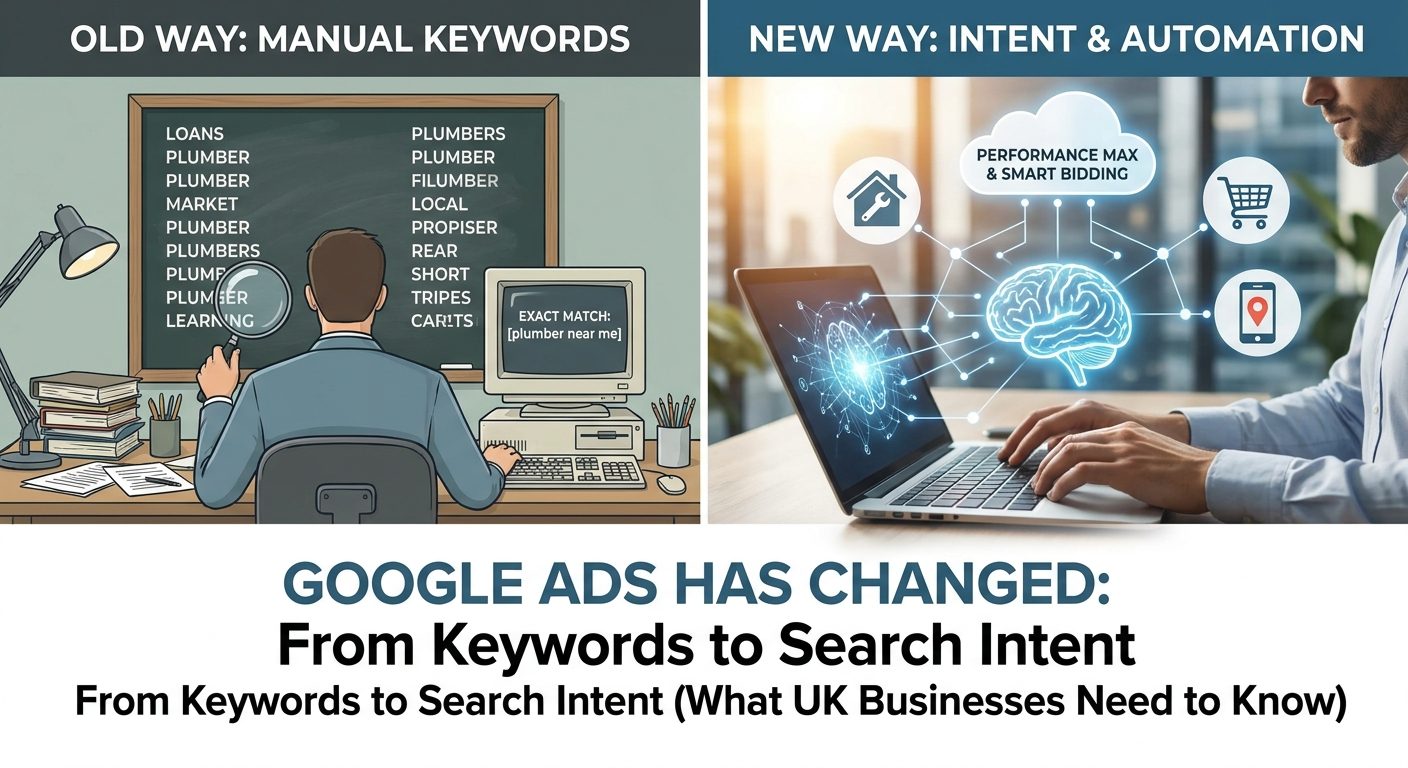
The most useful question you can ask about any keyword is no longer 'how many people search for this every month.' It is: 'what does someone do after they know the answer to this?' That single reframe changes almost every targeting decision a small business needs to make in 2025.
Some queries end in understanding. Someone types 'how does underfloor heating work' and, once they know, they close the tab. The AI Overview is perfectly suited to that moment, and no click will follow. Other queries end in an action: book, buy, call, compare specific providers, visit a location, request a quote. Those are the queries where a real business still needs to be found, and where the click is not optional for the person searching. Building your keyword strategy around the second type is not a workaround. It is the correct strategic response to how search now works.
A Four-Part Filter Worth Using
Before targeting any keyword, run it through these four questions:
- Is the answer fully satisfiable by a paragraph of text? If yes, an AI Overview will absorb it.
- Does the searcher need a specific business to act? If no specific business is required, no click is required either.
- Can only your website provide the next step? A price, a booking form, a direct phone number, a face behind the service?
- Is there a local or personal dimension that AI cannot invent? A physical address, a service radius, a real name?
A phrase like 'emergency electrician Lancing no call-out fee' scores well on all four counts. The answer cannot be satisfied by a paragraph. The searcher needs a specific, real business. Only your page can provide the actual phone number to call. The local dimension is built into the query itself. Contrast that with 'what qualifications does an electrician need,' which fails all four filters and should be deprioritised accordingly.
This matters especially for small businesses with limited time and content resource. Semrush's 2025 data confirms that niche, long-tail content faces the highest AI disruption risk on the informational side but the lowest disruption risk on the transactional side. That split is the key insight. A broad informational blog strategy, the kind many SMEs were encouraged to build over the past decade, is now the most exposed type of content. A tightly focused set of service and location pages targeting high-intent, specific phrases is the most protected.
For a kitchen fitter in Worthing, that means a page built around 'bespoke kitchen fitter Worthing quote' will consistently outperform ten blog posts about kitchen trends. Write fewer pages, make each one count, and point every one of them at a decision a real customer is trying to make.

Structuring Your Website So AI Cites You Rather Than Replaces You
There is a meaningful difference between a website that AI summarises and a website that AI cites. When AI summarises your content, it absorbs the information and presents it without a link. When AI cites your content, it includes your business name and a clickable reference in the answer. The structural decisions you make on your website right now determine which of those two outcomes you get.
Pages that clearly define services, locations, and supporting context are far more likely to be included as cited sources, as noted in research from Wellows.com covering how AI Overviews shape local SEO results. Vague, general pages that cover multiple services in broad terms give the AI nothing specific enough to attribute. Specific, well-structured pages give it a quotable source.
Schema Markup Is No Longer Optional
Structured data markup, particularly the following schema types, helps Google's AI understand what your business does, where it operates, and why it is trustworthy:
- LocalBusiness schema, which tells Google your trading name, address, phone number, and opening hours in a format it can parse directly
- Service schema, which connects specific services to your business entity rather than leaving that connection implicit
- FAQPage schema, which surfaces your question and answer pairs in a format AI can quote directly
- Review schema, which signals trust signals in a structured, machine-readable way
Implementing these does not require rebuilding your site. Most WordPress installations can add them through a plugin like Yoast or Rank Math. For custom-built sites, they can be added directly to the page HTML. The important thing is that they are present and accurate.
Entity Definition Matters More Than Keyword Density
Your website needs to clearly state who you are, what specific services you offer, which geographic areas you serve, and what makes your business distinct. Not buried deep in an About page written as a personal statement, but in structured, crawlable content that appears on service pages, contact pages, and your homepage. If Google cannot determine from your site that you are a specific business offering specific services in a specific area, it cannot confidently cite you in an answer about that area or those services.
AMK Coding's 2026 UK AI search guide makes the point plainly: how a website is structured now matters more than it ever did, because AI uses that structure to decide whether to cite or absorb the content. That is a practical distinction with real commercial consequences.
The practical actions follow from that logic:
- Dedicate a unique page to each core service rather than grouping several services onto one generic page
- Include real staff names and any relevant credentials or trade body memberships on the relevant pages
- Link out to genuine third-party mentions, trade association profiles, or press coverage where they exist, because these establish that your business exists in the real world beyond your own website
Think of every page as an entry in a reference work that an AI assistant might quote from. If the page is too vague to quote specifically, it will not be quoted at all. A page titled 'Our Services' with three paragraphs covering plumbing, heating, and bathrooms gives the AI nothing to work with. A page titled 'Boiler Installation in Shoreham-by-Sea' with specific information about the service, the area covered, the typical process, and the business delivering it gives the AI something it can accurately cite and recommend.
Measuring What Actually Matters When Click-Through Rates Fall
Click-through rate and raw organic traffic have been the default measures of SEO success for years. Both are now unreliable as standalone signals. If AI Overviews are appearing for your target queries, your impressions may hold steady or even rise while your clicks fall. That pattern does not mean your SEO is failing. It may mean it is working in a different way than before.
The metric that fills the gap is branded search volume. If your business name appears in an AI Overview as a recommended local provider, some of the people who see that recommendation will search your name directly rather than clicking the AI citation. A rising trend in branded searches, visible in Google Search Console under the queries filtered by your business name, is a reliable proxy for AI-driven awareness that never generated a click to your site. Track it monthly.
Conversion rate on the traffic that does arrive becomes equally important. One significant consequence of AI Overviews is that they filter out a large proportion of low-intent, informational visitors before those people ever reach your site. The visitors who do click through are, on average, further along in their decision. If your conversion rate on organic traffic is improving even as total visits fall, your overall revenue position can remain stable or grow. Moz has covered this dynamic directly, noting that the loss of high-volume informational traffic is often less commercially damaging than the raw numbers suggest, because that traffic rarely converted in the first place.
Google Search Console gives you the data to identify which queries are being intercepted. Filter your pages by high impressions and low CTR, then search those queries yourself in an incognito window. If an AI Overview appears above the organic results, you have your answer. That query is being intercepted, and the page ranking for it needs to be reconsidered against the click-worthiness filter rather than just optimised for position.
For local businesses specifically, a significant portion of the value generated by search visibility never touches website analytics at all. Phone calls made directly from a Google Business Profile, direction requests, and clicks on your profile's phone number are all captured in Google Business Profile insights rather than in Google Analytics. Checking those numbers monthly, alongside your website data, gives you a complete picture of how search is actually driving business enquiries.
The underlying mindset shift is straightforward: stop treating traffic as an end in itself. Traffic is only useful if it leads to enquiries, calls, bookings, or purchases. Optimising for those outcomes, and measuring them directly, is more productive than chasing impressions on queries that AI has already answered.
A Practical Starting Point for UK Small Businesses Adapting Right Now
Change like this can feel overwhelming, particularly if you are running a business rather than managing a marketing department. The good news is that the most valuable actions are specific and achievable within a few focused hours spread across a few weeks.
In week one, open Google Search Console and filter your pages by high impressions combined with low click-through rate. Those pages are your most exposed assets. For each one, search the query yourself and note whether an AI Overview appears. That list is your working priority. You now know exactly where AI is intercepting your visibility and which pages need rethinking first.
In week two, audit your Google Business Profile properly. Work through it systematically: every service listed and accurately described, recent photos that actually show your work or premises, opening hours that are current, and review responses that are specific rather than generic. This is not just housekeeping. Google uses GBP data to construct AI-generated answers about local businesses, and an incomplete or outdated profile gives AI systems lower-quality input to work with.
In week three, pick your three most commercially important service pages and stress-test each one against the four-part click-worthiness filter covered earlier in this article. Ask honestly whether the page gives AI something specific enough to cite, or whether it is vague enough to be absorbed and replaced. Most small business service pages need work on specificity, entity definition, and location clarity.
The broader principle running through all of this is that UK small businesses do not need to produce more content. They need to produce content that earns the click by offering something an AI summary cannot hand over: a real price, a real person, a real local business ready to help. That is the competitive advantage that no AI Overview can replicate, and it is available to every business willing to present it clearly.
Samson Web Design works with small businesses across West Sussex and the wider UK on exactly these kinds of strategic website and SEO updates. The goal is always a website that converts the visitors it earns, rather than one that chases traffic for its own sake. If your site is losing ground to AI-driven search changes and you are not sure where to start, that is precisely the kind of problem worth solving properly.